Practical Attention to Detail
Paterson uses Eiffel’s work on the Eiffel Tower to illustrate practical attention to detail: anticipating wind loads, foundations, and assembly alongside the overall design. Built for a temporary exhibition, the structure has endured for over 130 years.
THE IDEA
Practical Design of the Eiffel Tower The Tower was constructed for the Exposition Universelle of 1889 in Paris, with a projected life of a few decades. But instead, it was the highest building in the world for over 40 years, and it still stands after 130 years.
A crucial part of its appeal is its curved ‘A’ design. The original design concept came from Emile Nouguier and Maurice Koechlin. But it was Gustave Eiffel who was able to see both the potential and the challenges in the first design and to develop and build what we see today. The design looks simple, but was perfected after years of experience designing and building a range of important bridges (e.g. the Garabit viaduct and the Maria Pia bridge) as well as other structures, including the frame for the Statue of Liberty in New York, USA.2
Eiffel developed expertise across a range of important, progressive engineering specialisms, including stress and load calculations, understanding the effect of wind on structures and how to build solid foundations using compressed air caissons. He was also a ‘hands‐on’ designer and engineer and understood the need to design structures from a practical perspective. This included calculating loads on each of the four pillars at the bottom of the Tower as they were built higher and leaning inwards. He created scale models of the Tower to understand better the practical challenges that would arise and thought through how the four foundation pillars could be joined together to create the first floor of the Tower, with a precision of millimetres, some 57 m high.3 Illustration 7.1 highlights Eiffel's ability to think through practical details when designing the Tower.
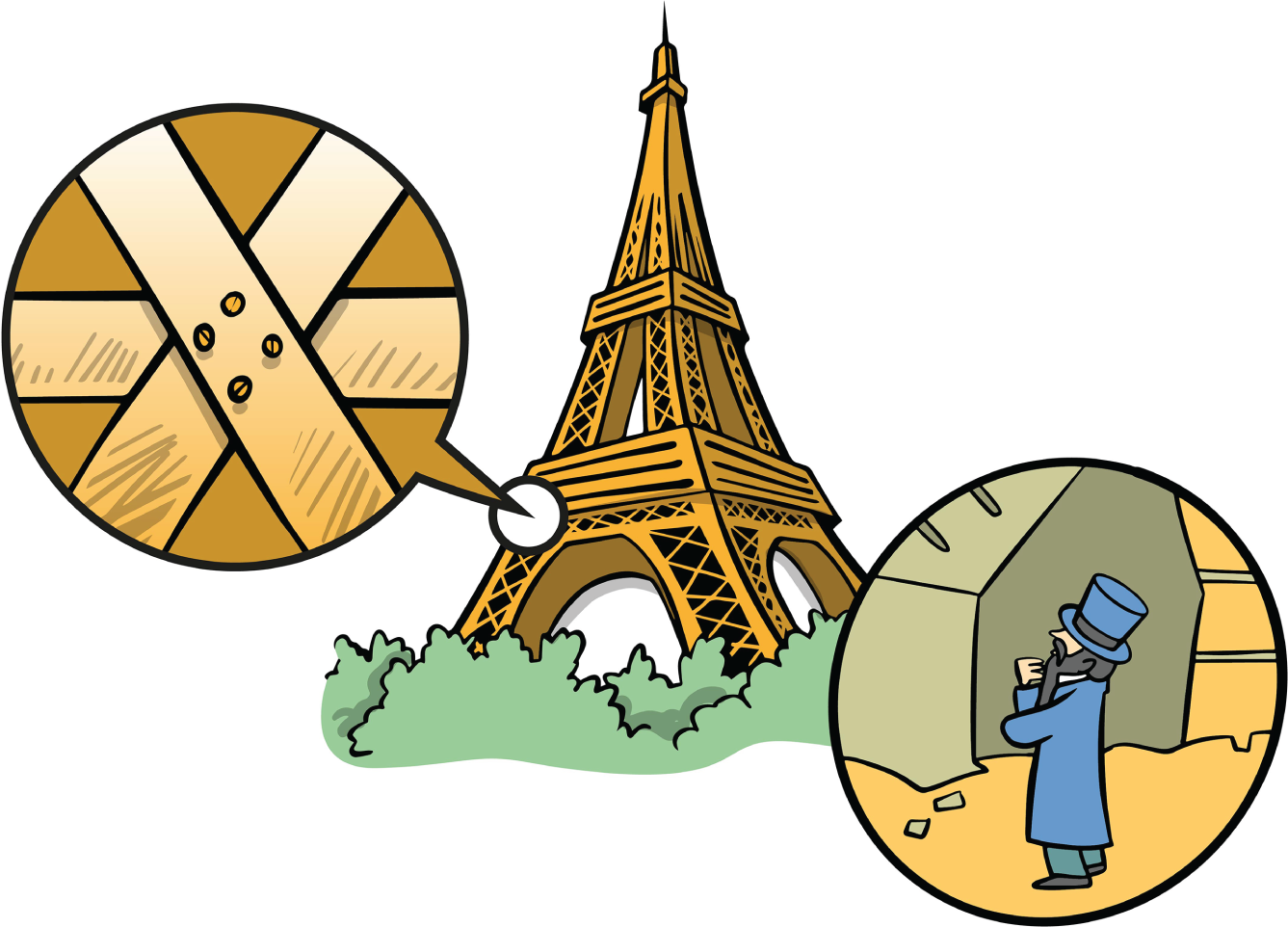
Illustration 7.1 Design
Eiffel recognised that the Tower could not be built so high as a closed, solid structure. Instead, the structure was able to hold its own weight because it is comprised of a lattice of relatively thin wrought iron girders.4 The example shows attention to construction details alongside the overall design. Eiffel also saw engineering and beauty as connected:
‘[Do you] think that because we are engineers, beauty does not preoccupy us or that we do not try to build beautiful, as well as solid and long‐lasting structures? Aren't the genuine functions of strength always in keeping with unwritten conditions of harmony?’5
When to use it
Designing a building or structure in a challenging environment (e.g., high winds, weak soil).
Planning a large infrastructure project where long-term durability is critical.
Developing a product with many interacting parts that requires precise assembly and testing.
Implementing a project management strategy that emphasizes iterative prototyping and hands-on oversight.
FROM THEORY TO EVERYDAY LIFE
In practice
Eiffel Tower
The Eiffel Tower, built for the 1889 Exposition Universelle, was intended to stand for a few decades but has lasted over 130 years. Paterson highlights Eiffel's practical design approach, including a lattice structure to handle wind loads and precise construction techniques.
Garabit Viaduct and Maria Pia Bridge
Eiffel's experience designing bridges like the Garabit viaduct and Maria Pia bridge provided him with expertise in stress calculations and wind effects, which he applied to the Tower.
A MOMENT TO REFLECT
Put it to work.
How can you apply Eiffel's hands-on approach to your own projects?
What practical details in your current work might be overlooked that could make the difference between success and failure?
How does understanding the full context of a problem (like wind loads in the Eiffel Tower) improve your design decisions?
CONTINUE THE CONVERSATION
Source texts
- Beyond the Five Whys Root Cause Analysis and Systems Thinking (James C. Paterson)