Polarization
De Bono uses polarization to describe how established categories pull ambiguous information toward familiar labels. Important differences can disappear when something is treated as a standard member of a category instead of prompting a closer look or a new category.
THE IDEA
Polarization
It is easier to establish two completely different patterns than to change an established pattern. If a new pattern is only slightly different then it will shift towards the established pattern. There is a tendency for established patterns to ‘mop up’ similar patterns which are treated as a repetition of the standard pattern. This results in a distortion of the information that is actually presented. The pattern that would have been established by the information is shifted towards an established pattern. If there are two established patterns then the shift may be towards one or other. If the two established patterns are opposite ‘poles’ in any sense then this shifting moves the new pattern towards one or other pole.
It is like having two wooden boxes side by side into which one is putting ping-pong balls. The balls have to go into one box or the other. A ball will not balance on the division between the two boxes. If the edges of the boxes are sloping then the ball may be moved quite a long way. The process is suggested by the diagram below.
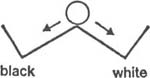
If one of the boxes is labelled ‘black balls’ and the other one ‘white balls’ then each ball is dropped into the appropriate box depending on whether it is black or white. If there are any grey balls then some sort of decision has to be made as to whether they go into the black box or the white box. Once the decision is made the balls go into the white box just as if they were white or into the black box just as if they were black. The apparent nature of the ball has been shifted to make it fit in with the established pattern.
A whole series of boxes might be imagined, each with its own label. As each item came along it would be put into whichever box had the most appropriate label. It would not matter if this most appropriate label was not really very appropriate. There is a shift to fit in with whatever labels are available. Once the shift has been made then it is impossible to tell that the item in the box is any different from the other items in the box.
In order to find an appropriate box for any item that does not fit readily into any available box one can do two things. One can concentrate on those points which show that it ought to fit into one box. Or one can concentrate on those points which show that it should not fit into a particular box. Thus with the grey ping-pong balls one might have said, ‘Grey is almost white therefore it fits into the white box’ or one might have said, ‘Black is a true absence of any colour therefore the grey ball cannot go into the black box.’
If two things are similar one could notice the points of similarity and say the two things are the same or one could notice the points of difference and say the two things are different. The two things would be shifted together to be similar or shifted apart to be different. Either way there would be some shift as suggested in the diagram.
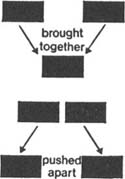
Similarly when there is an established label a new item is either pushed right under that label or else pushed right out. In a community that is sharply divided into ‘us’ and ‘them’ any stranger who happens along is assessed as to whether he is ‘one of us’ or ‘one of them’.
Probably the stranger has a mixture of characteristics which would make him fit either group. But whichever way the decision goes his characteristics are at once assumed to have changed so that they match exactly the characteristics of the label. The stranger is pushed towards one or other pole. He cannot remain in between any more than the needle of a compass can remain undecided when a magnet is brought near to it.
From a practical point of view this polarizing system is very effective. What it means is that one can establish a few major categories and then push everything into one or other of these. Instead of having to assess everything in detail and then decide how one is going to react one merely assesses whether it fits into one category or another. This is not even a matter of exact fit but of pushing it one way or another. Once the thing has been pushed into a category then reaction is easy since the categories are established and so is the reaction to them.
In exploring a new situation one might have two categories: ‘good to eat’ and ‘bad to eat’. This is sufficient. Anything examined can be pushed one way or the other. There is no need to have any subtle distinctions. Such distinctions as: ‘tastes nasty but is good for one’, or ‘good to eat but makes one very thirsty’, or ‘tastes good but is poisonous’, ‘not known but worth trying’ are excluded.
 New categories
At what point does a new category arise? At what point does one decide that the item will not fit into any of the boxes and so create a new box? At what point does one decide that grey ping-pong balls would go into a special box marked ‘grey’? At what point is it decided that the stranger is neither ‘we’ nor ‘they’ but something else?
The danger of polarization is that things can be shifted around so much that there never comes a point when a new category has to be created. Nor is there any indication as to how many established categories there should be.
One can get by with very few categories. The dangers of the polarizing tendency may now be summarized:
Once established the categories become permanent.
New information is altered so that it fits an established category. Once it has done so there is no indication that it is any different from anything else under that category.
At no point is it ever essential to create new categories. One can get by with very few categories.
The fewer the categories the greater the degree of shift.
When to use it
In political debates, nuanced positions are often polarized into simple left/right labels, ignoring complexity.
In product management, customer feedback may be categorized as 'positive' or 'negative' without capturing shades of opinion.
In education, students may be labeled as 'good' or 'bad' at a subject, overlooking mixed abilities and potential for growth.
In personal relationships, minor disagreements can escalate into 'with me or against me' thinking.
FROM THEORY TO EVERYDAY LIFE
In practice
Black and White Ping-Pong Balls
In de Bono’s analogy, grey ping-pong balls must go into a box labeled 'black' or 'white'. Their shade does not change, but the classification hides the difference. The label can then distort how someone thinks about the balls.
‘Us’ vs. ‘Them’ in a Community
A stranger with mixed characteristics is judged as either 'one of us' or 'one of them', and then assumed to have all the traits of that group.
A MOMENT TO REFLECT
Put it to work.
How might polarization affect your decision-making when you encounter ambiguous information?
Can you think of a time when you forced something into a category rather than creating a new one? What was the result?
What are the dangers of having too few categories in your thinking?
References
- Lateral Thinking — Edward de Bono (1970)
CONTINUE THE CONVERSATION
Source texts
- Lateral Thinking A Textbook of Creativity (Edward de Bono)