Organ Donations: The Default Solution Illusion
Defaults can raise recorded willingness to donate organs without producing an equivalent rise in available organs. Thaler and Sunstein favor prompted choice—asking people to record a decision—because they believe it best balances patients’ needs with the preferences of potential donors and their families.
THE IDEA
Organ Donations: The Default Solution Illusion
Policymakers have become increasingly sophisticated in their use of choice architecture to achieve policy goals. It is therefore surprising that a domain in which the details of choice architecture have been prominently discussed is one in which we think poor choices have been made. The topic is organ donation, which we discussed in the original version of this book. We are giving ourselves what golfers call a mulligan: pretending that a poor shot never happened and trying it again.
When we began working on that original version, we made a list of potential topics that we might include. Organ donation was one of the first topics on this list. We thought this would be a good topic because we knew about a result from a study written by our friends Eric Johnson and Dan Goldstein. The question they addressed was the effect of default rules on the expressed willingness of people to donate their organs if they should happen to die suddenly. Johnson and Goldstein obtained a dramatic finding. In countries that classified people as willing donors by default (so-called presumed consent countries), very few people chose to opt out. But in countries in which people have to take some action to become a donor (this policy is called informed consent, explicit consent, or in the United States, explicit authorization), most people failed to opt in. Their paper compared consent rates across countries.
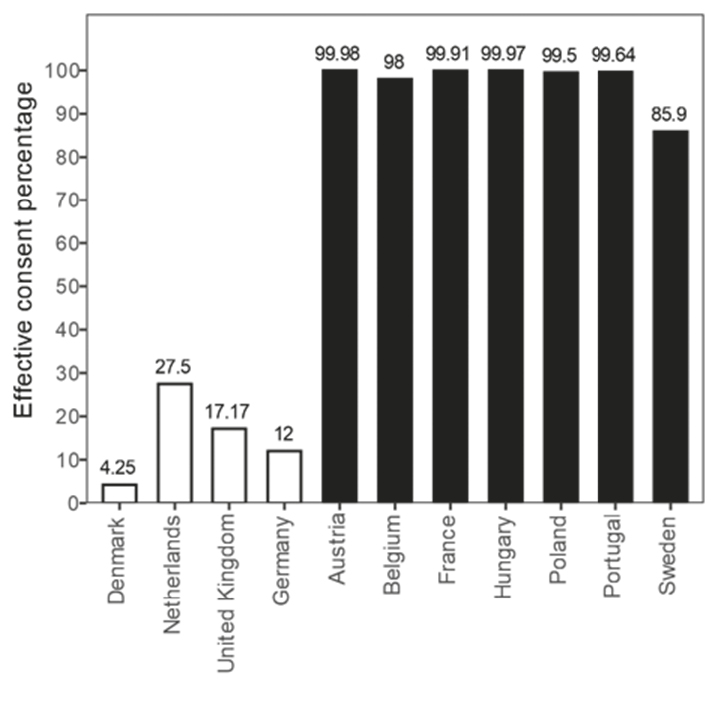
Figure 13.1. Effective Consent Rates by Country (Source: Johnson and Goldstein, 2013)
The contrast is striking. Only 12 percent of Germans agreed to be organ donors, while more than 99 percent of Austrians had failed to opt out. Amazing!
Naturally, we figured that in our chapter on organ donations, we would advocate the adoption of a presumed consent rule. And most people who know about our book, including many who have even read it, came to the same conclusion. But, surprise, that is not the conclusion we reached. After doing research on the topic, we advocated a different policy, one we call prompted choice.
To our dismay, in the years between the original book and this edition, several countries, including Wales, England, and Germany, have considered or made the switch to presumed consent. After such laws are passed, we often get notes of congratulations via Twitter! It is frustrating that on the single topic on which the selection of default rules has gotten the most attention, countries are adopting what we think is the wrong system. Cue the sound of our teeth grinding. Why has this happened? One possibility is that we came to the wrong conclusion, so part of our research to prepare for writing this new edition was to take a deep dive on the issue and to think carefully about the pros and cons of various policy alternatives. To preview what is to come, we think that there has been some confusion about the desired goals of this policy. The goal is not just to choose a system that gets the bars on that chart to be as high as possible. A central goal is to save lives, by making more organs available for use. But that is not the only goal; it is also important to consider potentially competing interests, preferences, and rights.
To help clarify how to think about this policy, it is essential to distinguish among three important (and overlapping) groups of people. The first are people who need or will need an organ to save their life. Let’s call this group Patients. In the second category are the people who at some point in their life may be close to death and whose organs could help save lives. These are the people to whom the default rules directly apply, and we call them Potential Donors. This category includes all healthy adults in a country, and policy discussions tend naturally to focus on them. One useful fact: you are about three times more likely to be a patient in need of an organ than to be an organ donor.
The third group we consider are the family members of the tiny subset of Potential Donors who actually die and have healthy organs that could be used. We call this group Families. Families are relevant because transplant teams normally have conversations with the next of kin before organs are removed, typically in extremely trying circumstances because organ donation candidates are often the result of a sudden death and that death might be of a child or life partner. The nature of those conversations varies considerably across countries. We think that the role of these grieving Family members is often neglected in policy discussions.
Although a primary goal in this domain is to maximize the number of Patient lives saved, the policy should also respect the rights and preferences of Potential Donors and Families. This is a case in which the philosopher John Rawls’s notion of the veil of ignorance can be usefully applied. Everyone is a Potential Donor but could also, at some point in their life, be a Patient or member of a Family. We should design a policy that is best before anyone learns what role(s) they might play.
We discuss this issue in detail not only because it is important in itself, but because it offers some general lessons on the way default options work. As we saw in the case of pensions, people who have been automatically enrolled in something are not necessarily treated identically to those who elect to join on their own. The same issue is at play here. A Potential Donor who has failed to opt out in a presumed consent country is treated differently than someone who has decided to register as an organ donor in a country where explicit authorization is the law of the land. That important distinction makes the analysis more complicated than it is sometimes portrayed. We favor the policy of prompted choice because there is no evidence that a viable alternative system would save more lives (and hence is superior in terms of the interests of Patients), and because we think it does the best job of respecting the rights and interests of Potential Donors and Families. At the same time, we favor more nudges, and better choice architecture, to increase the prompting.
When to use it
Designing a prompt for organ donation registration when people renew their driver's license.
Evaluating the impact of default rules in medical consent forms.
Comparing the effectiveness of opt-in vs. opt-out policies in green energy subscription.
Informing policy debates on presumed consent for organ donation in different countries.
FROM THEORY TO EVERYDAY LIFE
In practice
Recorded Donor Consent in Germany and Austria
In the figures discussed by Thaler and Sunstein, 12% of Germans had agreed to be organ donors under explicit consent, while more than 99% of Austrians had not opted out under presumed consent. The comparison concerns recorded consent, which does not by itself show how many organs became available for transplant.
A MOMENT TO REFLECT
Put it to work.
How would you design a choice architecture for organ donation that balances saving lives with respecting individual preferences?
What are the potential unintended consequences of switching to a presumed consent policy?
How can the veil of ignorance framework help in evaluating organ donation policies?
Often confused with
References
- Defaults, Framing and Privacy: The Effect of Defaults on the Willingness to Donate Organs — Eric Johnson and Dan Goldstein (2013)
CONTINUE THE CONVERSATION
Source texts
- Nudge The Final Edition (Richard H. Thaler Cass R. Sunstein)