Nonexistent Boundaries
System boundaries are artificial constructs created for analysis. Drawing boundaries too narrowly can lead to surprises, while drawing them too broadly can obscure answers. The key is to maintain mental flexibility and choose appropriate boundaries for each problem.
THE IDEA
Nonexistent Boundaries
When we think in terms of systems, we see that a fundamental misconception is embedded in the popular term “side-effects.”… This phrase means roughly “effects which I hadn’t foreseen or don’t want to think about.”… Side-effects no more deserve the adjective “side” than does the “principal” effect. It is hard to think in terms of systems, and we eagerly warp our language to protect ourselves from the necessity of doing so.
—Garrett Hardin,5 ecologist
Remember the clouds in the structural diagrams of Chapters One and Two? Beware of clouds! They are prime sources of system surprises.
Clouds stand for the beginnings and ends of flows. They are stocks—sources and sinks—that are being ignored at the moment for the purposes of simplifying the present discussion. They mark the boundary of the system diagram. They rarely mark a real boundary, because systems rarely have real boundaries. Everything, as they say, is connected to everything else, and not neatly. There is no clearly determinable boundary between the sea and the land, between sociology and anthropology, between an automobile’s exhaust and your nose. There are only boundaries of word, thought, perception, and social agreement—artificial, mental-model boundaries.
The greatest complexities arise exactly at boundaries. There are Czechs on the German side of the border and Germans on the Czech side of the border. Forest species extend beyond the edge of the forest into the field; field species penetrate partway into the forest. Disorderly, mixed-up borders are sources of diversity and creativity.
In our system zoo, for instance, I showed the flow of cars into a car dealer’s inventory as coming from a cloud. Of course, cars don’t come from a cloud, they come from the transformation of a stock of raw materials, with the help of capital, labor, energy, technology, and management (the means of production). Similarly, the flow of cars out of the inventory goes not to a cloud, but through sales to the households or businesses of consumers.
Whether it is important to keep track of raw materials or consumers’ home stocks (whether it is legitimate to replace them in a diagram with clouds) depends on whether these stocks are likely to have a significant influence on the behavior of the system over the time period of interest. If raw materials are guaranteed to be abundant and consumers continue to demand the products, then clouds will do. But if there could be a materials shortage or a product glut, and if we drew a mental boundary around the system that did not include these stocks, then we could be surprised by future events.

Figure 47. Revealing some of the stocks behind the clouds.
There are still clouds in Figure 47. The boundary can be expanded further. Processed raw materials come from chemical plants, smelters, or refineries, whose input comes, ultimately, from the earth. Processing creates not only products, but also employment, wages, profits, and pollution. Discarded consumers’ stocks go to landfills or incinerators or recycling centers, from which they go on to have further effects on society and the environment. Landfills leach into drinking-water wells, incinerators produce smoke and ash, recycling centers move materials back into the production stream.
Whether it’s important to think about the full flow from mine to dump, or as industry calls it, “from cradle to grave,” depends on who wants to know, for what purpose, over how long. In the long term, the full flow is important and, as the physical economy grows and society’s “ecological footprint” expands, the long term is increasingly coming to be the short term. Landfills fill up with a suddenness that has been surprising for people whose mental models picture garbage as going “away,” into some sort of a cloud. Sources of raw materials—mines, wells, and oil fields—can be exhausted with surprising suddenness too.
With a long enough time horizon, even mines and dumps are not the end of the story. The great geological cycles of the earth keep moving materials around, opening and closing seas, raising up and wearing down mountains. Eons from now, everything put in a dump will end up on the top of a mountain or deep under the sea. New deposits of metals and fuels will form. On planet Earth there are no system “clouds,” no ultimate boundaries. Even real clouds in the sky are part of a hydrological cycle. Everything physical comes from somewhere, everything goes somewhere, everything keeps moving.
Which is not to say that every model, mental or computer, has to follow each connection until it includes the whole planet. Clouds are a necessary part of models that describe metaphysical flows. Anger literally “comes out of a cloud,” as does love, hatred, self esteem, and so on. If we’re to understand anything, we have to simplify, which means we have to make boundaries. Often that’s a safe thing to do. It’s usually not a problem, for example, to think of populations with births and deaths coming from and going to clouds, as in Figure 48.

Figure 48. More clouds.
Figure 48 shows actual “cradle to grave” boundaries. Even these boundaries would be unserviceable, however, if the population in question experienced significant in- or out-migration, or if the problem under discussion was limited cemetery space.
The lesson of boundaries is hard even for systems thinkers to get. There is no single, legitimate boundary to draw around a system. We have to invent boundaries for clarity and sanity; and boundaries can produce problems when we forget that we’ve artificially created them.
When you draw boundaries too narrowly, the system surprises you. For example, if you try to deal with urban traffic problems without thinking about settlement patterns, you build highways, which attract housing developments along their whole length. Those households, in turn, put more cars on the highways, which then become just as clogged as before.
There are no separate systems. The world is a continuum. Where to draw a boundary around a system depends on the purpose of the discussion``—the questions we want to ask.
If you try to solve a sewage problem by throwing the waste into a river, the towns downstream make it clear that the boundary for thinking about sewage has to include the whole river. It might also have to include the soil and groundwater surrounding the river. It probably doesn’t have to include the next watershed or the planetary hydrological cycle.
Planning for a national park used to stop at the physical boundary of the park. But park boundaries around the world are regularly crossed by nomadic peoples, by migrating wildlife, by waters that flow into, out of, or under the park, by the effects of economic development at the park’s edges, by acid rain, and now by a climate changing from greenhouse gases in the atmosphere. Even without climate change, to manage a park you have to think about a boundary wider than the official perimeter.
Systems analysts often fall into the opposite trap: making boundaries too large. They have a habit of producing diagrams that cover several pages with small print and many arrows connecting everything with everything. There is the system! they say. If you have considered anything less, you are academically illegitimate.
This “my model is bigger than your model” game results in enormously complicated analyses, which produce piles of information that may only serve to obscure the answers to the questions at hand. For example, modeling the earth’s climate in full detail is interesting for many reasons, but may not be necessary for figuring out how to reduce a country’s CO 2 emissions to reduce climate change.
The right boundary for thinking about a problem rarely coincides with the boundary of an academic discipline, or with a political boundary. Rivers make handy borders between countries, but the worst possible borders for managing the quantity and quality of the water. Air is worse than water in its insistence on crossing political borders. National boundaries mean nothing when it comes to ozone depletion in the stratosphere, or greenhouse gases in the atmosphere, or ocean dumping.
Ideally, we would have the mental flexibility to find the appropriate boundary for thinking about each new problem. We are rarely that flexible. We get attached to the boundaries our minds happen to be accustomed to. Think how many arguments have to do with boundaries—national boundaries, trade boundaries, ethnic boundaries, boundaries between public and private responsibility, and boundaries between the rich and the poor, polluters and pollutees, people alive now and people who will come in the future. Universities can maintain disputes for years about the boundaries between economics and government, art and art history, literature and literary criticism. Too often, universities are living monuments to boundary rigidity.
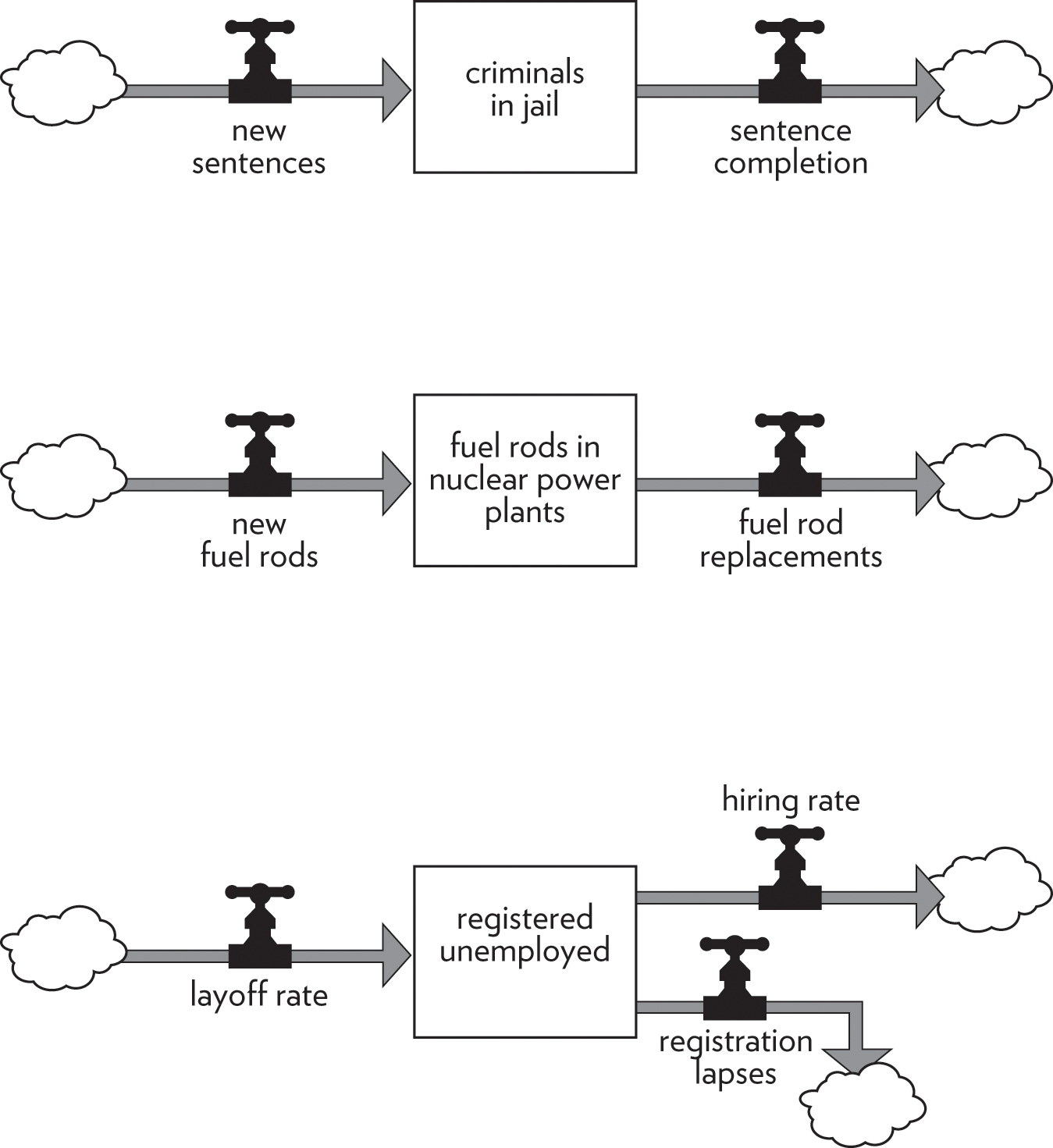
Figure 49. Examples of more clouds. These are systems in which a boundary or cloud should not stop you from thinking beyond the borders of the system, but start you thinking beyond those borders. What is driving the supply of people being given new sentences? Where do the fuel rods go after replacement? What happens to an unemployed person whose registration for unemployment lapses?
It’s a great art to remember that boundaries are of our own making, and that they can and should be reconsidered for each new discussion, problem, or purpose. It’s a challenge to stay creative enough to drop the boundaries that worked for the last problem and to find the most appropriate set of boundaries for the next question. It’s also a necessity, if problems are to be solved well.
When to use it
Deciding on the scope of an environmental impact assessment for a new development project, considering upstream and downstream effects over multiple time scales.
Designing a policy to reduce traffic congestion in a city, accounting for land use, public transportation, and behavioral feedbacks rather than just building more roads.
Managing a cross-border river basin where water quantity and quality are affected by activities in multiple countries, requiring a watershed-level boundary rather than political boundaries.
Setting the curriculum for an interdisciplinary course that bridges economics, ecology, and sociology, avoiding rigid disciplinary silos to address complex real-world problems.
FROM THEORY TO EVERYDAY LIFE
In practice
Traffic and Highways
If you try to deal with urban traffic problems without thinking about settlement patterns, you build highways, which attract housing developments along their whole length. Those households, in turn, put more cars on the highways, which then become just as clogged as before.
Sewage and Rivers
If you try to solve a sewage problem by throwing the waste into a river, the towns downstream make it clear that the boundary for thinking about sewage has to include the whole river. It might also have to include the soil and groundwater surrounding the river.
National Park Planning
Planning for a national park used to stop at the physical boundary of the park. But park boundaries are regularly crossed by nomadic peoples, migrating wildlife, waters flowing into/out/under the park, economic development at the edges, acid rain, and climate change. To manage a park, you have to think about a boundary wider than the official perimeter.
Academic Disciplines
Universities can maintain disputes for years about the boundaries between economics and government, art and art history, literature and literary criticism. Too often, universities are living monuments to boundary rigidity.
A MOMENT TO REFLECT
Put it to work.
Think of a current problem you are facing. What boundaries are you assuming? How might expanding or narrowing those boundaries change your understanding of the problem and possible solutions?
Identify a situation where a too-narrow boundary led to an unexpected surprise or unintended consequence. How could a broader boundary have helped anticipate that outcome?
In what ways are the boundaries of your discipline, department, or organization artificial? How might these boundaries limit the range of solutions you consider?
CONTINUE THE CONVERSATION
Source texts
- Thinking in Systems A Primer