Newspapers Become Ad Agencies
Some news publishers operate in-house studios that produce advertising in the style of journalism. The source examines how sponsored stories can borrow a publication’s credibility and make the boundary between reporting and advertising harder to recognize.
THE IDEA
In the days of print newspapers, ads were set off from regular content, often with a blue box marked by the word “advertisement.” The people who worked on the business side and who sold these advertisements would hit the streets rounding up business. Professional ad agencies would design the copy, and the newspapers would print it.
Not anymore. Newspapers now have their own in-house ad agencies, writing, designing, and tweaking their client’s message. As for those salespeople? Today they are more likely to be called “creative directors” or “content strategists” or “video producers”—often former journalists pitching ads to their own newsrooms a flight of stairs below.13
Among mainstream newspapers, the acknowledged leader in stealth advertising is the New York Times, which established T Brand Studio in 2014. Ad industry insiders lauded one of T Brand Studio’s first “stories,” “Women Inmates: Why the Male Model Doesn’t Work,” paid for by Netflix to promote the show Orange Is the New Black. Soon, all the big media players were in on the game. The Wall Street Journal has Custom Studios, with a staff of thirty-two.14 The BBC has StoryWorks, which uses “BBC’s creative excellence and rigorous editorial quality to help brands connect through beautifully crafted storytelling.”15 The Guardian has its “Branded Content from the Guardian” squad. CNN has Courageous, which “specializes in bold, culturally-relevant creative documentary-style premium storytelling that captivates audiences.”16 The Atlantic has its Re:think studio. What will they re:think up next?
Publishers contort themselves into pretzels trying to explain why all of this “premium storytelling” is kosher. An executive from Turner Broadcasting, CNN’s parent company, waxed poetic about upholding journalist ethics: “This isn’t about confusing editorial with advertising. . . . This is about telling advertisers’ stories—telling a similar story but clearly labeling and differentiating that. . . . This is CNN. We’re not here to blur the lines.”17 Responding to these overblown statements of faith, Janine Jackson of the media watchdog group Fairness & Accuracy in Reporting quipped: “Advertisers aren’t stupid. When they pay money for something they expect to get money in return . . . whether it’s called storytelling or content or co-branding. An ad is an ad is an ad.”18
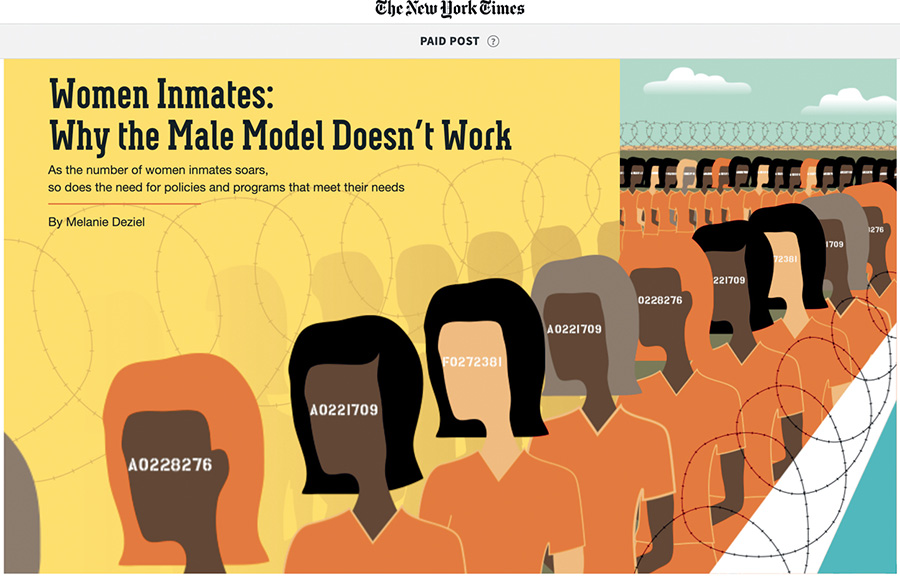
Figure 9.7 Paid post appearing in the New York Times to promote the Netflix show Orange Is the New Black (https://www.nytimes.com/paidpost/netflix/women-inmates-separate-but-not-equal.html)
When to use it
When evaluating the credibility of a news article, check for disclosures like 'paid post' or 'sponsored content'.
In marketing, consider how native advertising can reach audiences but may damage trust if not transparent.
For media literacy education, use this example to teach about the economics of journalism and conflicts of interest.
FROM THEORY TO EVERYDAY LIFE
In practice
New York Times T Brand Studio
In 2014, the New York Times launched T Brand Studio, an in-house agency that creates native advertising. One notable campaign was 'Women Inmates: Why the Male Model Doesn’t Work,' paid for by Netflix to promote 'Orange Is the New Black.'
Wall Street Journal Custom Studios
The book describes the Wall Street Journal’s Custom Studios as a branded-content operation with a staff of thirty-two. It uses the example to show how publishers produce advertising in a journalistic style.
A MOMENT TO REFLECT
Put it to work.
How does the blurring of editorial and advertising affect your trust in news sources?
Can you identify instances of native advertising in your daily media consumption?
What are the ethical implications of journalists working on sponsored content?
CONTINUE THE CONVERSATION
Source texts
- Verified How to Think Straight, Get Duped Less, and Make Better Decisions about What to Believe Online (Mike Caulfield, Sam Wineburg)