Modern Darwinian Synthesis
The Modern Synthesis integrates Darwin's natural selection with Mendelian genetics, mutation, and population genetics to explain evolution as changes in gene frequencies within populations over time, driven by genetic variation and natural selection.
THE IDEA
MODERN DARWINIAN SYNTHESIS
I have called this principle, by which each slight variation, if useful, is preserved, by the term of Natural Selection. —Charles Darwin
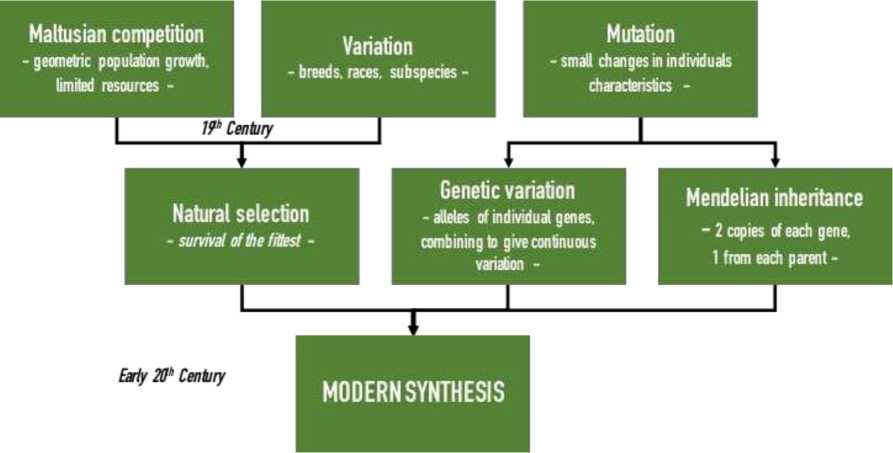
The Modern Synthesis is the integration of Charles Darwin’s theory of the evolution of species by natural selection, Gregor Mendel’s genetic theory as the basis of genetic inheritance, random mutation as a source of variation, and population genetics. This stream of thought regarding evolution originated between 1937 and 1950, incorporating genetics, systematics, and paleontology as relevant evidence for evolutionary theory.
Dobzhansky, Simpson, Mayr, and Huxley were among those who developed the synthesis. Genetics helped explain what Darwin’s account could not: how heritable variation arises and passes between generations. Mutation produces new genetic variants, recombination rearranges them, and natural selection changes their representation according to their effects on survival and reproduction.
Nothing in biology makes sense except in the light of evolution. —Theodosius Dobzhansky
A mutation’s effect depends on the organism and its environment: it may be harmful, neutral, or beneficial. An inherited variant that was previously neutral may become advantageous when conditions change. Recombination during sexual reproduction creates new combinations of existing variants.
When to use it
Understanding the development of antibiotic resistance in pathogens and devising strategies to combat it.
Conservation biology: predicting how species may adapt to climate change based on existing genetic variability.
Agricultural breeding programs: using knowledge of mutation and recombination to develop disease-resistant crop varieties.
Personalized medicine: interpreting how genetic mutations in individuals affect disease susceptibility and drug response.
FROM THEORY TO EVERYDAY LIFE
In practice
Darwin's Finches
Variation in beak size among finches, arising from random mutations, became differentially selected based on available food sources on the Galápagos Islands, demonstrating how mutation, recombination, and natural selection lead to adaptation and speciation.
Antibiotic Resistance
In a bacterial population, a random mutation confers resistance to an antibiotic. When the antibiotic is introduced, resistant bacteria survive and reproduce, passing the resistance gene to offspring. Over generations, the population evolves resistance, illustrating mutation and natural selection.
A MOMENT TO REFLECT
Put it to work.
How do random mutations contribute to the diversity of traits in a population?
In what ways does recombination increase genetic variation without introducing new mutations?
Can you think of a recent example where a previously neutral mutation became advantageous due to environmental change?
CONTINUE THE CONVERSATION
Source texts
- Wisdom Theory 100 Mental Models (2020) (Wisdom Theory)