Method of Exhaustion
An ancient Greek method for calculating areas and volumes by inscribing and circumscribing polygons with increasingly many sides to closely approximate curved shapes, famously used by Archimedes to estimate π.
THE IDEA
EXHAUSTION
What’s the area of the following circle?
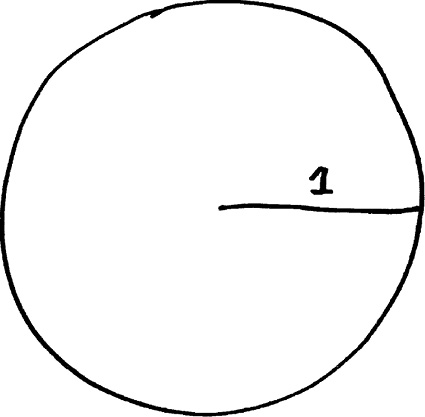
In the modern world, that’s a problem so standard you could put it on the SAT. The area of a circle is πr², and in this case the radius r is 1, so the area is π. But two thousand years ago this was a vexing open question, important enough to draw the attention of Archimedes.
Why was it so hard? For one thing, the Greeks didn’t really think of π as a number, as we do. The numbers they understood were whole numbers, numbers that counted things: 1, 2, 3, 4 . . . But the first great success of Greek geometry—the Pythagorean Theorem * —turned out to be the ruin of their number system.
Here’s a picture:
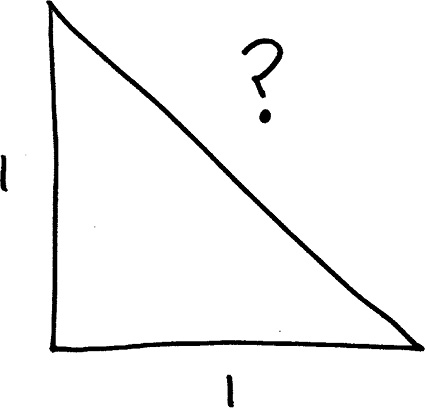
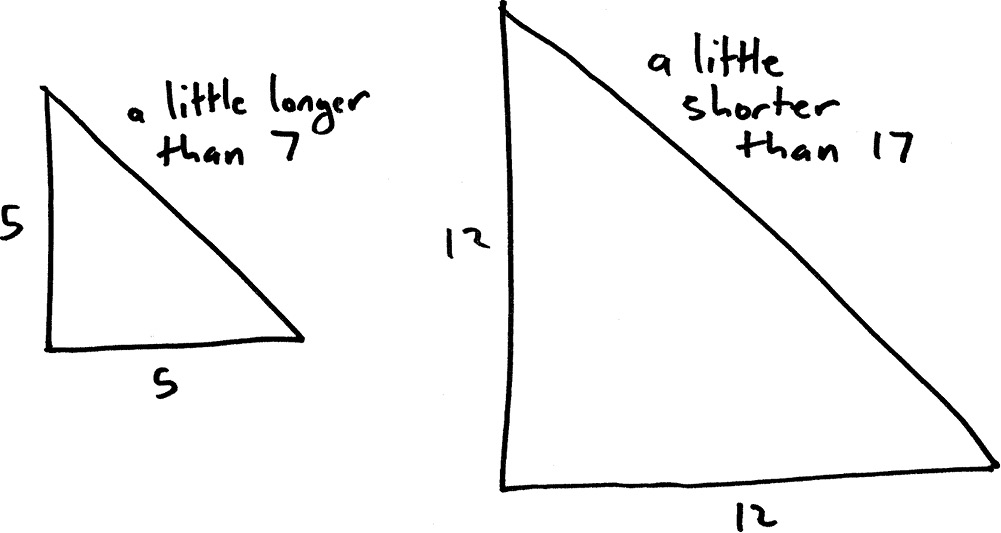
The Pythagorean Theorem tells you that the square of the hypotenuse—the side drawn diagonally here, the one that doesn’t touch the right angle—is the sum of the squares of the other two sides, or legs. In this picture, that says the square of the hypotenuse is 1² + 1² = 1 + 1 = 2. In particular, the hypotenuse is longer than 1 and shorter than 2 (as you can check with your eyeballs, no theorem required). That the length is not a whole number was not, in itself, a problem for the Greeks. Maybe we just measured everything in the wrong units. If we choose our unit of length to make the legs 5 units long, you can check with a ruler that the hypotenuse is just about 7 units long. Just about—but a bit too long. For the square of the hypotenuse is
5² + 5² = 25 + 25 = 50
and if the hypotenuse were 7, its square would be 7 × 7= 49.
Or if you make the legs 12 units long, the hypotenuse is almost exactly 17 units, but is tantalizingly too short, because 12² + 12² is 288, a smidgen less than 17², which is 289.
And at some point around the fifth century BCE, a member of the Pythagorean school made a shocking discovery: there was no way to measure the isosceles right triangle so that the length of each side was a whole number. Modern people would say “the square root of 2 is irrational”—that is, it is not the ratio of any two whole numbers. But the Pythagoreans would not have said that. How could they? Their notion of quantity was built on the idea of proportions between whole numbers. To them, the length of that hypotenuse had been revealed to be not a number at all.
This caused a fuss. The Pythagoreans, you have to remember, were extremely weird. Their philosophy was a chunky stew of things we’d now call mathematics, things we’d now call religion, and things we’d now call mental illness. They believed that odd numbers were good and even numbers evil; that a planet identical to our own, the Antichthon, lay on the other side of the sun; and that it was wrong to eat beans, by some accounts because they were the repository of dead people’s souls. Pythagoras himself was said to have had the ability to talk to cattle (he told them not to eat beans) and to have been one of the very few ancient Greeks to wear pants.
The mathematics of the Pythagoreans was inseparably bound up with their ideology. The story (probably not really true, but it gives the right impression of the Pythagorean style) is that the Pythagorean who discovered the irrationality of the square root of 2 was a man named Hippasus, whose reward for proving such a nauseating theorem was to be tossed into the sea by his colleagues, to his death.
But you can’t drown a theorem. The Pythagoreans’ successors, like Euclid and Archimedes, understood that you had to roll up your sleeves and measure things, even if this brought you outside the pleasant walled garden of the whole numbers. No one knew whether the area of a circle could be expressed using whole numbers alone.* But wheels must be built and silos filled;* so the measurement must be done.
The original idea comes from Eudoxus of Cnidus; Euclid included it as book 12 of the elements. But it was Archimedes who really brought the project to its full fruition. Today we call his approach the method of exhaustion. And it starts like this.
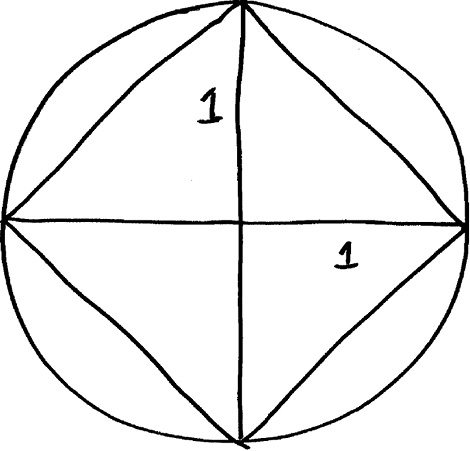
The square in the picture is called the inscribed square; each of its corners just touches the circle, but it doesn’t extend beyond the circle’s boundary. Why do this? Because circles are mysterious and intimidating, and squares are easy. If you have before you a square whose side has length X, its area is X times X—indeed, that’s why we call the operation of multiplying a number by itself squaring! A basic rule of mathematical life: if the universe hands you a hard problem, try to solve an easier one instead, and hope the simple version is close enough to the original problem that the universe doesn’t object.
The inscribed square breaks up into four triangles, each of which is none other than the isosceles triangle we just drew.* So the square’s area is four times the area of the triangle. That triangle, in turn, is what you get when you take a 1 × 1 square and cut it diagonally in half like a tuna fish sandwich.
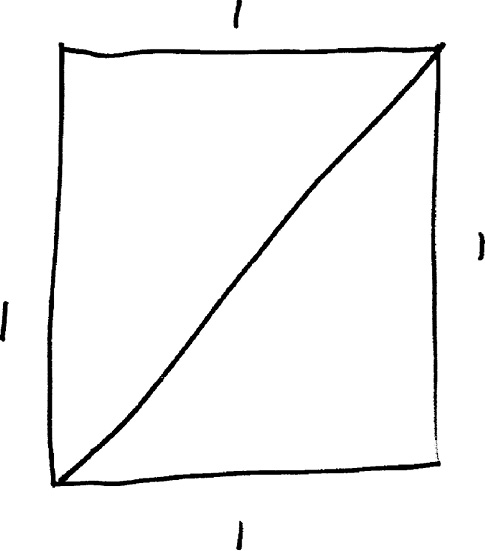
The area of the tuna fish sandwich is 1 × 1= 1, so the area of each triangular half-sandwich is 1/2, and the area of the inscribed square is 4 × 1/2, or 2.
By the way, suppose you don’t know the Pythagorean Theorem. Guess what—you do now! Or at least you know what it has to say about this particular right triangle. Because the right triangle that makes up the lower half of the tuna fish sandwich is exactly the same as the one that is the northwest quarter of the inscribed square. And its hypotenuse is the inscribed square’s side. So when you square the hypotenuse, you get the area of the inscribed square, which is 2. That is, the hypotenuse is that number which, when squared, yields 2; or, in the usual more concise lingo, the square root of 2.
The inscribed square is entirely contained within the circle. If its area is 2, the area of the circle must be at least 2.
Now we draw another square.
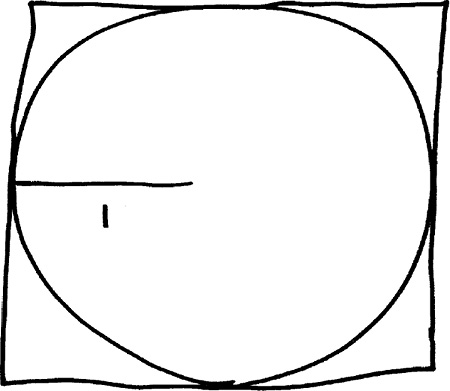
This one is called the circumscribed square; it, too, touches the circle at just four points. But this square contains the circle. Its sides have length 2, so its area is 4; and so we know the area of the circle is at most 4.
To have shown that pi is between 2 and 4 is perhaps not so impressive. But Archimedes is just getting started. Take the four corners of your inscribed square and mark new points on the circle halfway between each adjacent pair of corners. Now you’ve got eight equally spaced points, and when you connect those, you get an inscribed octagon, or, in technical language, a “stop sign”:
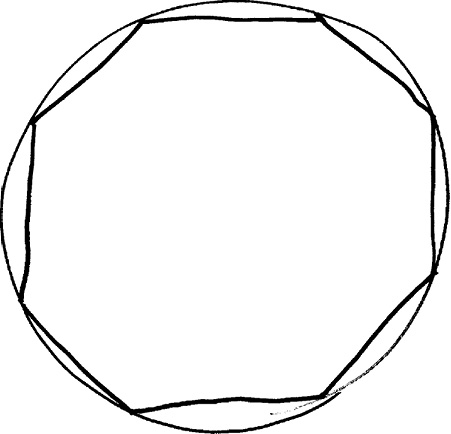
Computing the area of the inscribed octagon is a bit harder, and I’ll spare you the trigonometry. The important thing is that it’s about straight lines and angles, not curves, and so it was doable with the methods available to Archimedes. And the area is twice the square root of 2, which is about 2.83.
You can play the same game with the circumscribed octagon
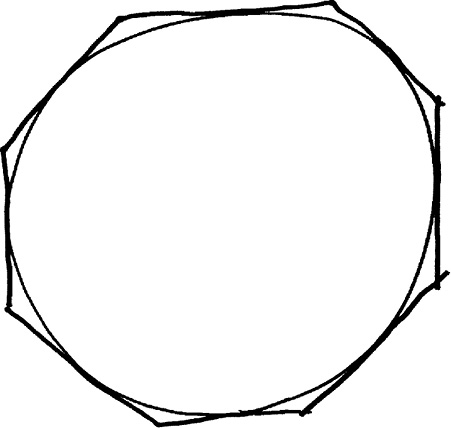
whose area is 8(√2 − 1), a little over 3.31.
So the area of the circle is trapped in between 2.83 and 3.31.
Why stop there? You can stick points in between the corners of the octagon (whether inscribed or circumscribed) to make a 16-gon; after some more trigonometric figuring, that tells you that the area of the circle is in between 3.06 and 3.18. Do it again, to make a 32-gon; and again, and again, and pretty soon you have something that looks like this:
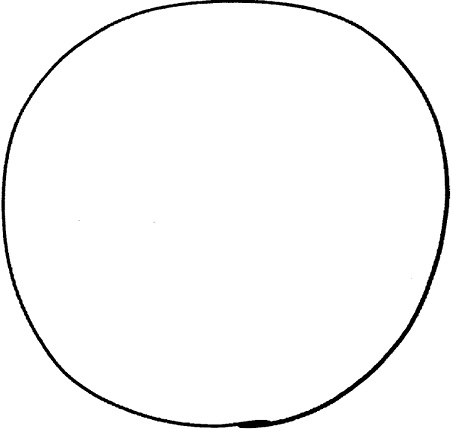
Wait, isn’t that just the circle? Of course not! It’s a regular polygon with 65,536 sides. Couldn’t you tell?
The great insight of Eudoxus and Archimedes was that it doesn’t matter whether it’s a circle or a polygon with very many very short sides. The two areas will be close enough for any purpose you might have in mind. The area of the little fringe between the circle and the polygon has been “exhausted” by our relentless iteration. The circle has a curve to it, that’s true. But every tiny little piece of it can be well approximated by a perfectly straight line, just as the tiny little patch of the earth’s surface we stand on is well approximated by a perfectly flat plane.*
The slogan to keep in mind: straight locally, curved globally.
Or think of it like this. You are streaking downward toward the circle as from a great height. At first you can see the whole thing:
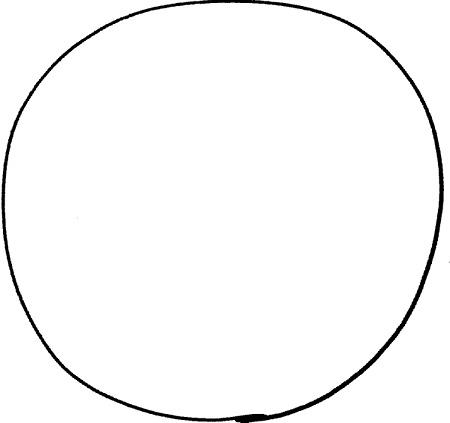
Then just one segment of arc:
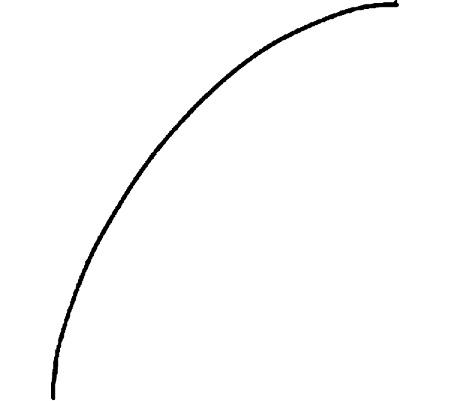
And a still smaller segment:
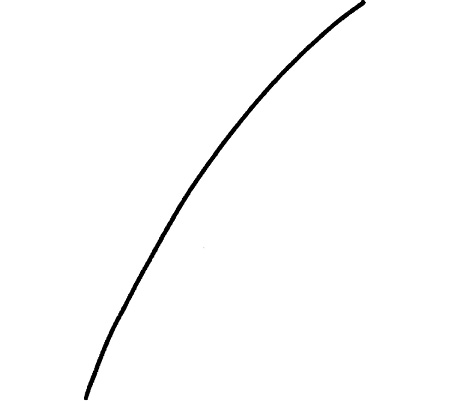
Until, zooming in, and zooming in, what you see is pretty much indistinguishable from a line. An ant on the circle, aware only of his own tiny immediate surroundings, would think he was on a straight line, just as a person on the surface of the earth (unless she is clever enough to watch objects crest the horizon as they approach from afar) feels like she’s standing on a plane.
When to use it
Computing the area of irregular land plots by approximating with polygons
Numerical integration in calculus to calculate area under a curve
Rendering 3D objects in computer graphics using polygonal meshes
Estimating the volume of a complex shape by summing volumes of simpler solids
FROM THEORY TO EVERYDAY LIFE
In practice
Approximating Pi
To illustrate exhaustion, the account starts with an inscribed square of area 2 and a circumscribed square of area 4, bounding π between 2 and 4. Doubling the sides gives octagon bounds of about 2.83 and 3.31, then 16-gon bounds of 3.06 and 3.18. Repeating the process narrows the interval around π.
A MOMENT TO REFLECT
Put it to work.
How can you apply the method of exhaustion to estimate a value that is difficult to measure directly?
In what other fields might iterating from simple approximations to more accurate ones be useful?
How does the concept of 'straight locally, curved globally' appear in other contexts?
CONTINUE THE CONVERSATION
Source texts
- How Not to Be Wrong The Power of Mathematical Thinking (Ellenberg, Jordan)