Mediocristan vs Extremistan
Taleb contrasts Mediocristan, where no single observation dominates the total, with Extremistan, where a few extremes can have a disproportionate effect. He argues that suppressing small fluctuations can sometimes hide or increase the risk of larger disruptions.
THE IDEA
AWAY FROM EXTREMISTAN
Human intervention can change the statistical pattern of a system’s volatility. There is a mathematical property to bottom-up volatility, and to the volatility of natural systems. It generates the kind of randomness I call Mediocristan: plenty of variations that might be scary, but tend to cancel out in the aggregate (over time, or over the collection of municipalities that constitute the larger confederation or entity). This stands in contrast to the unruly kind called Extremistan, where you have mostly stability and occasionally large chaos—errors there carry massive consequences. One fluctuates, the other jumps. One produces many small variations, the other varies in lumps. It is like comparing the income of a taxi driver to that of a bank employee. The two types of randomness are qualitatively distinct.
Mediocristan has many variations, none of which is extreme; Extremistan has few variations, but those that do occur are extreme. Another way to understand the difference: your caloric intake is from Mediocristan. If you add the calories you consume in a year, even without adjusting for your lies, no single day will dominate the total. A high-intake day might account for more than 0.5 percent of the total—five thousand calories out of the perhaps eight hundred thousand you consume in a year—but that is still a small share. The rare event plays an inconsequential role in the aggregate and the long term. You cannot double your weight in a single day—but you can double your net worth or lose half of it in a single moment. By comparison, if you look at the sale of novels, more than half of sales (and perhaps 90 percent of profits) tends to come from the top 0.1 percent; the exception, the one-in-a-thousand event, is dominant there. Financial matters—and many other economic affairs—tend to hail from Extremistan, just like history, which moves by discontinuities and jumps from one state to another.
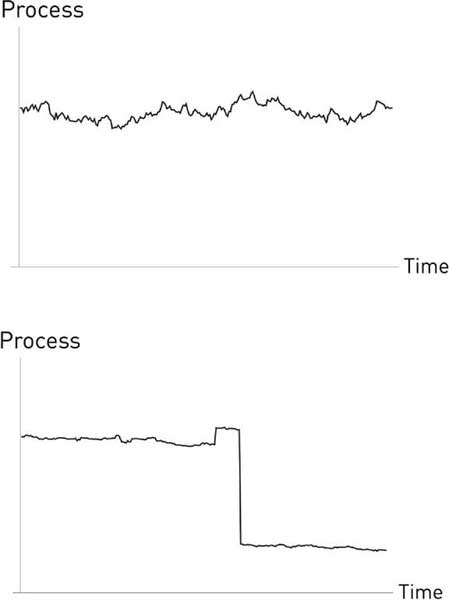
FIGURE 3. Municipal noise, distributed variations in the souks (first) compared to that of centralized or human-managed systems (second)—or, equivalently, the income of a taxi driver (first) and that of an employee (second). The second graph shows moves taking place from cascade to cascade, or Black Swan to Black Swan. Human overintervention to smooth or control processes causes a switch from one kind of system, Mediocristan, into another, Extremistan. This effect applies to all manner of systems with constrained volatility—health, politics, economics, even someone’s mood with and without Prozac. Or the difference between the entrepreneur-driven Silicon Valley (first) and the banking system (second).
Figure 3 illustrates how antifragile systems are hurt when they are deprived of their natural variations (mostly thanks to naive intervention). Beyond municipal noise, the same logic applies to: the child who, after spending time in a sterilized environment, is left out in the open; a system with dictated political stability from the top; the effects of price controls; the advantages of size for a corporation; and so on. We switch from a system that produces steady but controllable volatility (Mediocristan), closer to the statistical “bell curve” (from the benign family of the Gaussian or Normal Distribution), into one that is highly unpredictable and moves mostly by jumps, called “fat tails.” Fat tails—a synonym for Extremistan—mean that remote events, those in what is called the “tails,” play a disproportionate role. The first graph is volatile; it fluctuates but does not sink. The second graph sinks without significant fluctuations outside of episodes of turmoil. In the long run the second system will be far more volatile—but volatility comes in lumps. When we constrain the first system we tend to get the second outcome.
Note also that in Extremistan, predictability is very low. In the pseudo-smooth kind of randomness, mistakes appear to be rare, but they will be large, often devastating when they occur. In my view, anything locked into planning tends to fail precisely because of these attributes—it is quite a myth that planning helps corporations: the world is too random and unpredictable to base a policy on visibility of the future. What survives comes from the interplay of some fitness and environmental conditions.
The distinction calls for identifying which kind of randomness matters in a particular setting. Taleb’s argument is to preserve manageable variation where it helps a system adapt, while preparing for extremes where they can dominate outcomes.
When to use it
When managing a company's risk, avoid suppressing all small fluctuations (e.g., minor budget variances) as it may lead to bigger shocks (e.g., financial crisis).
In fitness, use manageable increases in training load, with recovery, rather than avoiding every physical challenge.
In innovation, foster a bottom-up, entrepreneur-driven approach with many small experiments (Silicon Valley) rather than top-down planning prone to catastrophic failures (banking system).
In policy-making, avoid centralizing control that creates apparent stability but hides large discontinuities; instead, distribute power to allow local adaptation.
Risk management: Recognize that financial markets often behave like Extremistan, not Mediocristan, so diversify against tail risks.
Innovation: Expect that a few breakthrough ideas (extremes) will generate most of the value, rather than a uniform spread.
Policy: Avoid using average-based metrics alone (e.g., GDP per capita) without considering extreme inequalities.
FROM THEORY TO EVERYDAY LIFE
In practice
Caloric intake vs net worth
Daily caloric intake illustrates Mediocristan: even a day exceeding 0.5% of annual intake would usually remain a small part of the total. Net worth, by contrast, can double or halve quickly. The comparison concerns an extreme event’s share of the aggregate, rather than a fixed calorie threshold.
Taxi driver vs bank employee income
Taleb contrasts a taxi driver’s varying daily income with an employee’s regular salary that can disappear after a job loss. The analogy illustrates frequent small changes versus rare large disruptions; it does not classify every driver or bank employee’s finances.
Income Distribution
A normal distribution illustrates mild variation, while a heavy-tailed wealth distribution can be dominated by a small number of observations. The relevant question is how much the extremes contribute to the total.
Book Sales
Most books sell few copies, but a handful of bestsellers dominate, illustrating Extremistan's disproportionate impact.
A MOMENT TO REFLECT
Put it to work.
Identify a system in your life (health, finances, relationships) where you see Mediocristan or Extremistan. How does intervention affect its volatility?
Think of a time when smoothing small fluctuations (overprotecting) led to a larger crisis. Could allowing natural variation have helped?
How can you design your decisions to leverage the benefits of Mediocristan (resilience through variation) while protecting against Extremistan's jumps?
How might your reliance on averages (Mediocristan thinking) lead you to underestimate rare but impactful events?
Which averages in your work might conceal outcomes large enough to dominate the total?
Often confused with
References
- The Black Swan: The Impact of the Highly Improbable — Nassim Nicholas Taleb (2007)
CONTINUE THE CONVERSATION
Source texts
- The Black Swan The Impact of the Highly Improbable With a new section On Robustness and Fragility (Nassim Nicholas Taleb)
- Antifragile (Nassim Nicholas Taleb)