Mathematics as an Extension of Common Sense
Ellenberg describes mathematics as a way to extend ordinary reasoning with precise definitions, proofs, and calculations. Intuition can suggest the problem and the approach; formal tools help where intuition becomes unreliable, especially with complex motion or uncertain outcomes.
THE IDEA
MATHEMATICS IS THE EXTENSION OF COMMON SENSE BY OTHER MEANS
Abraham Wald’s aircraft problem began with bullet holes in planes that returned from combat. The missing evidence was the planes that did not return: damage scarce on the survivors might have been fatal elsewhere. His insight was to account for those missing aircraft when deciding where armor was needed.
My teenage interlocutor might reasonably ask: Where’s the math? Wald was a mathematician, and his solution was ingenious, but the insight can be explained without a trig identity, an integral, an inequality, or a formula.
First of all: Wald did use formulas. I have sketched the idea without them. When you write a book explaining human reproduction to preteens, the introduction stops short of the really hydraulic stuff about how babies get inside Mommy’s tummy. Instead, you start with something more like “Everything in nature changes; trees lose their leaves in winter only to bloom again in spring; the humble caterpillar enters its chrysalis and emerges as a magnificent butterfly. You are part of nature too, and . . .”
But we’re all adults here. Turning off the soft focus for a second, here’s what a sample page of Wald’s actual report looks like:
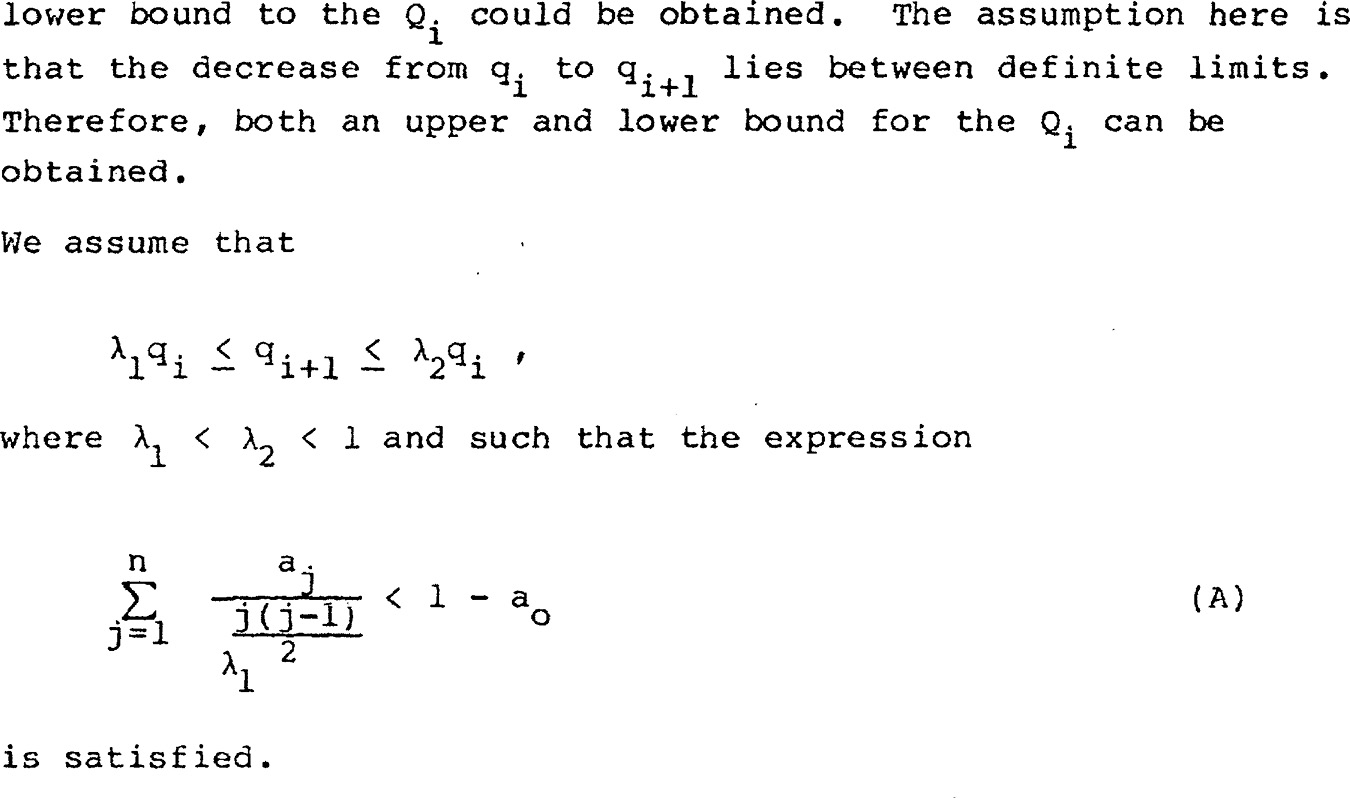
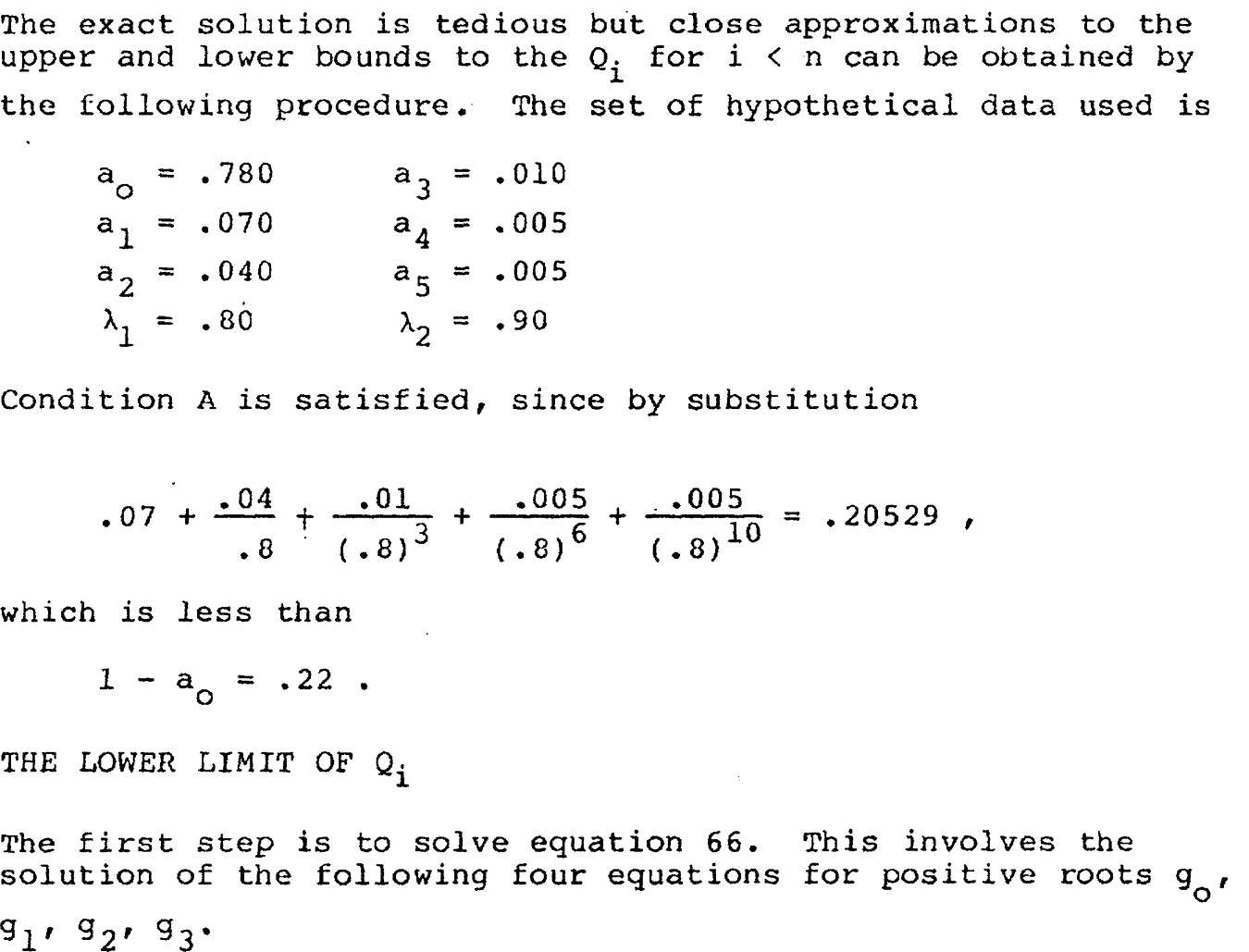
I hope that wasn’t too shocking.
Still, the real idea behind Wald’s insight doesn’t require any of the formalism above. We’ve already explained it, using no mathematical notation of any kind. So my student’s question stands. What makes that math? Isn’t it just common sense?
Yes. Mathematics is common sense. On some basic level, this is clear. How can you explain to someone why adding seven things to five things yields the same result as adding five things to seven? You can’t: that fact is baked into our way of thinking about combining things together. Mathematicians like to give names to the phenomena our common sense describes: instead of saying, “This thing added to that thing is the same thing as that thing added to this thing,” we say, “Addition is commutative.” Or, because we like our symbols, we write:
For any choice of numbers a and b, a + b = b + a.
Despite the official-looking formula, we are talking about a fact instinctively understood by every child.
Multiplication is a slightly different story. The formula looks pretty similar:
For any choice of numbers a and b, a × b = b × a.
The mind, presented with this statement, does not say “no duh” quite as instantly as it does for addition. Is it “common sense” that two sets of six things amount to the same as six sets of two?
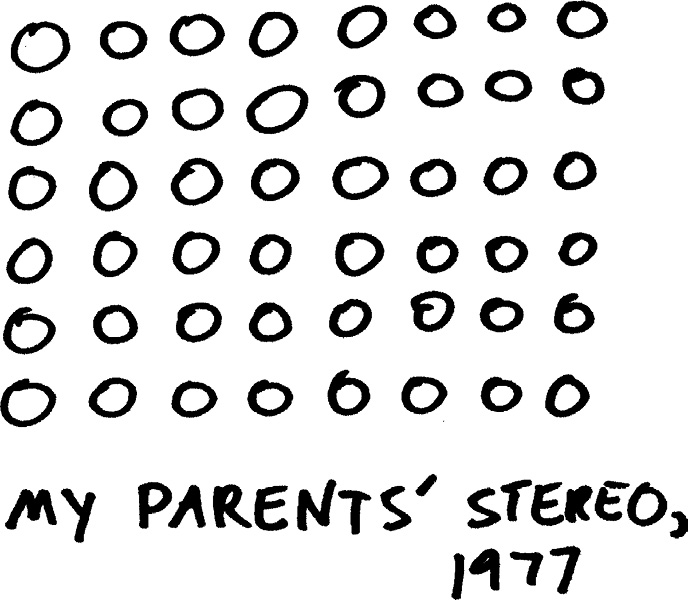
Maybe not; but it can become common sense. Here’s my earliest mathematical memory. I’m lying on the floor in my parents’ house, my cheek pressed against the shag rug, looking at the stereo. Very probably I am listening to side two of the Beatles’ Blue Album. Maybe I’m six. This is the seventies, and therefore the stereo is encased in a pressed wood panel, which has a rectangular array of airholes punched into the side. Eight holes across, six holes up and down. So I’m lying there, looking at the airholes. The six rows of holes. The eight columns of holes. By focusing my gaze in and out I could make my mind flip back and forth between seeing the rows and seeing the columns. Six rows with eight holes each. Eight columns with six holes each.
And then I had it—eight groups of six were the same as six groups of eight. Not because it was a rule I’d been told, but because it could not be any other way. The number of holes in the panel was the number of holes in the panel, no matter which way you counted them.
We tend to teach mathematics as a long list of rules. You learn them in order and you have to obey them, because if you don’t obey them you get a C-. This is not mathematics. Mathematics is the study of things that come out a certain way because there is no other way they could possibly be.
Now let’s be fair: not everything in mathematics can be made as perfectly transparent to our intuition as addition and multiplication. You can’t do calculus by common sense. But calculus is still derived from our common sense—Newton took our physical intuition about objects moving in straight lines, formalized it, and then built on top of that formal structure a universal mathematical description of motion. Once you have Newton’s theory in hand, you can apply it to problems that would make your head spin if you had no equations to help you. In the same way, we have built-in mental systems for assessing the likelihood of an uncertain outcome. But those systems are pretty weak and unreliable, especially when it comes to events of extreme rarity. That’s when we shore up our intuition with a few sturdy, well-placed theorems and techniques, and make out of it a mathematical theory of probability.
The specialized language in which mathematicians converse with one another is a magnificent tool for conveying complex ideas precisely and swiftly. But its foreignness can create among outsiders the impression of a sphere of thought totally alien to ordinary thinking. That’s exactly wrong.
Math is like an atomic-powered prosthesis that you attach to your common sense, vastly multiplying its reach and strength. Despite the power of mathematics, and despite its sometimes forbidding notation and abstraction, the actual mental work involved is little different from the way we think about more down-to-earth problems. I find it helpful to keep in mind an image of Iron Man punching a hole through a brick wall. On the one hand, the actual wall-breaking force is being supplied, not by Tony Stark’s muscles, but by a series of exquisitely synchronized servomechanisms powered by a compact beta particle generator. On the other hand, from Tony Stark’s point of view, what he is doing is punching a wall, exactly as he would without the armor. Only much, much harder.
To paraphrase Clausewitz: Mathematics is the extension of common sense by other means.
Without the rigorous structure that math provides, common sense can lead you astray. That’s what happened to the officers who wanted to armor the parts of the planes that were already strong enough. But formal mathematics without common sense—without the constant interplay between abstract reasoning and our intuitions about quantity, time, space, motion, behavior, and uncertainty—would just be a sterile exercise in rule-following and bookkeeping. In other words, math would actually be what the peevish calculus student believes it to be.
That’s a real danger. John von Neumann, in his 1947 essay “The Mathematician,” warned:
As a mathematical discipline travels far from its empirical source, or still more, if it is a second and third generation only indirectly inspired by ideas coming from “reality” it is beset with very grave dangers. It becomes more and more purely aestheticizing, more and more purely l’art pour l’art. This need not be bad, if the field is surrounded by correlated subjects, which still have closer empirical connections, or if the discipline is under the influence of men with an exceptionally well-developed taste. But there is a grave danger that the subject will develop along the line of least resistance, that the stream, so far from its source, will separate into a multitude of insignificant branches, and that the discipline will become a disorganized mass of details and complexities. In other words, at a great distance from its empirical source, or after much “abstract” inbreeding, a mathematical subject is in danger of degeneration.
When to use it
Making probabilistic decisions about rare events (e.g., insurance, lottery) by combining intuition with formal probability theory.
Understanding compound interest by intuitively grasping multiplication of rates and then using formulas to calculate long-term growth.
Analyzing data with bias correction (e.g., survivorship bias) by recognizing missing information and applying mathematical adjustments.
Using calculus to optimize an intuitively understood process, such as minimizing cost in manufacturing by interpreting marginal changes.
FROM THEORY TO EVERYDAY LIFE
In practice
The Stereo Airhole Example
A child lying on the floor sees a rectangular grid of airholes: eight across and six down. By focusing on rows or columns, they realize that six rows of eight holes equals eight columns of six holes—an intuitive grasp of commutativity of multiplication without formal rules.
Wald's Survivorship Bias
During WWII, Abraham Wald’s reasoning about aircraft armor accounted for planes that did not return. Areas with fewer observed hits on surviving aircraft could be more vulnerable, rather than safer. The missing-data insight can be explained without equations; Wald’s formal work quantified the problem.
A MOMENT TO REFLECT
Put it to work.
Think of a time when your intuition misled you—could mathematical formalization have helped you make a better decision?
How does the view of math as extended common sense change how you approach learning a new mathematical concept?
In what everyday situations do you rely on mathematical thinking without realizing it?
References
- The Mathematician — John von Neumann (1947)
CONTINUE THE CONVERSATION
Source texts
- How Not to Be Wrong The Power of Mathematical Thinking (Ellenberg, Jordan)