Intelligent Rationality
Intelligent rationality is a concept that redefines intelligence as the ability to create mutual benefit in human interactions by combining logic with emotional understanding, rather than using logic to defeat others. It draws on Carlo M. Cipolla's definition of intelligence as actions that benefit both oneself and others.
THE IDEA
INTELLIGENT RATIONALITY
Life doesn’t have to be a zero-sum game, where the only way to win is to ensure that someone else loses. People who think it does are usually trying to manipulate other people whom they think they can beat. I may sound rather optimistic, but there are abundant examples of situations where people collaborate for the greater good, rather than compete. This is the essence of teamwork and communities, and perhaps the very essence of humanity. We are not, after all, each living in a cave by ourselves, but living in communities at many different scales: families, neighbourhoods, schools, companies, cities, countries, and even, with any luck, cooperation between countries.
I believe in a slightly modified version of Carlo M. Cipolla’s theory of intelligence in The Basic Laws of Human Stupidity. He defines stupidity and intelligence according to benefits and losses to yourself and others.
If you benefit yourself but harm others, you are a bandit. If you benefit others but hurt yourself (or incur losses), he calls this “unfortunate”, though I might rather say you are being a martyr. Both pit one person’s interests against another’s. On the other hand there are people who hurt others and themselves at the same time, as in the prisoner’s dilemma. Cipolla defines this as stupidity. The remaining possibility is to help yourself and others at the same time, and Cipolla defines intelligence to be the quadrant of mutual benefit:
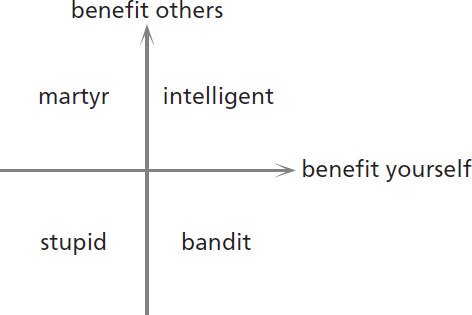
This is an eye-opening definition of intelligence, involving nothing to do with knowledge, achievements, grades, qualifications, degrees, prizes, talent or ability. I like it, and it is this form of intelligence that I will use to describe intelligent rationality. Intelligent rationality is where you don’t just use logic, and you don’t just use it powerfully, but you use it in human interactions to help everyone. The aim should be to help achieve better mutual understanding, to help others and yourself at the same time. If you are only using logic to defeat someone else’s argument and promote your own, that is the intellectual version of being a bandit.
Intelligent rationality is about using logic in human interactions, and so it must involve emotions to back up logical arguments in ways that support understanding. Without this, I don’t believe we have any serious chance of reaching mutual understanding with those who seem to disagree with us. Conversely, intelligent rationality should involve being able to find the logic in someone else’s emotional response as well as our own, rather than just calling emotions wrong.
For example, when I was offered a chance to move to Chicago I was perplexed because rationally it was obviously the best choice for me, but emotionally I felt reluctant. In order to understand this dissonance I wrote a list of weighted pros and cons, and I discovered why I was confused: in favour of the move were a small number of really enormous points, but putting me off the move was a huge list of minor details. I had emotionally become swamped by the huge quantity of minor details. Once I had discovered the source of my fear I was able to reduce it, and in the end I made the decision with no hesitation, and no regrets.
Another example is when I eat far too much ice cream although I know it’s going to make me feel ill later. I could tell myself I’m just being illogical, but it’s more nuanced than that: I am prioritising short-term pleasure (delicious ice cream) over medium-term pain. That’s not illogical; it’s a choice, and once I see it as that, I am sometimes able to make a different choice.
Arguing and reasoning with oneself is a good first step, but what about arguing with others? What should we do about people who disagree with us?
When to use it
Team decision-making where conflicting interests exist, aiming for win-win solutions
Negotiations involving multiple stakeholders, focusing on empathy and logic to find common ground
Personal decisions involving short-term vs long-term trade-offs, like health or career choices
Resolving political or social disputes by understanding the emotional logic behind opposing views
FROM THEORY TO EVERYDAY LIFE
In practice
Deciding to move to Chicago
The author faced a dilemma: rationally, moving to Chicago was the best choice, but emotionally they felt reluctant. By creating a weighted pros and cons list, they realized that the large number of minor negative details overwhelmed the few major positive points. Recognizing this emotional dissonance allowed them to make a confident decision.
Overeating ice cream
The author acknowledges that eating too much ice cream despite knowing it will cause later discomfort is not simply illogical. Instead, it is a choice prioritizing short-term pleasure over medium-term pain. Reframing it as a conscious trade-off can help in making different choices.
A MOMENT TO REFLECT
Put it to work.
Think of a recent disagreement. How could you reframe it to achieve mutual benefit rather than one side winning?
When making a decision, are you aware of both logical and emotional factors? How can you integrate them to reach a more intelligent rationality?
Can you identify a situation where you acted as a bandit or martyr? How could intelligent rationality change the outcome?
Often confused with
References
- The Basic Laws of Human Stupidity — Carlo M. Cipolla
CONTINUE THE CONVERSATION
Source texts
- The Art of Logic How to Make Sense in a World that Doesn’t (Eugenia Cheng)