Ingroup Bias and Outgroup Rivalry
People derive belonging and status from group membership, leading to favoritism for their own group and hostility toward rival groups, even when group boundaries are arbitrary.
THE IDEA
FITTING IN AND STANDING OUT
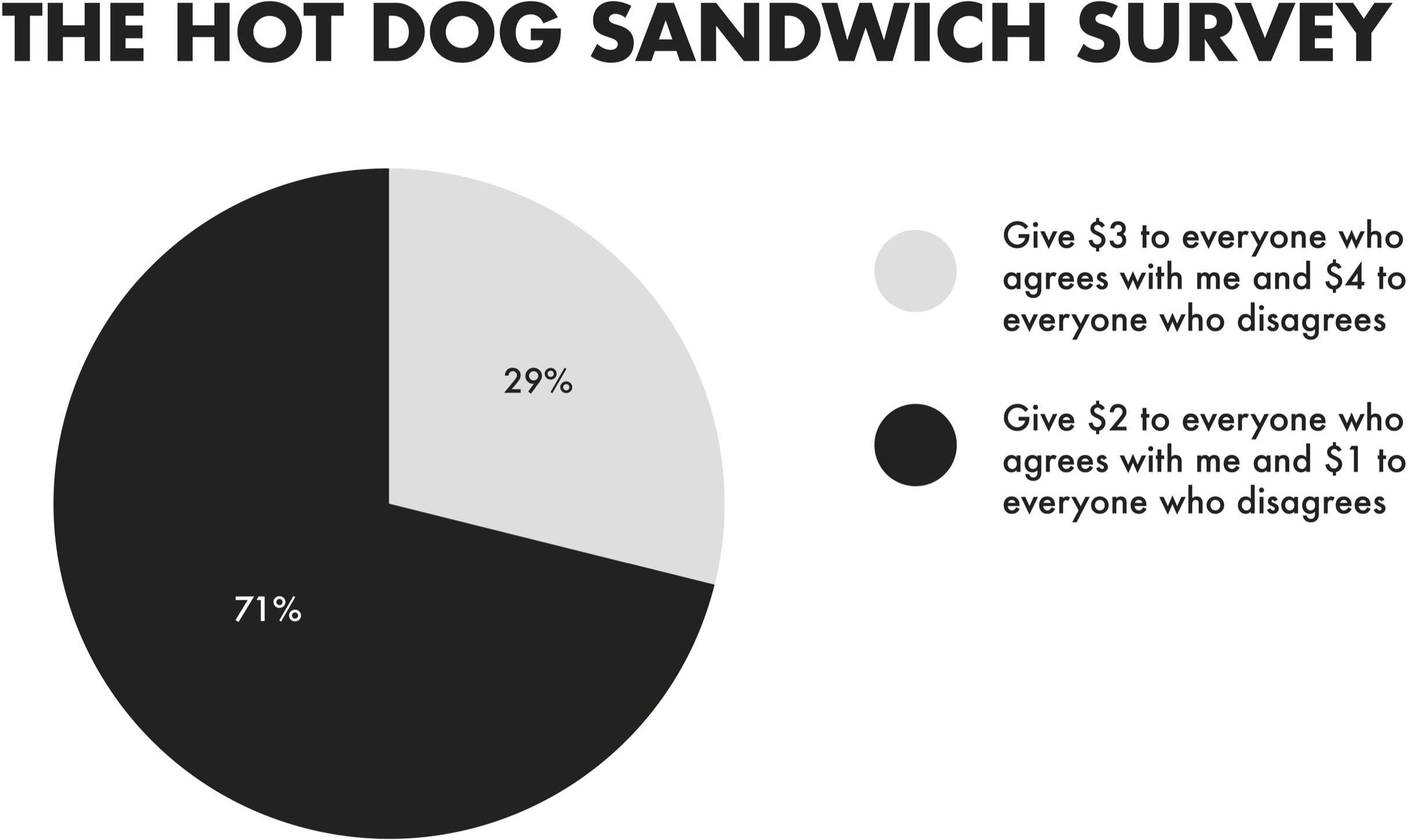
For decades psychologists have found that people can feel animosity toward other groups even when the boundaries between them are trivial. Take a seemingly innocuous question: is a hot dog a sandwich? When students answered this question, most felt strongly enough that they were willing to sacrifice a dollar to those who agreed with them to make sure those who disagreed got less.
In every human society, people are motivated to seek belonging and status. Identifying with a group checks both boxes at the same time: we become part of a tribe, and we take pride when our tribe wins. In classic studies on college campuses, psychologists found that after their team won a football game, students were more likely to walk around wearing school swag. From Arizona State to Notre Dame to USC, students basked in the reflected glory of Saturday victories, donning team shirts and hats and jackets on Sunday. If their team lost, they shunned school apparel, and distanced themselves by saying “they lost” instead of “we lost.” Some economists and finance experts have even found that the stock market rises if a country’s soccer team wins World Cup matches and falls if they lose.*
Rivalries are most likely to develop between teams that are geographically close, compete regularly, and are evenly matched. The Yankees and Red Sox fit this pattern: they’re both on the East Coast, they play each other eighteen or nineteen times a season, they both have histories of success, and as of 2019, they had competed over 2,200 times—with each team winning over 1,000 times. The two teams also have more fans than any other franchises in baseball.
I decided to test what it would take to get fans to rethink their beliefs about their bitter rivals. Working with a doctoral student, Tim Kundro, I ran a series of experiments with passionate Yankees and Red Sox supporters. To get a sense of their stereotypes, we asked over a thousand Red Sox and Yankees fans to list three negative things about their rivals. They mostly used the same words to describe one another, complaining about their respective accents, their beards, and their tendency to “smell like old corn chips.”
When to use it
In marketing, understanding ingroup bias can help create brand communities that foster loyalty and rivalry with competitors.
In team management, leaders can reduce harmful outgroup hostility by emphasizing superordinate goals that unite different groups.
In sports, recognizing the psychological dynamics of rivalry can help coaches and players manage fan pressure and media narratives.
In conflict resolution, acknowledging the role of social identity can facilitate dialogue by framing issues around common ingroup identities.
FROM THEORY TO EVERYDAY LIFE
In practice
Hot Dog Sandwich Debate
Students were willing to sacrifice a dollar to ensure that those who disagreed with them on whether a hot dog is a sandwich received less, demonstrating that even trivial group boundaries can trigger strong ingroup favoritism.
College Football Fandom
After their team won a football game, students were more likely to wear school apparel (basking in reflected glory). After a loss, they avoided team gear and used 'they' instead of 'we' to distance themselves.
A MOMENT TO REFLECT
Put it to work.
Think of a rivalry you are part of (sports, politics, etc.). How does your group's success or failure affect your sense of self-esteem?
Reflect on a time you used 'we' for a group success and 'they' for a failure. What does that say about your identification with that group?
Consider an arbitrary group division you've experienced (e.g., favorite brand, hometown). Did you feel animosity toward those on the other side? Why?
CONTINUE THE CONVERSATION
Source texts
- Think Again The Power of Knowing What You Dont Know (Adam Grant)