Hierarchical Organization of Life
Living things are organized into nested hierarchical levels, from cells and tissues to ecosystems and the biosphere. Understanding this organization reveals emergent properties and the coherence of biological systems.
THE IDEA
Life is not found in atoms or molecules or genes as such, but in organization; not in symbiosis but in synthesis. —Edwin Grant Conklin
The living world can be organized on different levels. Many individual organisms can be organized into the following:
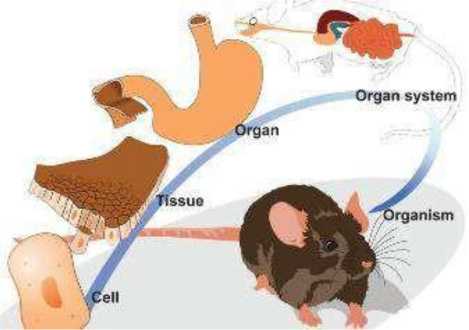
Organization Within Organisms
- Cell: Basic unit of structure and function of all living things.
- Tissue: Cells organized to perform related functions; a tissue can include several cell types.
- Organs: Structure composed of one or more types of tissue. The tissues of an organ work together to fulfill a specific function.
- Organ System: Group of organs that work together to fulfill a certain function.
- Organism: Individual living being. Multicellular organisms may have tissues and organ systems; a single-celled organism does not.
This implies that the laws governing organic cohesion, the organization leading from the part to the whole, represent a biological uncertainty, indeed an uncertainty of the first order. —Walter Rudolf Hess
For example, a mouse is made up of several organ systems. The digestive system, which separates food into a form that cells can use, includes organs like the stomach. The stomach is made of different tissue types, each composed of cells working together.
Levels Above Organism
- Population: Organisms of the same species living in the same area. (e.g., all goldfish in a pond)
- Community: All populations living in the same area. (e.g., goldfish, other fish, aquatic plants)
- Ecosystem: All living things in an area plus the inert environment (water, sunlight, physical factors).
- Biome: A group of similar ecosystems with the same type of physical environment.
- Biosphere: The part of Earth where all life exists, including inhabited regions of land, water, and air.
When to use it
Curriculum design for biology education
Ecological conservation planning
Medical diagnosis linking symptoms to organ systems and cellular mechanisms
Systems biology research integrating data across levels
FROM THEORY TO EVERYDAY LIFE
In practice
Mouse Digestive System
A mouse's digestive system is composed of organs like the stomach, which is made of tissues (e.g., muscle tissue, epithelial tissue), each consisting of cells. The organ system (digestive) works with other systems to sustain the organism.
Goldfish Population Ecology
All goldfish in a pond form a population. Together with other fish, aquatic plants, and organisms, they form a community. The community plus water, sunlight, and physical factors forms an ecosystem. Similar ecosystems make a biome, and all Earth's biomes constitute the biosphere.
A MOMENT TO REFLECT
Put it to work.
How does the hierarchical organization explain the complexity of life?
What emergent properties appear at the ecosystem level that aren't present at the organism level?
Why is it important to study biology at multiple levels of organization?
References
- — Edwin Grant Conklin
CONTINUE THE CONVERSATION
Source texts
- Wisdom Theory 100 Mental Models (2020) (Wisdom Theory)