Group Dynamics
Group dynamics shape who speaks, which issues get discussed, and whether a team learns from mistakes. Leaders can encourage honest discussion by admitting their own mistakes and responding constructively when others raise concerns.
THE IDEA
Group Dynamics
Staff and managers are often expected to learn collaboration ‘on the job’, including on cross‐functional projects, with limited training or coaching.
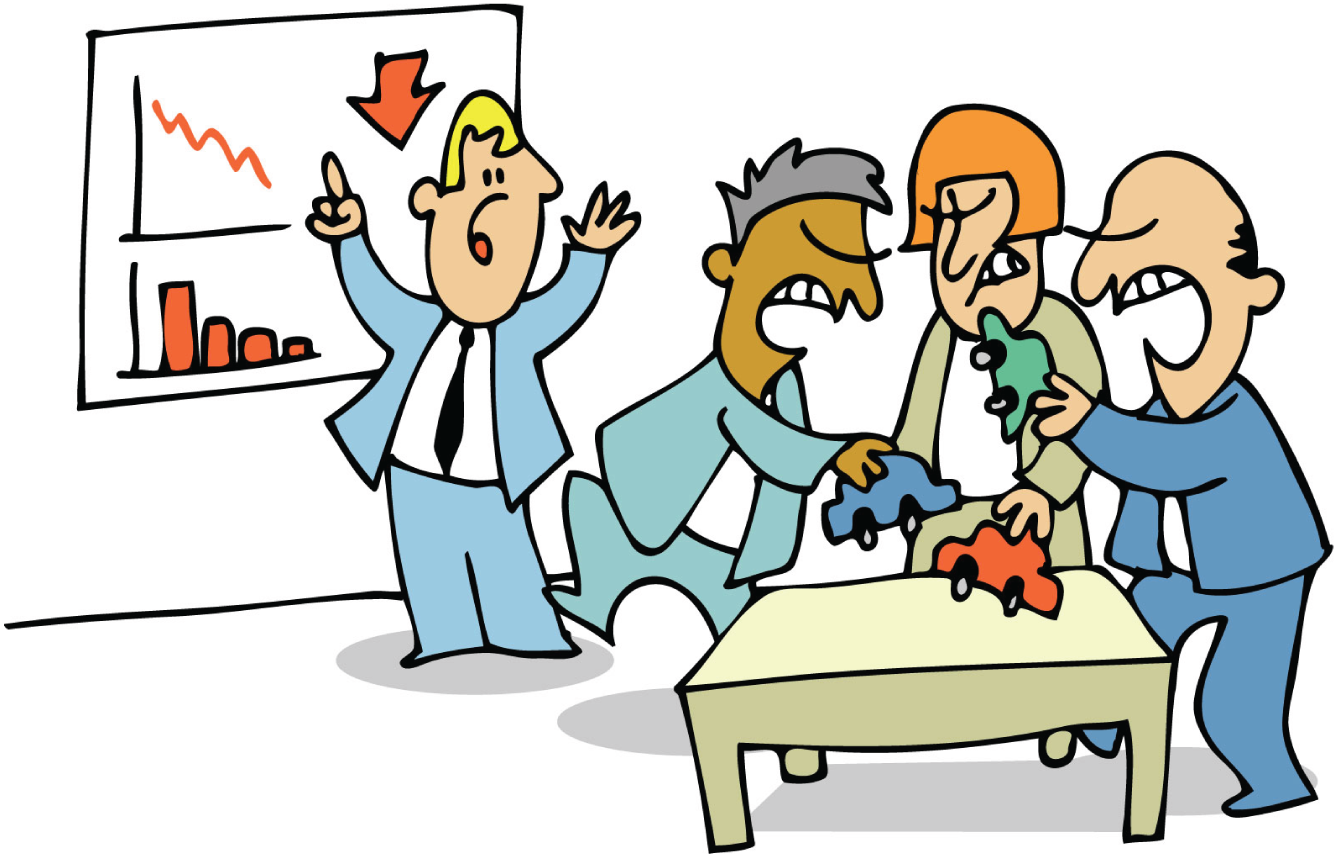
In meetings, dominant personalities can crowd out other team members’ views. Different group dynamics can arise, such as ‘fight/flight’ where essential issues are scheduled, but time is used up for less important matters, leading to no, or only a cursory, discussion on the crucial topic (see Illustration 10.3).31
An independent review can help a team notice these patterns. Some organisations engage psychologists or facilitators to observe meetings and suggest changes.32
Charlie Hendry describes how a leader changed the discussion after a serious incident:
‘In my career working in the Fire Service, I have seen some very tragic things, both in terms of members of the public who get caught in a fire and firefighters who die in the line of duty. The death of a firefighter is a rare occurrence, thankfully, especially since firefighters can be, by the very nature of their role, in very hazardous situations. Nonetheless, when a firefighter dies, there is going to be a thorough investigation of what happened and why the firefighter died.
Illustration 10.3 Group dynamics – fight flight
Sometimes, an investigation will provide insights concerning well‐established, well‐intentioned policies and procedures, as well as flaws with training, and the way things are executed in practice, which is absolutely as it should be, nothing should be “off the table”. In one case, I remember the investigation revealed there was a misguided view of what should be happening on the ground and a questionable decision at the level of the “incident commander”.
Now incident commanders are very experienced personnel who “calls the shots” and will know the appropriate decisions to make to handle a difficult incident effectively and keep everyone safe, often under extreme time pressure. Incident commanders can change during the evolution of an incident depending on its severity and the duration of the incident. So, despite your best efforts, there will be moments when decisions are made with incomplete information.
The outcome of our inquiry was to create a simplified model for firefighters to make decisions in the field by distilling down the big‐ticket risk issues into simple chunks that they could process under pressure at pace. Before that, the guidance firefighters got for making decisions came from what I would call the “laboratory model”, gathering all the information, sifting it, prioritising it, implementing it and then reviewing it. But that is not what can happen in an emergency because it takes too long.
As we worked on a new way of making decisions under pressure, we started to see that, even though there was no overt blame culture, there was still a culture where firefighters were afraid of being blamed for not making the “right” decision. Here accountability for a task became accountability for taking the blame rather than doing your best. I can't go into all the details, but we realised there wasn't enough challenge from the front line to say, “I can't make this work, this doesn't work for me, I can't remember this. People glossed over it, avoided it and didn't talk about it”.
Through these insights, we encouraged firefighters to raise concerns during incidents, and we also developed a “review of command” process, which was implemented after large incidents. Here there might be three or four commanders of escalating seniority, and they would meet afterwards with a facilitator to look at what decisions were made, why they were made and what happened as a result.
At first, several incident commanders went into these review meetings with the mindset: “I'm not going to say anything because if I say anything, I will be blamed and I may get into trouble”. The people facilitating these reviews came out of the first two or three and said, “We are going nowhere with this; they are not learning anything because people won't talk about what really happened. They seem to be conceding points in vague, impersonal terms and avoiding personal responsibility”.
What changed things was that one of the most senior operational officers in the fire service happened to be involved in an incident. He decided he would participate in the review process, and he sat there at the beginning and opened it up by saying he thought he had made some mistakes and wanted to talk about what happened. He was brave enough to admit he probably rushed one decision and should have checked something else. This changed everything because it gave permission for others in the room to be open. Following this, we took great care to make sure learnings were shared in a positive spirit with senior staff, and I made it clear this was what I was looking forward to seeing in the future. It wasn't perfect, and we had to work at this on an ongoing basis, but it set a tone that encouraged people to be open and honest, to admit mistakes and to want to learn.
No matter what people say about openness and honesty in the workplace, unless they see senior leaders admitting mistakes, expressing doubts, asking questions sincerely and taking on board difficult feedback, you will mostly have people paying lip service to the needed behavioural change.’
Healthy group behaviour does not necessarily make meetings run smoothly. A lack of challenge and questioning can itself be a problem. As Andy Stanley says, ‘Leaders who don't listen will eventually be surrounded by people who have nothing to say’.33
When to use it
When facilitating team meetings, be aware of dominant personalities and use techniques to ensure all voices are heard.
During post-incident or project reviews, establish a psychologically safe environment so participants feel comfortable sharing honest feedback.
When implementing change, consider potential group dynamics that may lead to resistance or avoidance, and plan interventions.
Use external facilitators or psychologists to observe team dynamics and provide feedback for improvement.
FROM THEORY TO EVERYDAY LIFE
In practice
Fire Service Incident Command Review
After a serious incident, the fire service implemented a 'review of command' process. Initially, commanders were reluctant to speak, but when a senior officer admitted mistakes, it set a tone of openness, leading to more effective learning and a culture of challenge.
Fight/Flight in Meetings
A team schedules an important strategic issue but spends the meeting on minor operational details. Paterson uses this avoidance as an illustration of the fight/flight pattern: the group stays busy without addressing the difficult topic.
A MOMENT TO REFLECT
Put it to work.
Think of a recent meeting where group dynamics hindered progress. What specific behaviours contributed to the problem?
How can you encourage honest discussion and challenge while keeping disagreements focused on the work?
When have you observed a leader admit a mistake and what impact did it have on the group's openness?
CONTINUE THE CONVERSATION
Source texts
- Beyond the Five Whys Root Cause Analysis and Systems Thinking (James C. Paterson)