Google Scholar Source Check
Use Google Scholar to look for research behind a historical claim and trace the evidence cited by its source. A sparse scholarly record can prompt further investigation, but search results alone do not establish whether the claim is true.
THE IDEA
Using Google Scholar to Find Scholarly Sources
We’ll start with the claim that there was a concentration camp in Natchez, Mississippi, during the Civil War. You could search “Natchez + concentration camp” but doing so brings up a slew of unfamiliar sites and random YouTube videos. If an event of such magnitude happened—twenty thousand deaths at the hands of a liberating army that was supposed to protect these freed men, women, and children—there’s bound to be some kind of scholarly footprint, even if it didn’t make it into your history book. To evaluate this and other claims, a great place to start is Google Scholar (scholar.google.com), which, according to Google, “provides a simple way to broadly search for scholarly literature.”9
Google Scholar operates on the same principles as a regular Google search. You put in keywords and see what comes up. In the authors’ search exercise, “Devil’s Punchbowl + Natchez + concentration camp” turned up little—almost nothing. The only result they found was a thesis by a master’s student at Louisiana State University, who heard about the Devil’s Punchbowl but found little concrete evidence.10 When he consulted historians, “most had not heard about the story, and some were doubtful of the story.”11
That an event of this immensity lacks a scholarly footprint should, by itself, raise a red flag. At the same time, the tweet about it has a link to an article on a website called Black Main Street.
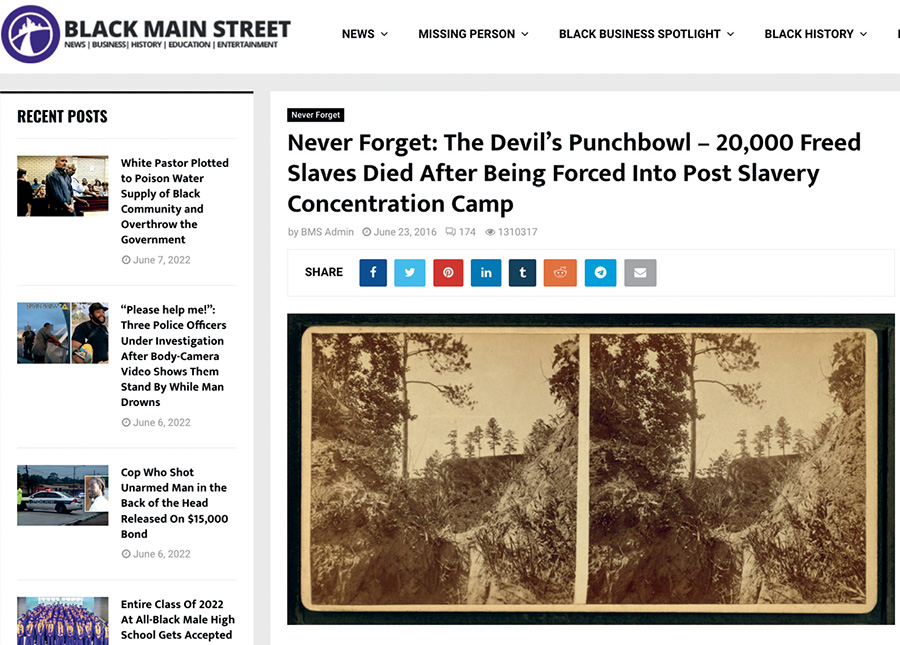
Figure 6.5 Article on the Devil’s Punchbowl in Natchez, Mississippi (https://blackmainstreet.net/never-forget-devils-punchbowl-20000-freed-slaves-died-forced-post-slavery-concentration-camp/)
The article repeats the claim that “20,000 freed slaves died” after being herded into a “post slavery concentration camp.” But the article contains no footnotes to the source of this information. Instead, there’s a reference to a researcher named Paula Westbrook. Putting her name into Google Scholar came up empty in the authors’ exercise—red flag number two. Their regular Google search yielded slightly more. Paula Westbrook, it turns out, is no historian. She’s not an academic or an archivist. She’s not a teacher. What, then, are her qualifications?
Westbrook is part of something called the Southern Paranormal & Anomaly Research Society, a “Mississippi based paranormal investigation team.” Her bio explains that while growing up in Louisiana’s backwoods, she became skilled in the practices of voodoo, sparking “her interest in the paranormal.” Probably not the kind of “expert” you’ll want to cite in your history paper.12
When to use it
Evaluating a social media post that makes a shocking historical claim.
Checking whether a controversial statistic or event reported in news appears in academic literature.
Checking a quoted expert’s publications alongside institutional biographies, archival work and the evidence they cite.
Assessing the reliability of a source by looking for citations and scholarly backing before sharing.
FROM THEORY TO EVERYDAY LIFE
In practice
Devil's Punchbowl Concentration Camp Claim
The authors investigate a claim that 20,000 freed slaves died in a concentration camp at Devil’s Punchbowl in Natchez, Mississippi. Their Scholar search finds little beyond a master’s thesis expressing doubt. They then examine the linked Black Main Street article, its lack of citations and the background of its named researcher, Paula Westbrook. These checks give them reasons to seek stronger historical evidence; the search’s sparse results alone do not disprove the event.
A MOMENT TO REFLECT
Put it to work.
When you encounter a viral historical claim on social media, what is the first step you should take using Google Scholar?
Why is the absence of a scholarly footprint a significant red flag for a historical claim of this magnitude?
How can you systematically evaluate the credibility of an author or researcher cited in an online article?
CONTINUE THE CONVERSATION
Source texts
- Verified How to Think Straight, Get Duped Less, and Make Better Decisions about What to Believe Online (Mike Caulfield, Sam Wineburg)