Google Is a Mirror Reflecting Back What You Give It
Search results from Google often reflect the user's assumptions and the way they phrase their query, rather than providing an objective answer. This can reinforce misconceptions if the user is not careful, as illustrated by the learning styles controversy.
THE IDEA
Google Is a Mirror Reflecting Back What You Give It
Are you an auditory learner? A kinesthetic one? Do you learn best by watching a video or reading a text? What’s your “learning style”?
The field of learning styles is mired in controversy.12 Even though the idea of learning styles has been around for years, its scientific basis is skimpy. Attempts to match people to their preferred learning style produce no better results than when they’re matched to their “unpreferred” style. But scientific findings wither in the face of people’s deep-seated intuitions. “I’m a visual learner! Don’t try to convince me otherwise!”
In an ideal search, we’d want Google to alert us to a controversy where laypeople say one thing but the scientific consensus says another. In fact, when we asked Google if learning styles are real, that’s just what we got:
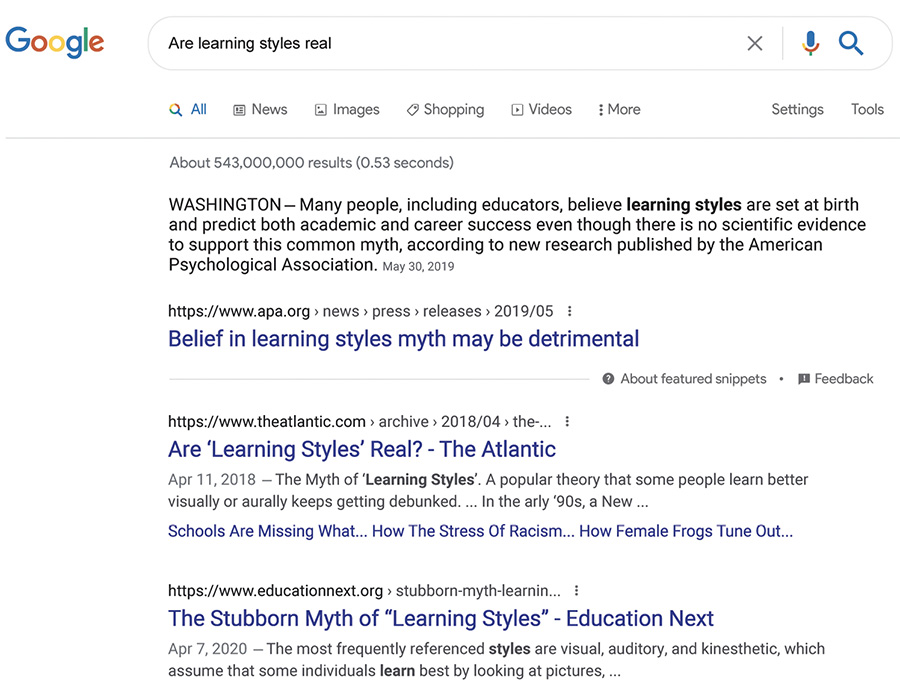 Figure 3.22 Search results for “Are learning styles real,” December 2020. (Google and the Google logo are trademarks of Google LLC.)
At the top is a featured snippet from the American Psychological Association, the largest research group of psychologists in the world. No equivocating here: “there is no scientific evidence to support this common myth.”
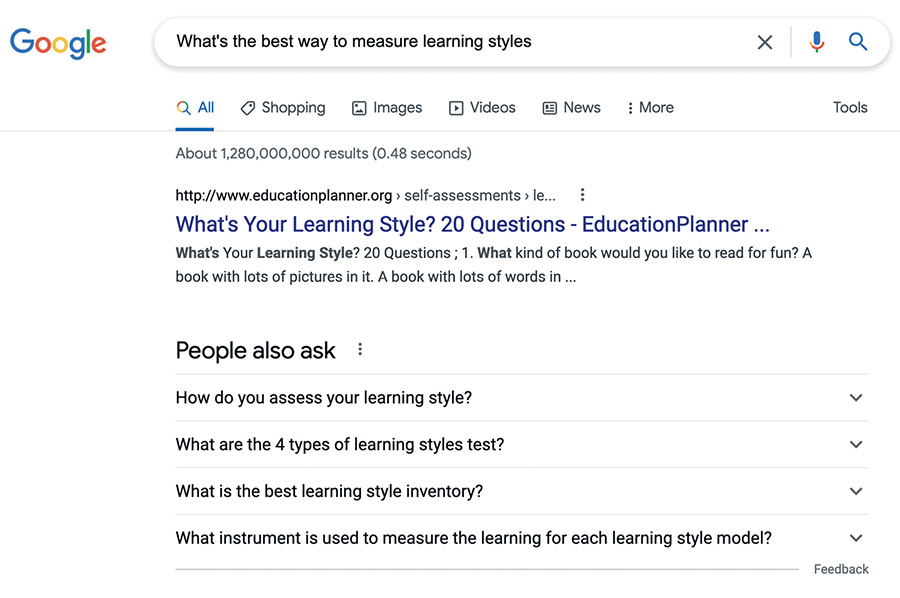 Figure 3.23 Results page for “What’s the best way to measure learning styles.” (Google and the Google logo are trademarks of Google LLC.)
What happens when we assume that learning styles are real, but what we want to know is how to measure them? When we ask, “What’s the best way to measure learning styles?” Google also obliges.
The top result takes you to a site where, in twenty questions (e.g., “Do you prefer books with words or pictures?”), you can “determine” your learning style. For fun, we answered the questions completely at random. We received an official-looking report telling us we’re “visual learners” who should “sit near the front of the classroom.”
There are two problems here: keywords and inferred intent. As far as keywords go, experts in education may talk about learning styles in the context of whether they make a difference. But given the shaky state of research, they’re unlikely to talk about “the best way” to measure learning styles because, well, it’s debatable whether they even exist. So you’re not going to find these keywords in documents written by experts.
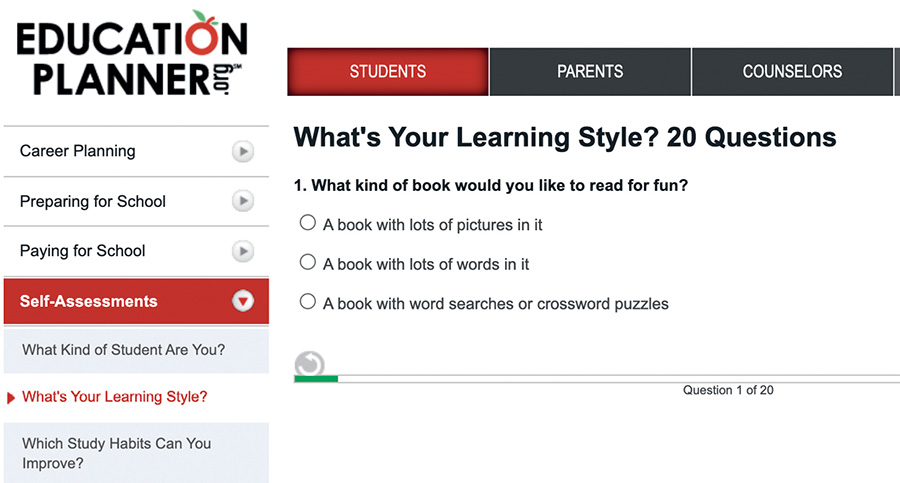 Figure 3.24 “What’s Your Learning Style?” questionnaire from educationplanner.org (http://www.educationplanner.org/students/self-assessments/learning-styles.shtml)
But what about inferred intent—the attempt by Google’s algorithms to deduce what we’re looking for by the way we phrase a search? It’s reasonable to assume we’re already believers when we ask, “What’s the best way to measure learning styles?” Google, being Google, guides us down that path.
When to use it
When researching health advice, be aware that searching for 'benefits of [treatment]' may yield different results than 'risks of [treatment]'.
When trying to verify a rumor, try searching with neutral phrasing and compare results across multiple queries.
In educational settings, teach students how search engines work and the importance of critical search strategies.
When evaluating a product, search for both 'reviews' and 'problems' to get a more complete picture.
FROM THEORY TO EVERYDAY LIFE
In practice
Learning Styles Search
In the authors’ search exercise, 'Are learning styles real' returned an APA snippet challenging the idea. A search for 'What’s the best way to measure learning styles' instead led to a quiz that assumed the categories were useful. The contrast shows how a query’s premise can shape the sources it retrieves.
A MOMENT TO REFLECT
Put it to work.
When you search for a controversial topic, how does your phrasing influence the results you get?
Can you think of a time you accepted a search result without questioning whether your query was biased?
How might you adjust your search strategy to find more balanced information?
Often confused with
CONTINUE THE CONVERSATION
Source texts
- Verified How to Think Straight, Get Duped Less, and Make Better Decisions about What to Believe Online (Mike Caulfield, Sam Wineburg)