Global and Local Maxima
A local maximum is at least as good as nearby alternatives; a global maximum is at least as good as every alternative in the defined search space. Improving a locally good solution may require trying a different approach, sometimes accepting a temporary decline without knowing whether it will pay off.
THE IDEA
Global and Local Maxima
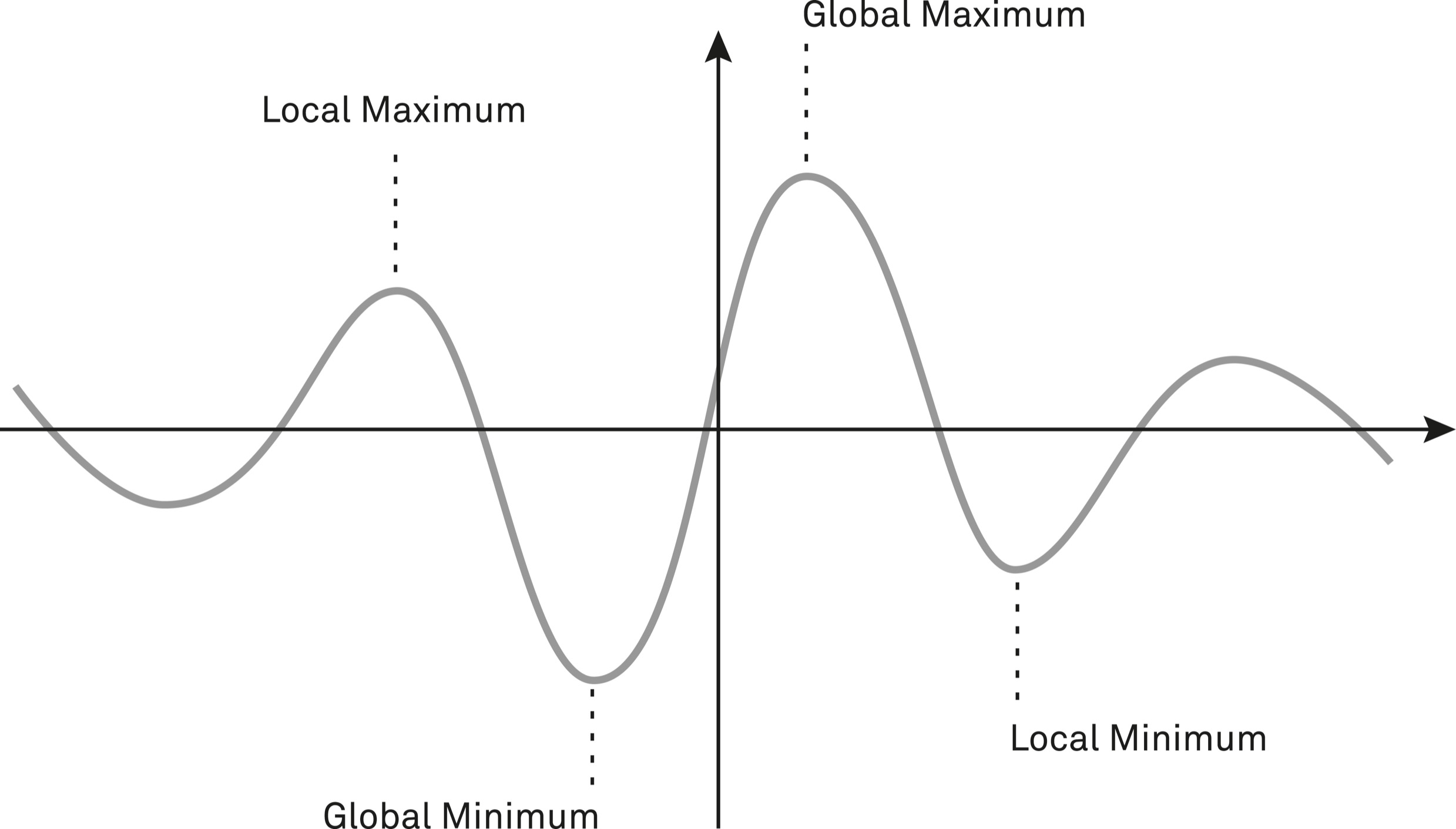
A function reaches a global maximum where its value is at least as high as at every other point in its domain. It reaches a local maximum where its value is at least as high as at nearby points. A global maximum can also be a local maximum, and several points can share the same maximum value. Some functions have no maximum at all.
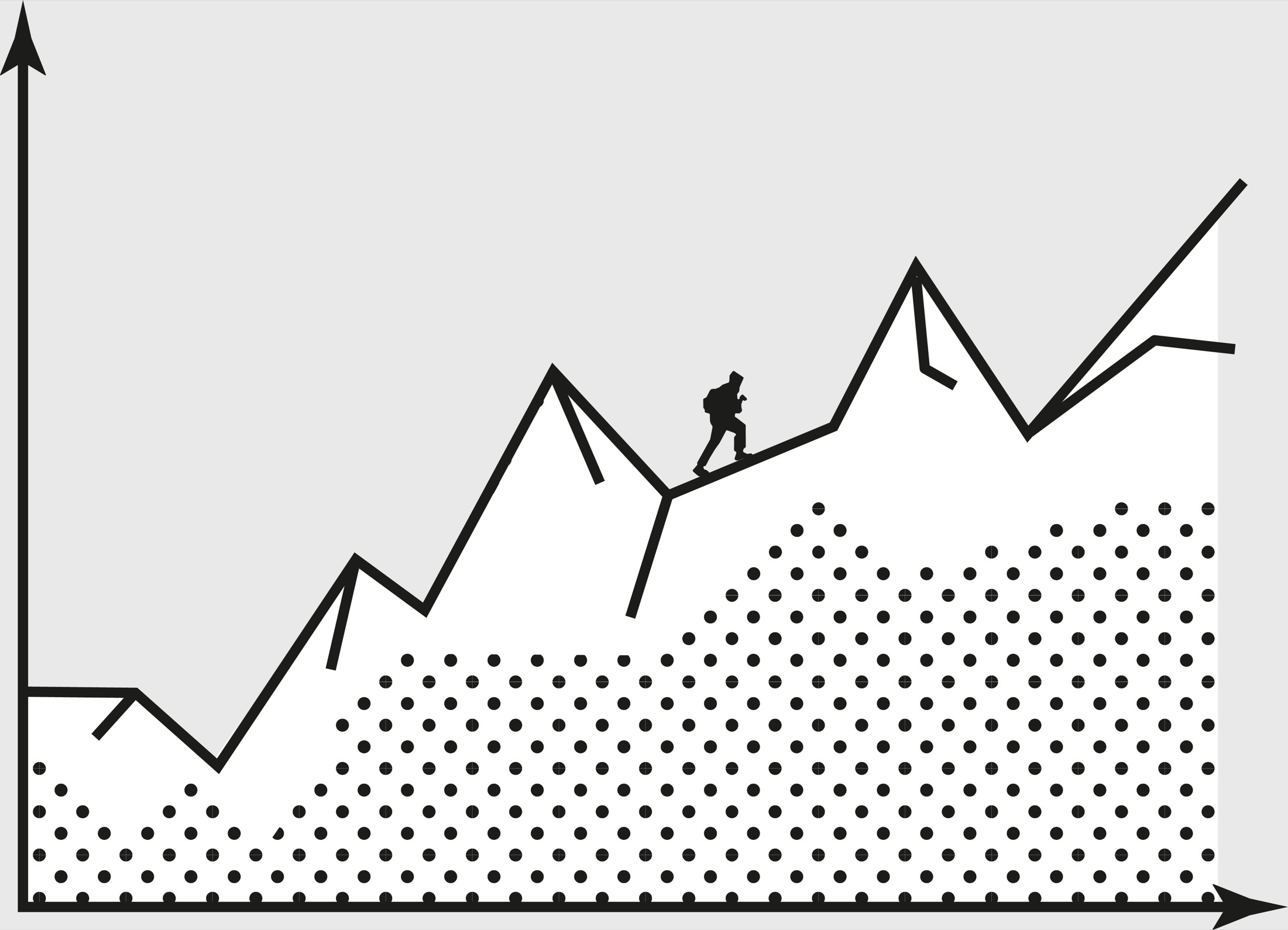
Picture a landscape with several hills. Walking uphill from your starting point may take you to the top of a nearby hill without taking you to the highest point in the landscape. In computer science, one such search method is called “hill climbing,” because it repeatedly moves to a better nearby solution. It searches the landscape; it does not create it. As Brian Christian and Tom Griffiths explain, “the search through a space of solutions, some better and some worse, is commonly thought of in terms of a landscape with hills and valleys, where your goal is to reach the highest peak.”
If every small change makes a solution worse, an approach that accepts only immediate improvements can get stuck. A broader search might require a different starting point, a larger change, or a temporary loss:
We may need to temporarily worsen our solution if we want to continue searching for improvements.
—Brian Christian and Tom Griffiths
In “Escaping Local Maxima,” Dave Rael describes the “chasms between where we are and where we could be [are] opportunities to improve by finding ways of moving from a place where progress is flat to find a new slope to climb.” The practical question is whether the changes you are considering merely refine the current approach or open up a different set of possibilities.
The Jogbra story
In 1977, Lisa Lindahl developed a working sports-bra prototype. Turning it into a business brought unfamiliar problems: production, sales, distribution, and marketing. Lindahl and her partners tried approaches that failed, including a mittens line called Jogmit, while finding a market for Jogbra in sporting goods stores. Later, selling the company to Playtex brought another transition.
The story illustrates the limits of improving only what you already know how to do. A good prototype did not settle the manufacturing or sales questions. Lindahl had to learn skills for which success with the original design provided little preparation. She describes the experience this way:
“You make your plans looking upward toward your goal, only to reach it and find that what you thought was the pinnacle, the ceiling of your endeavor, was in fact only the floor of your next level.”
The analogy has limits. Business success is not a fixed landscape that can be fully mapped, and a failed experiment is not necessarily a step toward a better outcome. The Jogbra account shows learning through changes in approach; it does not prove that every setback is necessary or beneficial.
Deciding whether to search further
Start by defining what you want to improve. In engineering it might be efficiency within constraints on cost and reliability. In a career decision it might be a combination of pay, time, and work you value. Without a clear objective, calling a different option a higher peak says little.
Then ask what you have actually compared. A design can be the best of several small variations while a different architecture remains unexplored. A job can be attractive among the roles you know without being the best job you could possibly have. Usually you cannot establish a global maximum in such open-ended choices.
Search has costs as well as potential benefits. A small prototype, trial project, or limited period of retraining can help you investigate an alternative without committing everything to it. Decide what evidence would justify a larger move and how much temporary loss you can afford. A plateau is a reason to consider other approaches, not a promise that a better outcome lies beyond it.
When to use it
Strategic planning: Businesses analyzing whether their current success is a local or global maximum and if they need disruptive innovation.
Personal development: Individuals seeking new skills or careers after plateaus in growth.
Software engineering: Refactoring code to escape local optima in performance or design patterns.
Scientific research: Scientists abandoning a comfortable theory to explore new paradigms that might better explain phenomena.
A startup founder considering whether to pivot from a profitable niche to a larger but riskier market.
An individual changing careers and accepting a temporary pay cut to enter a field with higher long-term potential.
A company deciding to cannibalize its own successful product to innovate for the future.
Learning a new skill like public speaking, where initial attempts are awkward but necessary for mastery.
Comparing a different engineering architecture with further refinements to the current design.
Testing a change in work hours to explore a better balance of income, leisure, and family time.
Business strategy: avoiding complacency with a currently successful product
Comparing the costs and risks of replacing a current investment with an alternative that may perform better.
FROM THEORY TO EVERYDAY LIFE
In practice
Business Innovation
A company has a profitable product line, but small improvements no longer address a changing market. It could test a different technology, accepting lower near-term profits for a chance of better long-term results. The investment may open a better option; it does not guarantee the best possible outcome.
Career Change
A graphic designer is comfortable in a job but wants to explore UX design. An internship might involve a pay cut while they learn the work and find out whether it offers the fulfillment and income they want. The temporary decline is a cost of exploring an alternative, not proof that the alternative will succeed.
Scaling the Jogbra Company
After the initial Jogbra prototype worked, Lisa Lindahl and Hinda Schreiber faced challenges in sourcing, manufacturing, distribution, and marketing. The account describes mistakes with product names, colors, and a mittens line. Building the business required learning beyond product design; the setbacks illustrate that learning process without establishing that each failure was necessary.
Personal Growth and Epilepsy
In Lindahl’s account, epilepsy had encouraged her to avoid risks such as living alone and had influenced her decision to marry early. Running changed how she related to her body, and she returned to college in her late twenties despite feeling intimidated. She reconsidered choices that had once seemed settled.
Product Design
An engineering team has a design that works well, but by exploring a completely different approach, they might achieve a breakthrough in efficiency, even if initial tests are less promising.
A MOMENT TO REFLECT
Put it to work.
Think of a time when you were at a peak in some area of life. Were you at a local or global maximum? How did you know?
What's one area where you're comfortable but suspect there might be a higher mountain? What would it take to leave the current peak?
What 'valleys' might you need to cross to reach your next summit, and how can you prepare for the descent?
What small improvements have you already tried, and what fundamentally different approach remains unexplored?
When have you had to descend into uncertainty to learn a new skill? How did it feel and what was the outcome?
How can you distinguish between a local and a global maximum in your decision-making?
What are you trying to maximize, and what constraints or competing goals matter?
How much temporary loss could you afford while testing an alternative? What would make you stop?
When would the cost of further searching outweigh the likely benefit of a better solution?
References
- Algorithms to Live By: The Computer Science of Human Decisions — Brian Christian and Tom Griffiths (2016)
- Unleash the Girls — Lisa Lindahl
CONTINUE THE CONVERSATION
Source texts
- The Great Mental Models Volume 3 Systems and Mathematics
- The Great Mental Models Volume 3 Systems and Mathematics
- The Great Mental Models Volume 3 Systems and Mathematics