False False Equivalence
Accusing someone of false equivalence when their analogy is actually valid is itself a fallacy. The burden is on the critic to show that the analogy breaks down on a crucial point, not merely that it is not identical.
THE IDEA
FALSE FALSE EQUIVALENCE
False equivalences can be used to shut down valid arguments. But so can false accusations of false equivalence.
Imagine an argument about whether higher education should be paid for by the government. One person objects on the grounds that higher education is optional and everyone gets to decide for themselves whether they go or not, so if it’s paid for by the state then individuals get to decide how to spend the government’s money.
Someone else might argue that this is true of healthcare as well – when healthcare is paid for by the state, individuals get to decide whether to go to the doctor or not, so they too are essentially deciding how to spend the government’s money. Of course this argument won’t work with someone who doesn’t believe healthcare should be paid for either, but what if the person objects to government-funded higher education but supports government-funded healthcare? Is that inconsistent?
At this point if you accuse someone of inconsistency in this way they’re likely to exclaim “That’s not the same”, which is the usual battle cry when someone is trying to argue against another person’s analogy. But of course the analogy isn’t the same – it’s an analogy. The question is whether the analogy breaks down on a crucial rather than an irrelevant point.
You could argue that people don’t “decide” to go to the doctor, they just go when they’re sick. Whereas in fact I think an arguably analogous level of decision goes into going to see the doctor and going on to higher education. Different people decide to go at different points for different reasons. I don’t think it’s as clear cut as “hypochondriacs vs normal people”, and “sick people vs well people”. Some people seem to think it is a black and white logic system:
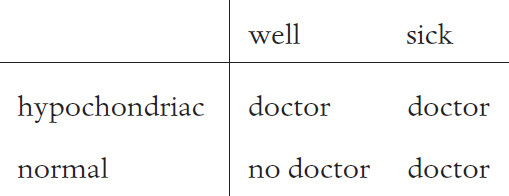
whereas I think it’s more like a fuzzy logic system:
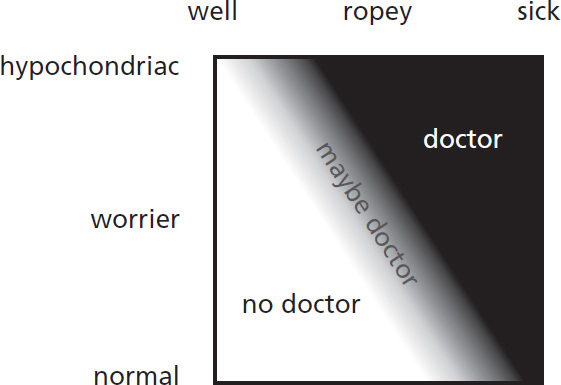
Some people refuse ever to go to the doctor. Will Boast’s haunting memoir Epilogue talks of his father dying in his car by the side of the road rather than hitting the emergency button, so averse was he to the idea of getting medical help.
Aside from that, there are situations in which most people would seek medical attention, such as if they’ve broken all their limbs, or got third-degree burns, and others in which some people would go to the doctor and others would decide not to. Notoriously, many people go to the doctor when they have a bad cold, and want antibiotics although antibiotics do nothing for viruses, whereas I just go to bed and drink whisky. All this is to say that we do make choices about using healthcare.
Compare this with higher education. It is not exactly a free choice whether to go or not, as so many professions are inaccessible nowadays if you do not have a degree. This is very different from, say, fifty years ago when it was more of an indulgence to go, unless you wanted to be a doctor or a research scientist (or perhaps a few other things). You could still be a banker, a civil servant, a teacher without a degree. Today you can choose not to go but then you’ll probably either be restricted to a low-paid unskilled job, or you’ll have to rely on being a rare entrepreneur. Even artists are mostly expected to have degrees now although vocational apprenticeships fortunately still exist in some fields.
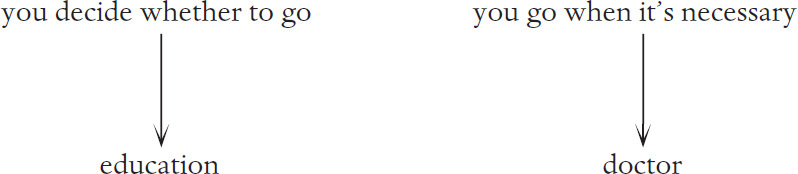
The two different points of view can be represented like this. One person thinks education and health care are not analogous, because they are using these principles:
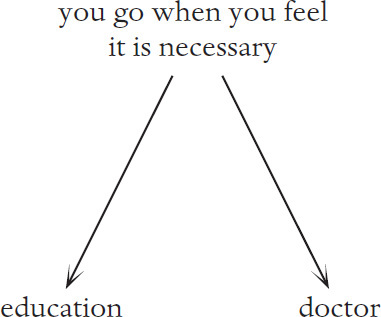
Someone else thinks they are analogous, by using this principle:
I think with both college and the doctor, most people go because they perceive it to be crucial to their future life. However, that level of perception is subjective, and what looks like an involuntary, critical matter to one person can look like an indulgent choice to another. I will concede that there might be some exceptions – rich people who go to university just for the sheer fun of it, as they will never need to depend on their education in their lives. Perhaps this is analogous to hypochondriacs who go to the doctor for no particular reason?
So, are the situations equivalent or not? A claim of “false equivalence” itself needs to be justified. Just saying that something isn’t the same does not mean that it isn’t equivalent in some crucial way.
When to use it
Debating public policy, such as comparing funding for different government programs.
Ethical discussions where two situations are compared to draw moral conclusions.
Science communication when analogies are used to explain complex concepts.
Everyday arguments where someone dismisses a comparison without examining the relevant similarities.
FROM THEORY TO EVERYDAY LIFE
In practice
Government-funded higher education vs. healthcare
A person opposes state-funded higher education because it's optional, but supports state-funded healthcare claiming it's necessary. When someone points out the similarity—both involve individuals deciding how to spend government money—the first person may cry 'false equivalence.' But the critic must show why the analogy fails on a crucial difference, not just that the two services are not identical.
A MOMENT TO REFLECT
Put it to work.
When you hear someone say 'that's not the same,' how can you determine whether the analogy actually fails on a crucial point?
Think of a debate where you have been accused of making a false equivalence. Were you making a valid analogy, or did it break down?
How can you ensure you are not dismissing a valid analogy by simply labeling it a false equivalence?
Often confused with
References
- Epilogue: A Memoir — Will Boast
CONTINUE THE CONVERSATION
Source texts
- The Art of Logic How to Make Sense in a World that Doesn’t (Eugenia Cheng)