Expected Value Analysis (Pascal's Wager and Franklin's Pro-Con List)
Expected-value analysis compares actions by weighting each possible outcome’s value by its probability and adding the results. Nisbett relates this to Franklin’s method of weighing pros and cons and illustrates it with Pascal’s wager about religious belief.
THE IDEA
4. Should You Think Like an Economist?
When difficult cases [decisions] occur, they are difficult chiefly because while we have them under consideration, all the reasons pro and con are not present to the mind at the same time … To get over this, my way is to divide half a sheet of paper by a line into two columns; writing over the one “Pro,” and the other “Con.” Then … I put down under the different heads short hints of the different motives … for and against the measure … I endeavor to estimate their respective weights; where I find one on each side that seem equal, I strike them both out. If I find a reason pro equal to two reasons con, I strike out three … and thus proceeding I find at length where the balance lies … And, though the weight of reasons cannot be taken with the precision of algebraic quantities, yet when each is thus considered, separately and comparatively, and the whole lies before me, I think I can judge better, and am less liable to take a rash step.
—Benjamin Franklin
Benjamin Franklin’s suggestions about how to deal with choice are what we now call decision analysis. Nisbett relates this procedure to a different way of weighing consequences, developed in the middle of the seventeenth century by the mathematician, physicist, inventor, and Christian philosopher Blaise Pascal. Franklin’s list does not itself require explicit probabilities. In carrying out what is called expected value analysis, you list the possible outcomes of each of a set of choices, determine their value (positive or negative), and calculate the probability of each outcome. For each action, multiply each outcome’s value by its probability, then sum those products. The total is the action’s expected value. You then pick the action with the highest expected value.
Pascal described his decision theory in the context of considering his famous wager: Everyone has to decide whether to believe in God or not. At the heart of his analysis was what we would call today a payoff matrix:
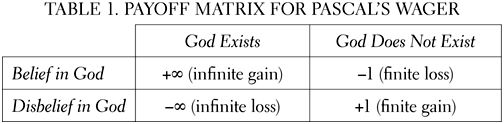
If God exists and we believe in him, the reward is eternal life. If he exists and we do not believe in him, the consequence is eternal damnation. If God does not exist and we believe in him, there is a loss that is not too substantial—mostly forgoing guilty pleasures and avoiding selfish behavior that harms others. If God does not exist and we disbelieve, there is a relatively minor gain—indulging those guilty pleasures and behaving selfishly. (I note parenthetically that many psychologists today would say that Pascal may have gotten the finite gains and losses reversed. It actually is better for your well-being to give money than to receive it,1 and kind consideration of others makes one happier.2 But this doesn’t affect the logic of Pascal’s payoff matrix.)
Pity the poor atheist if Pascal got the payoffs right in the event that God exists. Only a fool would fail to believe. But unfortunately you can’t just grunt and produce belief.
Pascal had a solution to this problem, though. Nisbett interprets his solution as anticipating an idea associated with cognitive dissonance theory. If our beliefs are incongruent with our behavior, something has to change: either our beliefs or our behavior. We don’t have direct control over our beliefs but we do have control over our behavior. Discomfort about inconsistency can motivate people to change their beliefs, behavior, or interpretation of what they are doing.
Pascal’s prescription for atheists is to proceed “by doing everything as if they believed, by taking holy water, by having Masses said, etc.… This will make you believe … What have you to lose?”
The psychological suggestion is that acting in a certain way can influence belief. It is not a guarantee: someone may change the behavior instead, explain away the inconsistency, or remain unconvinced. The wager also depends on accepting its proposed outcomes and payoffs.
When to use it
Deciding between two job offers by listing pros and cons and weighing them subjectively.
Evaluating investment options by calculating expected returns based on probabilities and outcomes.
Making a health-related decision, such as whether to undergo a medical procedure, by comparing risks and benefits numerically.
Applying Pascal's logic to moral dilemmas, considering long-term consequences versus short-term gains.
FROM THEORY TO EVERYDAY LIFE
In practice
Pascal's Wager
In Pascal’s proposed payoff matrix, belief brings eternal life if God exists, while disbelief brings eternal damnation. If God does not exist, the gains and losses are finite. The wager favors belief under those assumptions; assessing the argument also requires examining whether its account of the possible outcomes and payoffs is acceptable.
A MOMENT TO REFLECT
Put it to work.
How might using a pro-con list help you avoid impulsive decisions in your daily life?
In what situations might expected value analysis fail because probabilities or values are hard to estimate?
Can you think of a personal decision where the expected value calculation pointed one way but your intuition pointed another? Which would you trust and why?
CONTINUE THE CONVERSATION
Source texts
- Mindware Tools for Smart Thinking (Richard E. Nisbett)