Emotional Framing
Emotional framing occurs when equivalent descriptions of a choice produce different preferences. A loss may feel different when described as a cost, or a treatment may seem more attractive when its outcomes are presented as survival rather than mortality. Comparing both descriptions can expose the influence of the wording.
THE IDEA
EMOTIONAL FRAMING
Amos and I applied the label of framing effects to the unjustified influences of formulation on beliefs and preferences. This is one of the examples we used:
Would you accept a gamble that offers a 10% chance to win $95 and a 90% chance to lose $5?
Would you pay $5 to participate in a lottery that offers a 10% chance to win $100 and a 90% chance to win nothing?
First, take a moment to convince yourself that the two problems are identical. In both of them you must decide whether to accept an uncertain prospect that will leave you either richer by $95 or poorer by $5. Someone whose preferences are reality-bound would give the same answer to both questions, but such individuals are rare. In fact, one version attracts many more positive answers: the second. A bad outcome is much more acceptable if it is framed as the cost of a lottery ticket that did not win than if it is simply described as losing a gamble. We should not be surprised: losses evokes stronger negative feelings than costs. Choices are not reality-bound because System 1 is not reality-bound.
The problem we constructed was influenced by what we had learned from Richard Thaler, who told us that when he was a graduate student he had pinned on his board a card that said COSTS ARE NOT LOSSES. In his early essay on consumer behavior, Thaler described the debate about whether gas stations would be allowed to charge different prices for purchases paid with cash or on credit. The credit-card lobby pushed hard to make differential pricing illegal, but it had a fallback position: the difference, if allowed, would be labeled a cash discount, not a credit surcharge. Their psychology was sound: people will more readily forgo a discount than pay a surcharge. The two may be economically equivalent, but they are not emotionally equivalent.
In an elegant experiment, a team of neuroscientists at University College London combined a study of framing effects with recordings of activity in different areas of the brain. In order to provide reliable measures of the brain response, the experiment consisted of many trials. Figure 14 illustrates the two stages of one of these trials.
First, the subject is asked to imagine that she received an amount of money, in this example £50.
The subject is then asked to choose between a sure outcome and a gamble on a wheel of chance. If the wheel stops on white she "receives" the entire amount; if it stops on black she gets nothing. The sure outcome is simply the expected value of the gamble, in this case a gain of £20.
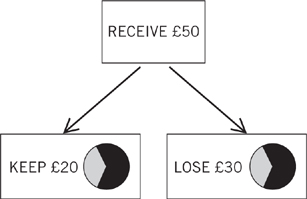
Figure 14
As shown, the same sure outcome can be framed in two different ways: as KEEP £20 or as LOSE £30. The objective outcomes are precisely identical in the two frames, and a reality-bound Econ would respond to both in the same way—selecting either the sure thing or the gamble regardless of the frame—but we already know that the Human mind is not bound to reality. Tendencies to approach or avoid are evoked by the words, and we expect System 1 to be biased in favor of the sure option when it is designated as KEEP and against that same option when it is designated as LOSE.
The experiment consisted of many trials, and each participant encountered several choice problems in both the KEEP and the LOSE frames. As expected, every one of the 20 subjects showed a framing effect: they were more likely to choose the sure thing in the KEEP frame and more likely to accept the gamble in the LOSE frame. But the subjects were not all alike. Some were highly susceptible to the framing of the problem. Others mostly made the same choice regardless of the frame—as a reality-bound individual should do. The authors ranked the 20 subjects accordingly and gave the ranking a striking label: the rationality index.
The activity of the brain was recorded as the subjects made each decision. Later, the trials were separated into two categories:
- Trials on which the subject's choice conformed to the frame
• preferred the sure thing in the KEEP version
• preferred the gamble in the LOSS version
- Trials in which the choice did not conform to the frame.
The remarkable results illustrate the potential of the new discipline of neuroeconomics—the study of what a person's brain does while he makes decisions. Neuroscientists have run thousands of such experiments, and they have learned to expect particular regions of the brain to "light up"—indicating increased flow of oxygen, which suggests heightened neural activity—depending on the nature of the task. Different regions are active when the individual attends to a visual object, imagines kicking a ball, recognizes a face, or thinks of a house. Other regions light up when the individual is emotionally aroused, is in conflict, or concentrates on solving a problem. Although neuroscientists carefully avoid the language of "this part of the brain does such and such…," they have learned a great deal about the "personalities" of different brain regions, and the contribution of analyses of brain activity to psychological interpretation has greatly improved. The framing study yielded three main findings:
• A region that is commonly associated with emotional arousal (the amygdala) was most likely to be active when subjects' choices conformed to the frame. This is just as we would expect if the emotionally loaded words KEEP and LOSE produce an immediate tendency to approach the sure thing (when it is framed as a gain) or avoid it (when it is framed as a loss). The amygdala is accessed very rapidly by emotional stimuli—and it is a likely suspect for involvement in System 1.
• A brain region known to be associated with conflict and self-control (the anterior cingulate) was more active when subjects did not do what comes naturally—when they chose the sure thing in spite of its being labeled LOSE. Resisting the inclination of System 1 apparently involves conflict.
• The most "rational" subjects—those who were the least susceptible to framing effects—showed enhanced activity in a frontal area of the brain that is implicated in combining emotion and reasoning to guide decisions. Remarkably, the "rational" individuals were not those who showed the strongest neural evidence of conflict. It appears that these elite participants were (often, not always) reality-bound with little conflict.
By joining observations of actual choices with a mapping of neural activity, this study provides a good illustration of how the emotion evoked by a word can "leak" into the final choice.
An experiment that Amos carried out with colleagues at Harvard Medical School is the classic example of emotional framing. Physician participants were given statistics about the outcomes of two treatments for lung cancer: surgery and radiation. The five-year survival rates clearly favor surgery, but in the short term surgery is riskier than radiation. Half the participants read statistics about survival rates, the others received the same information in terms of mortality rates. The two descriptions of the short-term outcomes of surgery were:
The one-month survival rate is 90%.
There is 10% mortality in the first month.
Surgery was much more popular in the former frame (84% of physicians chose it) than in the latter (where 50% favored radiation). The logical equivalence of the two descriptions is transparent, and a reality-bound decision maker would make the same choice regardless of which version she saw. But System 1, as we have gotten to know it, is rarely indifferent to emotional words: mortality is bad, survival is good, and 90% survival sounds encouraging whereas 10% mortality is frightening. An important finding of the study is that physicians were just as susceptible to the framing effect as medically unsophisticated people (hospital patients and graduate students in a business school). Medical training did not eliminate the framing effect in this experiment.
The KEEP-LOSE study and the survival–mortality experiment differed in one important respect. The participants in the brain-imaging study had many trials in which they encountered the different frames. They had an opportunity to recognize the distracting effects of the frames and to simplify their task by adopting a common frame, perhaps by translating the LOSE amount into its KEEP equivalent. It would take an intelligent person (and an alert System 2) to learn to do this, and the few participants who managed the feat were probably among the "rational" agents that the experimenters identified. In contrast, the physicians who read the statistics about the two therapies in the survival frame had no reason to suspect that they would have made a different choice if they had heard the same statistics framed in terms of mortality. Reframing is effortful and System 2 is normally lazy. Unless there is an obvious reason to do otherwise, most of us passively accept decision problems as they are framed and therefore rarely have an opportunity to discover the extent to which our preferences are frame-bound rather than reality-bound.
When to use it
When presented with a medical treatment decision, check how the outcomes are framed (e.g., survival vs. mortality) and reframe to ensure a balanced view.
In negotiations, consider how the framing of an offer as a discount vs. a surcharge affects your perception of its value.
When evaluating investment opportunities, reframe gains and losses to avoid being swayed by emotional wording.
In marketing, checking how a phrase such as '90% success rate' affects responses, and presenting the corresponding risk of failure clearly enough for customers to assess both.
FROM THEORY TO EVERYDAY LIFE
In practice
Gamble Framing
Would you accept a gamble that offers a 10% chance to win $95 and a 90% chance to lose $5? vs. Would you pay $5 to participate in a lottery that offers a 10% chance to win $100 and a 90% chance to win nothing? These are objectively identical but framed differently, leading to different preferences.
Cash Discount vs. Credit Surcharge
Gas stations considered labeling a price difference as a 'cash discount' rather than a 'credit surcharge'. People more readily forgo a discount than pay a surcharge, even though the amounts are equivalent.
Medical Treatment Framing
Physicians were more likely to choose surgery over radiation when the outcome was described as '90% survival rate' (84% chose surgery) compared to '10% mortality rate' (50% chose surgery), despite identical statistics.
Keep vs. Lose Experiment
A neuroscience experiment showed that subjects were more likely to choose a sure gain of £20 when it was framed as 'Keep £20' and more likely to gamble when the same outcome was framed as 'Lose £30'. Recorded brain activity differed between choices that followed the frame and choices that resisted it.
A MOMENT TO REFLECT
Put it to work.
Can you think of a time when the way a choice was presented influenced your decision, even though the outcomes were equivalent? How might you reframe a problem to see it more objectively?
How can awareness of framing effects help you make better decisions in medical, financial, or everyday contexts?
What are some common frames used in advertising or politics that exploit emotional reactions, and how can you guard against them?
Often confused with
CONTINUE THE CONVERSATION
Source texts
- Thinking, Fast and Slow (Daniel Kahneman)