Effective Topical Knowledge
Effective topical knowledge is the knowledge and skill someone can draw on for a particular task. It combines facts, procedures and remembered experience, including both what the person can explain and what they know through practice. People with similar formal training can develop different expertise as their work diverges.
THE IDEA
Knowing
A film presents images and sounds, but viewers also infer motives, relationships and a plot. Saying that we understand the story raises an epistemological 18 question: what supports that understanding? Figure 1.3 offers a way to distinguish kinds of knowledge.
The framework distinguishes how knowledge is acquired and expressed from the kind of knowledge involved. Explicit knowledge can be stated or recorded. Tacit knowledge is harder to articulate and often develops through practice. Formal instruction and informal experience can contribute to both. The framework also distinguishes (1) semantic knowledge of facts and concepts, (2) procedural knowledge of how to perform tasks, and (3) episodic memory of particular experiences, which may include their emotional context.
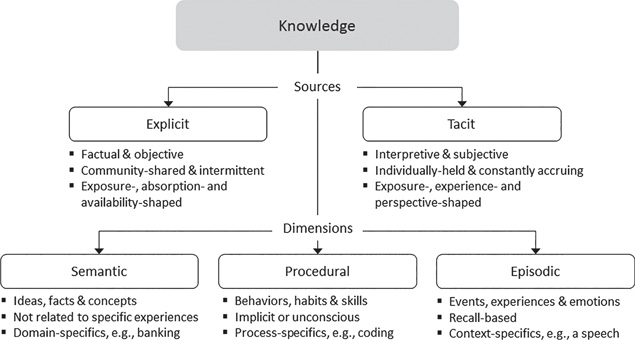
FIGURE 1.3 Dimensions of Knowledge.
Knowledge changes through use. Learning a regression technique in a course and applying it to messy data can reinforce some lessons and reveal limits in others. The author calls the resulting task-specific combination effective topical knowledge.
Imagine two statistics graduates with comparable training. One spends the next decade researching matrix methods for least-squares estimation; the other develops insurance-claims forecasts for clients. Their later expertise will reflect different problems, feedback and practice. Both may gain knowledge, revise earlier assumptions and become less fluent in material they seldom use.
For a decision, the relevant question is what knowledge the person can actually use. The author adds this task-specific combination to Figure 1.3, producing Figure 1.4.
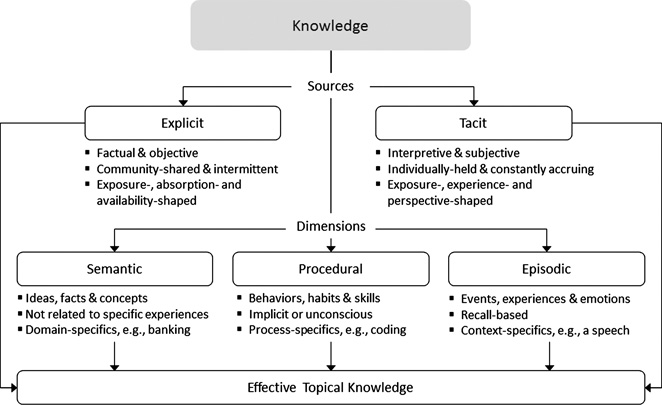
FIGURE 1.4 Effective Topical Knowledge.
An analyst estimating a customer’s probability of buying again needs more than a remembered formula. They may draw on concepts about regression, skill with tools such as R or SAS, and memories of earlier modeling problems. These forms of knowledge work together in performing the task.
Knowledge also depends on how it is transmitted. Socrates taught through questioning rather than books, an approach associated with the Socratic method.19 Plato’s dialogues preserved and developed a portrayal of that questioning. Aristotle, in turn, studied with Plato and developed different approaches to logic and inquiry. This example illustrates how later thinkers can preserve, reinterpret and extend earlier work; it does not reduce the history of scientific inquiry to a single line of descent.
The author’s first-follower analogy20 asks what happens to ideas when no one records or develops them. We cannot know which lost thinkers would have influenced later generations. Surviving records and people willing to carry an idea forward help determine what knowledge remains available.
When to use it
When assessing a candidate’s competence, consider what they can explain and demonstrate alongside their qualifications and practical experience.
A manager designing a training program should recognize that employees will develop different effective knowledge based on their unique work experiences, so personalized learning paths may be necessary.
In academic advising, two students with identical course grades may have vastly different effective knowledge due to their research or internship experiences; counselors should account for this when recommending specializations.
When making a high-stakes decision, a leader should gather input from team members with diverse tacit knowledge to ensure the decision benefits from varied effective topical knowledge.
FROM THEORY TO EVERYDAY LIFE
In practice
Understanding a Movie
When watching a film, our brain integrates discrete frames into a coherent story with themes and causality, illustrating how we 'know' a narrative despite the fragmented sensory input. This example shows the interplay between sensory stimuli and cognitive inference that leads to knowledge.
Diverging Expert Knowledge
Two statistics PhDs with identical formal training later develop distinct effective knowledge of regression analysis after one pursues academic research and the other applied consulting. Over a decade, different practice, feedback and use of earlier learning can produce different expertise.
A MOMENT TO REFLECT
Put it to work.
In your current field, how does your effective topical knowledge differ from what you learned in formal education?
Can you identify a situation where your tacit knowledge significantly altered or enhanced your explicit understanding of a topic?
Think of a skill you have developed over time. How have the three dimensions of knowledge (semantic, procedural, episodic) contributed to your expertise?
CONTINUE THE CONVERSATION
Source texts
- Evidence-Based Decision-Making How to Leverage Available Data and Avoid Cognitive Biases (Andrew D. Banasiewicz)