Ease of Recall Effect
People's judgments depend on both what they recall and how easy or difficult recall feels. In a classic experiment, participants who recalled 12 examples of assertive behavior rated themselves as less assertive than those who recalled 6, because the difficulty of recall suggested they were not very assertive.
THE IDEA
Table 5.2. Self-Reports of Assertiveness as a Function of Valence and Number of Recalled Behaviors
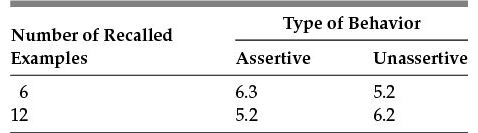
Note: N is 9 or 10 per condition. Mean score of three questions is given; possible range is 1 to 10, with higher values reflecting higher assertiveness. Adapted from Schwarz, Bless, Strack, Klumpp, Rittenauer-Schatka, and Simons (1991, Experiment 1).
As expected, participants reported higher assertiveness after recalling 6 examples of assertive behaviors than after recalling 6 examples of unassertive behaviors. However, this difference did not increase as participants had to recall more examples. To the contrary – participants who had to recall assertive behaviors reported lower assertiveness after recalling 12 rather than 6 examples. Similarly, participants who had to recall unassertive behaviors reported higher assertiveness after recalling 12 rather than 6 examples. In fact, they reported higher assertiveness after recalling 12 unassertive behaviors rather than 12 assertive behaviors, in contrast to what one would expect on the basis of recalled content. Apparently, the experience that it was difficult to bring 12 examples to mind suggested to them that they cannot be that assertive (or unassertive) after all. Thus, the experienced difficulty of recall induced participants to draw inferences opposite to the implications of recalled content.
A possible alternative explanation was tested: that the quality of examples changed over the course of recall, with later examples being less extreme. Schwarz et al. (1991, Experiment 1) found no evidence for this; if anything, the last two examples were more extreme. Thus, the subjective experience of difficulty is the key mechanism.
When to use it
Performance reviews: When employees are asked to list many examples of their accomplishments, the difficulty of recall may lead them to undervalue their own performance.
Self-improvement: When evaluating a personal trait (e.g., kindness), deliberately recalling only a few vivid examples may lead to a more positive self-assessment than trying to recall many.
Marketing: Advertisements that ask consumers to 'think of all the reasons you love this product' may backfire if consumers struggle to generate many reasons, leading them to devalue the product.
Survey design: Question formats that require listing many instances (e.g., 'list five times you felt stressed last week') may produce biased results due to ease-of-recall effects.
FROM THEORY TO EVERYDAY LIFE
In practice
Assertiveness Self-Rating Experiment
Participants recalled either 6 or 12 examples of assertive or unassertive behaviors. Those who recalled 12 assertive behaviors rated themselves as less assertive than those who recalled 6, because the difficulty of generating many examples implied they were not that assertive. Similarly, those who recalled 12 unassertive behaviors rated themselves as more assertive than those who recalled 6, because the difficulty of recalling many unassertive examples implied they were not that unassertive.
Happiness Judgments
If asked to recall 12 happy memories, the difficulty of doing so may lead people to conclude they are less happy than if they were asked to recall just 3 happy memories. The effort required to generate many examples overrides the valence of the content.
A MOMENT TO REFLECT
Put it to work.
Think of a time when you judged your own ability based on how easily you could recall past successes or failures. How might the ease (or difficulty) of recall have biased your assessment?
In a hiring context, if a candidate struggles to provide 10 examples of leadership, might you incorrectly infer they lack leadership skills? What alternative explanation could there be?
How could you use this effect deliberately to influence your own or others' self-perceptions? For example, asking someone to list only a few achievements rather than many.
References
- Ease of Retrieval as Information: Another Look at the Availability Heuristic — Schwarz, N., Bless, H., Strack, F., Klumpp, G., Rittenauer-Schatka, H., & Simons, A. (1991)
CONTINUE THE CONVERSATION
Source texts
- Heuristics and Biases The Psychology of Intuitive Judgment (Thomas Gilovich, Dale Griffin, Daniel Kahneman)