Drifting Goals
A shifting-the-burden structure where short-term solutions involve letting a long-term fundamental goal decline, often leading to gradual erosion of standards.
THE IDEA
Structure
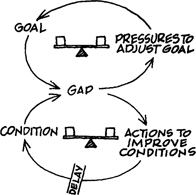
Description: A shifting the burden type of structure in which the short-term solution involves letting a long-term, fundamental goal decline.
Early Warning Symptom: “It’s okay if our performance standards slide a little, just until the crisis is over.”
Management Principle: Hold the vision.
Business Story: A high-tech manufacturer finds itself losing market share, despite a terrific product and ongoing improvements. But the firm, oriented toward its design “geniuses,” had never gotten production scheduling under control. An outside investigator discovered that customers were increasingly dissatisfied with late schedules, and were turning to competitors instead. The company stood on its record: “We’ve maintained a consistent 90 percent success in meeting the delivery time quoted to the customer.” It therefore looked elsewhere for the problem. However, every time the company began to slip its schedules, it responded by making the quoted delivery time a little longer. Thus, the quoted delivery time to customers was getting lengthier, and lengthier, and lengthier …
Other Examples: Successful people who lower their own expectations for themselves and gradually become less successful. Firms that tacitly lower their quality standards by cutting budgets rather than investing in developing new higher quality (and perhaps lower cost) ways of doing things, all the while proclaiming their continued commitment to quality. Lowered government targets for “full employment” or balancing the federal deficit. Sliding targets for controlling dangerous pollutants or protecting endangered species.
When to use it
When a company misses a quality goal, investigate the process before quietly redefining acceptable quality.
When personal performance declines, examine causes and resources before deciding whether to change the goal.
In government policy, retain a record of original benchmarks and make any revisions and their reasons explicit.
In team management, discuss pressures on standards openly so temporary accommodations do not silently become permanent.
FROM THEORY TO EVERYDAY LIFE
In practice
High-tech manufacturer delaying delivery times
The manufacturer maintained a 90% success rate against its quoted delivery dates by repeatedly quoting longer lead times. The metric concealed a decline in delivery performance that was driving customers away.
Lowering personal expectations
Successful people who lower their own expectations for themselves and gradually become less successful, illustrating how the drift can occur at an individual level.
Firms cutting quality budgets
Companies tacitly lower quality standards by cutting budgets instead of investing in higher quality methods, while proclaiming continued commitment to quality.
A MOMENT TO REFLECT
Put it to work.
Can you identify a situation where you have lowered your standards temporarily to cope with a crisis, only to find that the lower standard became the new norm?
In your organization, are there goals that have gradually slipped without explicit discussion? What might be the underlying structure?
How can you proactively 'hold the vision' when facing pressure to compromise long-term goals?
CONTINUE THE CONVERSATION
Source texts
- The Fifth Discipline The Art Practice of the Learning Organization (Peter M. Senge)