Dr. Jekyll and Mr. Hostile
When someone becomes hostile in an argument, instead of attacking or retreating, you can sidestep by shifting the conversation from the substance of the disagreement to the process of dialogue, showing curiosity and tranquility to defuse anger.
THE IDEA
Some years ago, a Wall Street firm brought me in to consult on a project to attract and retain junior analysts and associates. After two months of research I submitted a report with twenty-six data-driven recommendations. In the middle of my presentation to the leadership team, one of the members interrupted and asked, “Why don’t we just pay them more?”
I told him money alone probably wouldn’t make a difference. Many studies across a range of industries have shown that once people are earning enough to meet their basic needs, paying them more doesn’t stop them from leaving bad jobs and bad bosses. The executive started arguing with me: “That’s not what I’ve found in my experience.” I fired back in prosecutor mode: “Yes, that’s why I brought you randomized, controlled experiments with longitudinal data: to learn rigorously from many people’s experiences, not idiosyncratically from yours.”
The executive pushed back, insisting that his company was different, so I rattled off some basic statistics from his own employees. In surveys and interviews, a grand total of zero had even mentioned compensation. They were already well paid (read: overpaid), and if that could have solved the problem, it already would have.* But the executive still refused to budge. Finally I became so exasperated that I did something out of character. I shot back, “I’ve never seen a group of smart people act so dumb.”
In the hierarchy of disagreement created by computer scientist Paul Graham, the highest form of argument is refuting the central point, and the lowest is name-calling. In a matter of seconds I’d devolved from logic bully to playground bully.
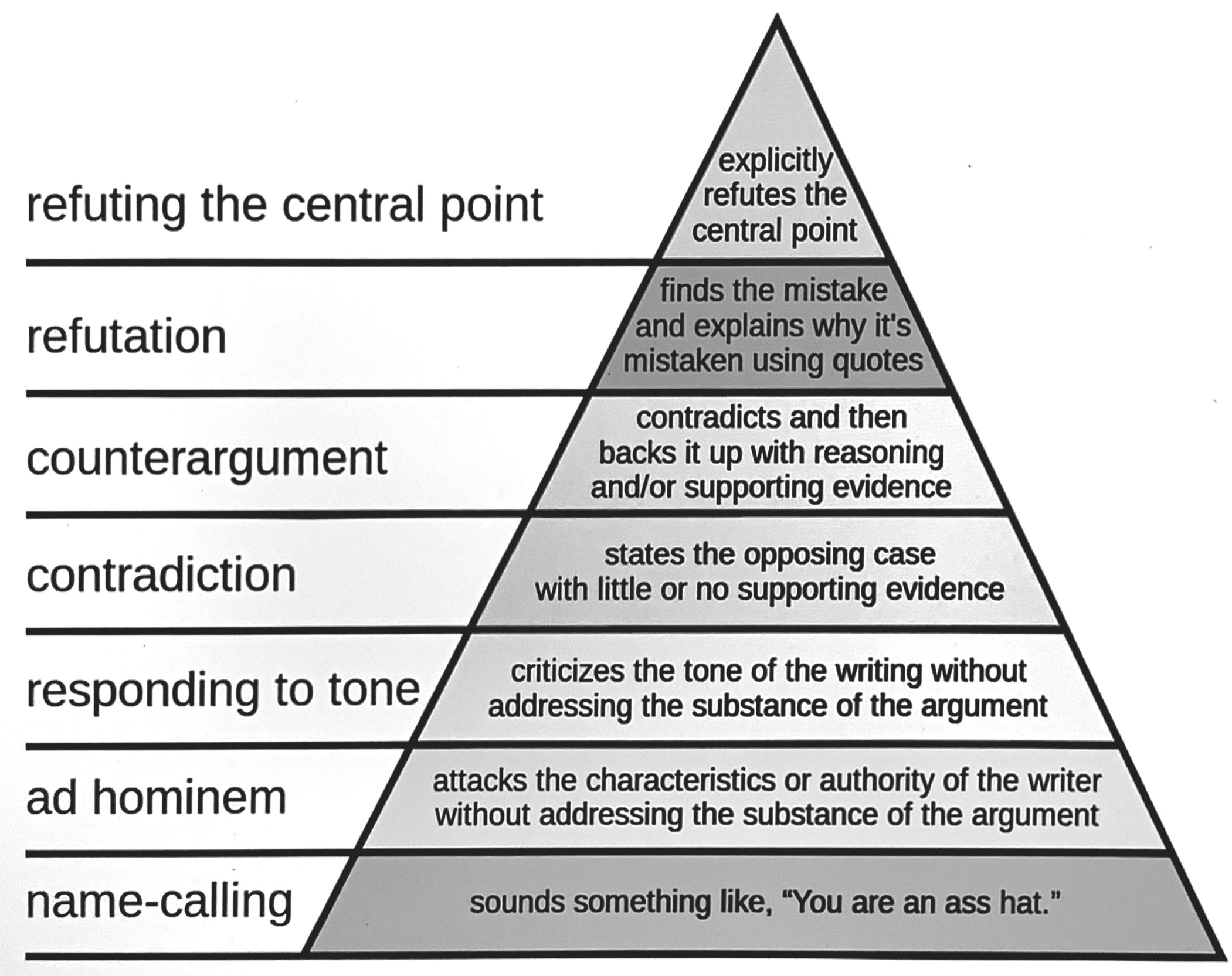
If I could do that session over, I’d start with common ground and fewer data points. Instead of attacking their beliefs with my research, I’d ask them what would open their minds to my data.
A few years later, I had a chance to test that approach. During a keynote speech on creativity, I cited evidence that Beethoven and Mozart didn’t have higher hit rates than some of their peers; they generated a larger volume of work, which gave them more shots at greatness. A member of the audience interrupted. “Bullsh*t!” he shouted. “You’re disrespecting the great masters of music. You’re totally ignorant—you don’t know what you’re talking about!”
Instead of reacting right then, I waited a few minutes until a scheduled break and then made my way to my heckler.
Me: You’re welcome to disagree with the data, but I don’t think that’s a respectful way to express your opinion. It’s not how I was trained to have an intellectual debate. Were you?
Music man: Well, no . . . I just think you’re wrong.
Me: It’s not my opinion—it’s the independent finding of two different social scientists. What evidence would change your mind?
Music man: I don’t believe you can quantify a musician’s greatness, but I’d like to see the research.
When I sent him the study, he responded with an apology. I don’t know if I succeeded in changing his mind, but I had done a better job of opening it.
When someone becomes hostile, if you respond by viewing the argument as a war, you can either attack or retreat. If instead you treat it as a dance, you have another option—you can sidestep. Having a conversation about the conversation shifts attention away from the substance of the disagreement and toward the process for having a dialogue. The more anger and hostility the other person expresses, the more curiosity and interest you show. When someone is losing control, your tranquility is a sign of strength. It takes the wind out of their emotional sails. It’s pretty rare for someone to respond by screaming “SCREAMING IS MY PREFERRED MODE OF COMMUNICATION!”
Commenting on the process was another move that expert negotiators made more often than average negotiators. They were more likely to comment on their feelings about the process and test their understanding of the other side’s feelings: I’m disappointed in the way this discussion has unfolded—are you frustrated with it? I was hoping you’d see this proposal as fair—do I understand correctly that you don’t see any merit in this approach at all? Honestly, I’m a little confused by your reaction to my data—if you don’t value the kind of work I do, why did you hire me?
In a heated argument, you can always stop and ask, “What evidence would change your mind?” If the answer is “nothing,” then there’s no point in continuing the debate. You can lead a horse to water, but you can’t make it think.
When to use it
During a business negotiation when the other party becomes defensive or aggressive.
In a political or ideological debate to de-escalate tension and open dialogue.
When receiving criticism or feedback that feels personal, to redirect toward constructive discussion.
In a team meeting when a colleague dismisses data with personal experience.
FROM THEORY TO EVERYDAY LIFE
In practice
Wall Street Executive Hostility
A consultant presented data-driven recommendations to a leadership team, but an executive argued that paying employees more would solve retention. The consultant fired back with research and statistics, escalating into name-calling. The consultant later realized they should have asked what would open the executive's mind rather than attacking his beliefs.
Keynote Heckler on Beethoven and Mozart
During Grant’s speech on creativity, a heckler accused him of disrespecting great composers. Grant waited for a break, challenged the way the objection was expressed, and asked what evidence would change the man’s mind. The man asked to see the research and apologised after Grant sent it.
A MOMENT TO REFLECT
Put it to work.
In a heated argument, what are some ways to shift the conversation from substance to process?
Think of a recent disagreement where you became hostile. How might asking 'What evidence would change your mind?' have changed the outcome?
How can you maintain tranquility when the other person is losing control, and what effect does that have?
References
- Hierarchy of Disagreement — Paul Graham
CONTINUE THE CONVERSATION
Source texts
- Think Again The Power of Knowing What You Dont Know (Adam Grant)