Dominant Ideas and Crucial Factors
To generate alternative ways of seeing a situation, first state the dominant idea shaping your current view. Naming that frame makes it easier to notice when proposed alternatives still depend on it.
THE IDEA
Dominant ideas and crucial factors 12
There is nothing vague about a geometrical shape. As a situation it is very definite — one knows what one is looking at. Most situations however are much more vague than this. Most of the time one has a vague awareness of the situation and nothing more. With a definite geometrical shape it is easy to think of alternative ways of dividing it up and alternative ways of putting the pieces together again. It is much more difficult to do this if there is only a vague awareness of the situation.
Everyone is confident that they know what they are talking about, reading about or writing about but if you ask them to pick out the dominant idea there is difficulty in doing so. It is difficult to convert a vague awareness into a definite statement. The statement is either too long and complicated or else it leaves out too much. Sometimes the different aspects of the subject do not hang together to give a single theme.
Unless one can convert a vague awareness to a definite pattern it is extremely difficult to generate alternative patterns, alternative ways of looking at the situation. In a defining situation one picks out the dominant idea not in order to be frozen by that idea but in order to be able to generate alternative ideas.
Unless one can pick out the dominant idea one is going to be dominated by it. Whatever way one tries to look at the situation is likely to be dominated by the ever present but undefined dominant idea. One of the main purposes of picking out the dominant idea is to be able to escape from it. One can more easily escape from something definite than from something vague. Liberation from rigid patterns and the generation of alternative patterns are the aims of lateral thinking. Both processes are made much easier if one can pick out the dominant idea.
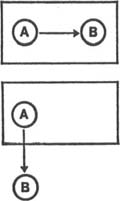
If one cannot pick out the dominant idea then any alternatives one generates are likely to be imprisoned within that vague general idea. The diagram below shows how one may feel that one is generating an alternative point of view and yet this is still within the same framework of the dominant idea as the original point of view. It is only when one becomes aware of the framework that one can generate an alternative point of view outside of it.
The dominant idea resides not in the situation itself but in the way it is looked at. Some people seem much better at picking out the dominant idea. Some people seem much better at crystallizing the situation in a single sentence. This may be because they can separate the main idea from the detail or it may be because they tend to have a simpler view of things. In order to be able to pick out the dominant idea one must make a conscious effort to do so and one needs practice.
When to use it
When tackling a complex problem, start by articulating the dominant idea or assumption to enable creative solution generation.
In conflict resolution, each party can identify their own dominant idea to open up dialogue and mutual understanding.
During product development, identify the dominant design assumption to explore disruptive innovations.
In personal growth, reflect on recurring patterns and name the dominant idea that keeps them in place.
FROM THEORY TO EVERYDAY LIFE
In practice
Business brainstorming session
In a team meeting discussing declining sales, the dominant idea initially is 'we need to cut costs'. By consciously identifying this as the dominant idea, the team can explore alternative solutions like rebranding, targeting a new customer segment, or improving product features, rather than being trapped in cost-cutting.
Personal reflection on a conflict
When stuck in a recurring argument with a partner, the dominant idea might be 'they don't listen to me'. Recognizing this allows one to generate alternative perspectives, such as 'maybe I am not expressing clearly' or 'there is a deeper need being ignored'.
A MOMENT TO REFLECT
Put it to work.
What is the dominant idea in a situation you currently face? How might that idea be limiting your options?
Think of a recent decision you made. What underlying assumption (dominant idea) drove that decision? Could you have chosen differently if you had identified it?
When you try to generate alternatives, do you find that they still fall within the same general framework? What would it take to step outside that framework?
Often confused with
CONTINUE THE CONVERSATION
Source texts
- Lateral Thinking A Textbook of Creativity (Edward de Bono)