Disjunction Fallacy
The disjunction fallacy occurs when people violate the probability rule that a disjunction (or superordinate category) is at least as probable as any of its subsets, often rating the subset as more likely. This bias is explained by the representativeness heuristic, where judgments are based on similarity rather than normative probability.
THE IDEA
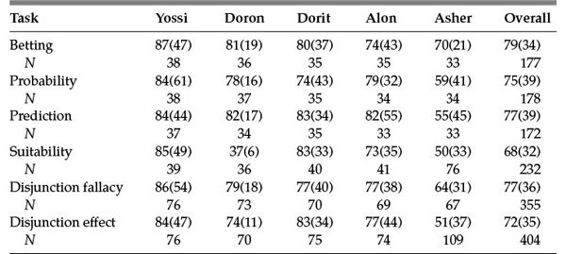
Table 3.4. Disjunction Fallacy Rates for Target (Foil) Pairs in Experiment 2, by Task, and by Combined Tasks
The disjunction fallacy is a cognitive bias in which individuals rate a specific, narrow category as more probable than a broader, more inclusive superordinate category that contains it. This violates the disjunction rule of probability, which requires that the probability of a general category be at least as high as that of any of its subsets. A related phenomenon, the disjunction effect, occurs when people rank a superordinate category higher than its subset even in tasks that do not carry a normative constraint against doing so (such as ranking by suitability or inclination to predict).
In Experiment 2, Tversky and Kahneman deliberately constructed stimuli so that the basic-level category (e.g., tennis as a ball game) was highly representative but its superordinate (e.g., ball games) was not. Spreading the basic category and its superordinate farther apart in terms of typicality was intended to boost the rates of the disjunction fallacy. The study included multiple ranking tasks: probability, willingness-to-bet, prediction, and suitability. The prediction task is of particular interest because, as Yaniv and Foster (1990, 1992) argued, when forecasting an event, people may prefer a more informative specific prediction over a less informative general one, making it normatively defensible to prefer the subset even though it is less probable. In contrast, for probability and betting rankings, the disjunction rule applies, and ranking the subset higher constitutes a fallacy. The suitability task provides a direct test of the representativeness hypothesis: if people rank options by representativeness regardless of the stated criterion, then the pattern of rankings should be highly similar across all four tasks.
The overall rate of the disjunction fallacy in the probability and betting tasks combined was .77, significantly higher than the .64 observed in Study 1 (z = 4.49). This increase is attributed to the wider gap in typicality between the basic categories and their superordinates. For foil categories—where the basic-level category was not particularly representative—the disjunction fallacy rate was .36, consistently below .50 (with only two minor exceptions) and roughly half the rate for target categories (.74). Contrary to the slight task effect seen in Study 1, no systematic difference emerged between the probability and betting versions in Experiment 2; in fact, the betting rates were slightly higher on average (.79 vs. .75, z = 0.90, n.s.).
The prediction task, where a preference for the subset is not necessarily fallacious, did not show a consistently distinct pattern. The disjunction effect rate in the prediction task (.77) was essentially identical to the overall disjunction fallacy rate (.77). When combining the two normatively constrained tasks (probability and betting) and the two unconstrained tasks (prediction and suitability), the fallacy rate (.77) was slightly higher than the effect rate (.72), though not significantly so (z = 1.57). For foils, the fallacy rate in constrained tasks (.36) was nearly identical to the effect rate in unconstrained tasks (.35), and lowest for suitability alone (.32). No clear normative influence of task was evident in the data.
There was, however, a story effect: some vignettes (e.g., Yossi) elicited higher disjunction fallacy rates than others (e.g., Asher), likely reflecting variability in how well the stimuli manipulated representativeness. This aligns with the representativeness hypothesis, which states that people’s probability judgments are driven by similarity, suitability, or typicality. Indeed, the correlation between the disjunction effect rates for suitability and the combined disjunction fallacy rates (probability and betting) was r = .97. When all seven ranked options were considered, the mean rankings by suitability correlated with each of the other criteria at a median of .91 (combined across stories exceeding .96). These correlations, comparable to Tversky and Kahneman’s (1983) .98 correlation between resemblance and probability for the Linda problem, support the interpretation that participants ranked options primarily by representativeness, regardless of the formal criterion.
The representativeness account also explains why the disjunction fallacy is so robust. Basic-level categories tend to share many common features with a target description, so moving to a more specific category when it matches increases perceived similarity, whereas moving to a less matching specific category decreases it. This asymmetry produces higher rankings for representative subsets, even when the superordinate category logically includes them.
To further test the persistence of the fallacy under real stakes, Study 3 introduced monetary incentives. Participants (25 philosophy seniors and 65 economics seniors, each answering two questions) ranked options by their willingness to bet, knowing that after ranking, their top-ranked option would be checked and, if correct, they would win 100 NS (a subset was drawn by lottery to bet for real). In another group of 36 subjects, all correct bets were rewarded 10 NS each, and this group responded only to the most effective stimulus from Study 1. The aim was to determine whether genuine incentives would prompt subjects to rank more normatively, as they now had a tangible reason to choose the option that was genuinely more likely rather than the one that felt most representative. Following Shafir, Smith, and Osherson (1990), the rankings in normatively constrained tasks are considered a disjunction fallacy, while those in unconstrained tasks are a disjunction effect. The results of Study 2 are summarized in Table 3.4, with rows showing rates for each task and for combined task groupings.
When to use it
In medical diagnosis, a doctor might rank a rare but representative disease as more likely than a common syndrome that includes it.
In legal reasoning, jurors may rank a specific scenario (e.g., murder by poisoning) as more probable than the broader category (e.g., homicide) because it matches the evidence more vividly.
In financial forecasting, an analyst might overestimate the probability of a specific market outcome because it seems more representative, ignoring the higher probability of a general trend.
Medical diagnosis: A doctor might overestimate the probability of a disease compared to a specific subtype, leading to incorrect treatment choices.
Investment decisions: An investor might assume a market downturn is more likely than a decline in a specific sector, affecting portfolio allocation.
Everyday reasoning: When evaluating the chances of 'winning a prize' versus 'winning a specific prize' in a lottery, people may commit the disjunction fallacy.
Legal judgments: Jurors might rank 'the defendant is guilty' higher than 'the defendant is guilty of a specific charge,' even when evidence differs.
Legal reasoning: Jurors may misinterpret probabilities of evidence combinations, leading to incorrect verdicts.
Business forecasting: Managers might overestimate the likelihood of a specific scenario (e.g., 'new product success with high marketing spend') over a more general one (e.g., 'new product success').
Medical diagnosis: Doctors could assign higher probability to a rare disease with typical symptoms than to a common disease with the same symptoms, violating probability rules.
Personal finance: Investors might think a specific stock performing well is more likely than the overall market performing well, ignoring base rates.
In investment decisions, an investor might underestimate the probability of a stock price going up or staying flat (disjunction) compared to just going up, leading to underinvestment.
In legal settings, a jury might incorrectly evaluate the probability that a defendant is guilty or that the evidence is flawed (disjunction) as less likely than just guilt, affecting verdicts.
In personal planning, someone might underestimate the chance that it will rain or be cloudy (disjunction) compared to just rain, leading to inadequate preparation.
In policy-making, considering multiple possible outcomes (disjunctions) as less likely than a single outcome can skew risk assessment and prioritization.
FROM THEORY TO EVERYDAY LIFE
In practice
Atypical Subsets
Tennis is an atypical ball game; South Africa is an atypical African country. In experiments, participants ranked 'tennis player' as more likely than 'ball game player' for a description fitting tennis, thus violating the disjunction rule.
Prediction Task Example
When asked 'What amount of money was spent on education by the U.S. federal government in 1987?' (correct: $22.5 billion), 80% of subjects said '$18 to $20 billion' was a better estimate than '$20 to $40 billion,' even though only the latter included the correct answer. Subjects preferred informativeness over probability.
Probability Task Example
In a probability judgment task, participants might rate the likelihood of 'being a musician' as higher than 'being a jazz musician,' even though the subset must have a lower or equal probability. This ranking violates normative probability rules, illustrating the disjunction fallacy.
Willingness-to-Bet Example
When asked to bet on which event is more likely, people may prefer to bet on 'a person being a musician' over 'a person being a jazz musician,' showing the same fallacy when monetary stakes are involved.
Feminist Bank Teller (Adapted from Linda Problem)
People often judge that it is more probable that 'Linda is a feminist and a bank teller' than that 'Linda is a bank teller', violating the conjunction rule. For the disjunction version, they might incorrectly think 'Linda is a bank teller or a feminist' is less probable than 'Linda is a bank teller'.
Experimental Story: Yossi
In the experiments described, the story 'Yossi' consistently elicited high disjunction fallacy rates, suggesting participants ranked the superordinate category as less probable than its subset when using representativeness.
Real Money Bet on Disjunction
Consider a scenario where a person is asked to bet on whether it will rain on a specific day (event A) or whether it will be cloudy (event B). The disjunction 'rain or cloudy' is more likely than either event alone, yet people may fallaciously rank the disjunction as less probable than one component (e.g., 'rain') when betting with real money, even though they should assign higher probability to the disjunction.
Hypothetical vs. Real Incentives
In the study, subjects ranked options like 'Linda is a bank teller' vs. 'Linda is a feminist bank teller'. While the conjunction fallacy often applies, here the disjunction fallacy involves judging 'Linda is a bank teller or a feminist' as less probable than 'Linda is a bank teller', a violation of probability rules. Real money bets may reduce this error compared to hypothetical questions.
A MOMENT TO REFLECT
Put it to work.
Think of a time you predicted a specific event (e.g., a particular stock rising) over a broader category (e.g., the market rising). Could this have been a disjunction fallacy?
How might the preference for informativeness affect your everyday predictions? Can you identify a situation where you valued a specific but less probable estimate over a more probable general one?
In legal or medical diagnosis, why might it be dangerous to rank a specific disease as more likely than a broader category of illnesses?
Think of a recent decision where you considered a broad category more likely than a specific subcategory. How might the disjunction fallacy have influenced your reasoning?
Under what conditions might it be acceptable to treat the disjunction effect as a rational shortcut rather than a fallacy?
How would you design an experiment to distinguish the disjunction fallacy from the disjunction effect in a real-world setting?
Can you recall a time when you judged a broad category (e.g., 'businessperson') as less likely than a specific subset (e.g., 'female businessperson')? What might have caused that?
How does the representativeness heuristic explain why people commit the disjunction fallacy in probability judgments?
What are the practical implications of the disjunction fallacy for decision-making in fields like law or medicine?
Why might someone be more willing to bet on a disjunction than to assign it a higher probability?
How does the introduction of real money affect the likelihood of committing the disjunction fallacy compared to hypothetical scenarios?
Can you think of a real-world decision where the disjunction fallacy could lead to suboptimal outcomes (e.g., in medical diagnosis or legal reasoning)?
Often confused with
References
- Extensional versus intuitive reasoning: The conjunction fallacy in probability judgment — Tversky, A., & Kahneman, D. (1983)
- The informativeness of predictions: The role of graininess and probability — Yaniv, I., & Foster, D. P. (1990)
- The Disjunction Fallacy in Probability Judgments — Shafir, Smith, and Osherson (1990)
CONTINUE THE CONVERSATION
Source texts
- Heuristics and Biases The Psychology of Intuitive Judgment (Thomas Gilovich, Dale Griffin, Daniel Kahneman)
- Heuristics and Biases The Psychology of Intuitive Judgment (Thomas Gilovich, Dale Griffin, Daniel Kahneman)
- Heuristics and Biases The Psychology of Intuitive Judgment (Thomas Gilovich, Dale Griffin, Daniel Kahneman)
- Heuristics and Biases The Psychology of Intuitive Judgment (Thomas Gilovich, Dale Griffin, Daniel Kahneman)