DISC Personality Model (DISA)
Erikson uses DISC, adapted as DISA in his book, to discuss behavioral preferences. Drawing on Marston’s work, the model groups behavior under dominance, inspiration, submission or stability, and compliance or analytic ability. The labels offer a vocabulary for discussing differences rather than a complete account of a person.
THE IDEA
William Moulton Marston
William Moulton Marston created a systolic blood pressure test that was used in an attempt to detect fraud. The discovery resulted in the modern lie detector. But Marston was also the author of essays in popular psychology. In 1928 he published his work Emotions of Normal People, in which he investigated the differences in the behavior patterns of healthy people. Earlier, both Jung and Freud had published studies involving mentally unstable people, but Marston was a kind of pioneer who provided the foundations for what became known as the DISA model, the model Erikson uses in Surrounded by Idiots. A few years after discovering Marston’s work (in the 1950s), Walter Clarke developed the DISA concept based on Marston’s observations. The model categorizes behavioral tendencies. Other practitioners have adapted it since Marston’s work, and it has also attracted criticism.
Marston found a way to demonstrate how people were different. He noted distinct differences between personalities, which formed the basis for the model used in this book. Nowadays we use the following divisions:
• Dominance produces activity in an antagonistic environment.
• Inspiration produces activity in a favorable environment.
• Submission produces passivity in a favorable environment.
• Compliance produces passivity in an antagonistic environment.
The four letters D, I, S, and C (Dominance, Inspiration, Submission, and Compliance) form the acronym of the DISC profile that is used throughout the world. Marston used the word “compliance”; however, in this book I render this as “analytic ability,” as that better describes the type of individuals.
The dominance trait in any given individual relates to how he approaches problems and deals with challenges.
Inspiration refers to a person who likes to influence others. A person with this trait tends to enjoy persuading others. In simple terms, you could say that dominance is about acting, and inspiration is about interacting.
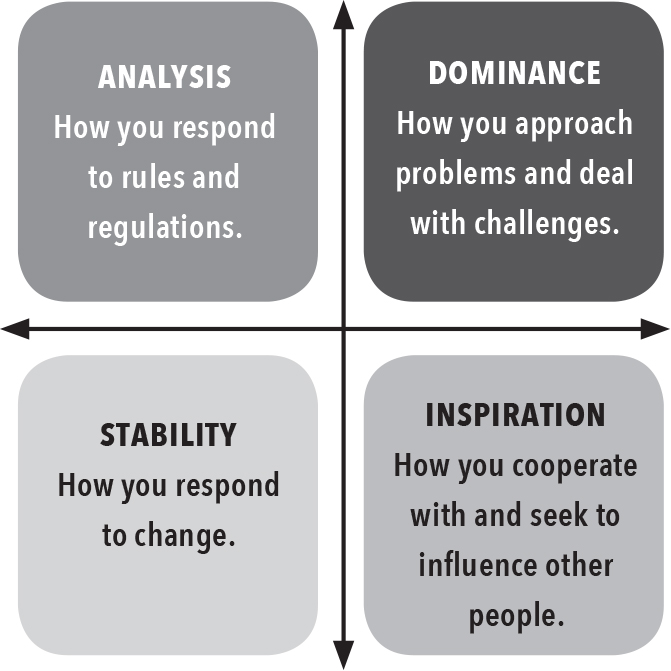
The degree of stability is measured primarily by how receptive an individual is to change. A strong need for stability means a person is resistant to change, while someone who enjoys change will have a lower need for stability. This leads, of course, to a number of specific behavior patterns—like a nostalgic belief in the long-lost “good old days” for instance.
Finally, analytic ability shows how willing someone is to follow rules and regulations. Of course, this also produces certain characteristics that are interrelated. Here we find those who can’t accept that things go wrong. Quality is important.
In Erikson’s presentation, behavioral traits are associated with colors. The colors aren’t critical; it’s only a way to make it easier for those who aren’t familiar with the system to make sense of the profiles. As a consultant, I’ve trained people in this topic for twenty years, and I’ve found that the colors facilitate learning.
Marston finished researching this topic sometime in the 1930s. Many others have used his research and developed a tool that, according to the estimate cited in this book, had been used by nearly 50 million people over thirty-five years. For example, the American Bill Bonnstetter developed assessment tools based on this approach. In the United States, a company TTI Success Insights (ttisuccessinsights.com) offers a comprehensive analysis tool.
But it’s always helpful to remember that though in theory there’s no difference between the concept on the page and the practice, in the real world there’s a big difference indeed.
I’ve described the four main traits that Marston pointed out, but remember that most of us are a combination of two colors.
Interviews in the source book
This excerpt comes from a translation of the fourth Swedish edition of Surrounded by Idiots: How to Understand Those Who Cannot Be Understood. Erikson says about fifteen thousand people read the Swedish edition. At his training courses and lectures, people had often asked him, “Where can we read more about this system?” Those requests prompted him to write the book.
In the interview section linked above, Erikson asks four people with different profiles about the model and their everyday lives. He invites readers to consider how they answer as well as what they say. Those interviews are not included in this excerpt.
When to use it
Team building workshops to improve communication and reduce misunderstandings.
Leadership coaching to help managers tailor their approach to employees' behavioral preferences.
Conflict mediation by identifying underlying behavioral drivers.
Discussing work preferences alongside examples of how someone actually collaborates and handles job responsibilities.
FROM THEORY TO EVERYDAY LIFE
In practice
Applying DISC in a Team Meeting
A team leader notices that one member speaks enthusiastically and tries to persuade others, while another focuses on the agenda and rules. DISC offers labels for discussing these preferences. The leader can ask what each person needs to contribute rather than assuming the label explains all their behavior.
DISC in Conflict Resolution
In a workplace conflict between a Dominance-oriented manager and a Stability-oriented employee, the manager pushes for quick decisions (dominance) while the employee resists change (stability). Recognizing these traits allows them to find a middle ground: the manager sets a clear deadline but allows gradual implementation.
A MOMENT TO REFLECT
Put it to work.
Which of the four DISC traits best describes your own behavior in stressful situations?
Think of a recent disagreement with a colleague. How might understanding their DISC profile have changed your approach?
In what ways can you adapt your communication style to better connect with someone who has a different primary trait?
References
- Emotions of Normal People — William Moulton Marston (1928)
CONTINUE THE CONVERSATION
Source texts
- Surrounded By Idiots (Thomas Erikson)