Deprival Superreaction Tendency
Munger uses deprival superreaction to describe an excessive response to losing something valued—or nearly obtaining it and then missing out. He applies the idea to threatened status, ideological conflict, gambling, auctions, and investment decisions.
THE IDEA
DEPRIVAL-SUPERREACTION TENDENCY
The concept of loss aversion is certainly the most significant contribution of psychology to behavioral economics.
—Daniel Kahneman
The quantity of man’s pleasure from a ten dollar gain does not exactly match the quantity of his displeasure from a ten-dollar loss. That is, the loss seems to hurt much more than the gain seems to help. Moreover, if a man almost gets something he greatly wants and has it jerked away from him at the last moment, he will react much as if he had long owned the reward and had it jerked away. I include the natural human reactions to both kinds of loss experience – the loss of the possessed reward and the loss of the almost-possessed reward – under one description, Deprival Superreaction Tendency.
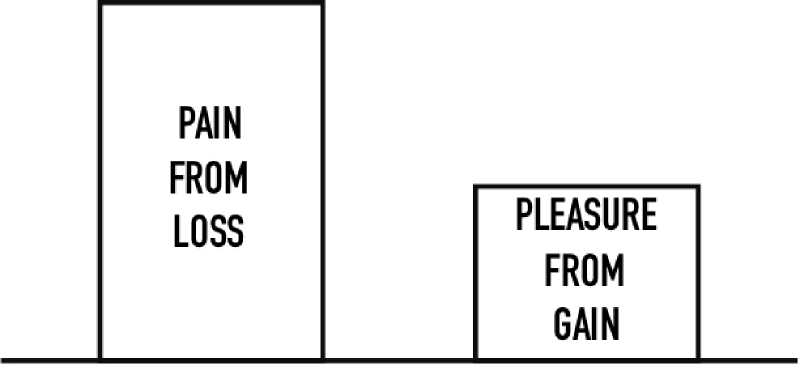
In displaying Deprival Superreaction Tendency, man frequently incurs disadvantage by misframing his problems. He will often compare what is near instead of what really matters. For instance, a man with $10 million in his brokerage account will often be extremely irritated by the accidental loss of $100 out of the $300 in his wallet.
The Mungers once owned a tame and good-natured dog that displayed the canine version of Deprival Super-reaction Tendency. There was only one way to get bitten by this dog. And that was to try and take some food away from him after he already had it in his mouth. If you did that, this friendly dog would automatically bite. He couldn’t help it. Nothing could be more stupid than for the dog to bite his master. But the dog couldn’t help being foolish. He had an automatic Deprival Superreaction Tendency in his nature.
Humans are much the same as this Munger dog. A man ordinarily reacts with irrational intensity to even a small loss, or threatened loss, of property, love, friendship, dominated territory, opportunity, status, or any other valued thing. As a natural result, bureaucratic in-fighting over the threatened loss of dominated territory often causes immense damage to an institution as a whole. This factor among others, accounts for much of the wisdom of Jack Welch’s long fight against bureaucratic ills at General Electric. Few business leaders have ever conducted wiser campaigns.
Deprival Superreaction Tendency often protects ideological or religious views by triggering hostility and hatred directed toward vocal nonbelievers. This happens, in part, because the ideas of the nonbelievers, if they spread, will diminish the influence of views that are now supported by a comfortable environment including a strong belief-maintenance system. University liberal arts departments, law schools, and business organizations all display plenty of such ideology-based groupthink that rejects almost all conflicting inputs. When the vocal critic is a former believer, hostility is often boosted both by:
-
- a concept of betrayal that triggers additional Deprival Superreaction Tendency because a colleague is lost, and
-
- fears that conflicting views will have extra persuasive power when they come from a former colleague.
The foregoing considerations help account for the old idea of heresy, which for centuries justified much killing of heretics, frequently after torture and frequently accomplished by burning the victim alive.
It is almost everywhere the case that extremes of ideology are maintained with great intensity and with great antipathy to non-believers, causing extremes of cognitive dysfunction. This happens, I believe, because two psychological tendencies are usually acting concurrently toward this same sad result: Inconsistency-Avoidance Tendency, plus Deprival Superreaction Tendency.
One antidote to intense, deliberate maintenance of groupthink is an extreme culture of courtesy, kept in place despite ideological differences, like the courtesy I observed among U.S. Supreme Court justices. Another antidote is to deliberately bring in able and articulate disbelievers of incumbent groupthink. Successful corrective measures to evil examples of groupthink maintenance have included actions like that of Derek Bok when, as president of Harvard, he started disapproving tenure appointments proposed by ideologues at Harvard Law School.
Even a one-degree loss from a 180-degree view will sometime create enough Deprival Superreaction Tendency to turn a neighbor into an enemy, as I once observed when I bought a house from one of two neighbors locked into hatred by a tiny tree newly installed by one of them.
As the case of these two neighbors illustrated, the clamor of almost any group of neighbors displaying irrational, extreme deprival superreaction over some trifle in a zoning hearing is not a pretty thing to watch. Such bad behavior drives some people from the zoning field. I once bought some golf clubs from an artisan who was formerly a lawyer. When I asked him what kind of law he had practiced, I expected to hear him say, “divorce law” But his answer was, “zoning law.”
Deprival Superreaction Tendency has ghastly effects in labor relations. Most of the deaths in the labor strife that occurred before World War I came when employers tried to reduce wages. Nowadays, we see fewer deaths and more occasions when whole companies disappear, as competition requires either takeaways from labor – which it will not consent to – or death of the business. Deprival Superreaction Tendency causes much of this labor resistance, often in cases where it would be in labor’s interest to make a different decision.
In contexts other than labor relations, takeaways are also difficult to get. Many tragedies, therefore, occur that would have been avoided had there been more rationality and less subconscious heed of the imperative from Deprival Superreaction Tendency.
Deprival Superreaction Tendency and Inconsistency-Avoidance Tendency often join to cause one form of business failure. In this form of ruin, a man gradually uses up all his good assets in a fruitless attempt to rescue a big venture going bad. One of the best antidotes to this folly is good poker skill learned young. The teaching value of poker demonstrates that not all effective teaching occurs on a standard academic path.
Deprival Superreaction Tendency is also a huge contributor to ruin from compulsion to gamble. First, it causes the gambler to have a passion to get even once he has suffered loss, and the passion grows with the loss. Second, the most addictive forms of gambling provide a lot of near misses and each one triggers Deprival Superreaction Tendency. Some slot machine creators are vicious in exploiting this weakness of man. Electronic machines enable these creators to produce a lot of meaningless bar-bar-lemon results that greatly increase play by fools who think they have very nearly won large rewards.
Deprival Superreaction Tendency often does much damage to man in open-outcry auctions. “social proof” tends to convince man that the last price from another bidder was reasonable, and then Deprival Superreaction Tendency prompts him strongly to top the last bid. The best antidote to being thus triggered into paying foolish prices at open-outcry auctions is the simple Buffett practice: Don’t go to such auctions.
I myself, the would-be instructor here, many decades ago made a big mistake caused in part by subconscious operation of my Deprival Superreaction Tendency. A friendly broker called and offered me 300 shares of ridiculously underpriced, very thinly traded Belridge Oil at $115 per share, which I purchased using cash I had on hand. The next day, he offered me 1,500 more shares at the same price, which I declined to buy, partly because I could only have made the purchase had I sold something or borrowed the required $173,000. This was a very irrational decision. I was a well-to-do man with no debt; there was no risk of loss; and similar no risk opportunities were not likely to come along. Within two years, Belridge Oil sold out to Shell at a price of about $3,700 per share, which made me about $5.4 million poorer than I would have been had I then been psychologically acute. As this tale demonstrates, psychological ignorance can be very expensive.
Some people may question my defining Deprival Superreaction Tendency to include reaction to profit barely missed, as in the well-documented responses of slot machine players. However, I believe that I haven’t defined the tendency as broadly as I should. My reason for suggesting an even broader definition is that many Berkshire Hathaway shareholders I know never sell or give away a single share after immense gains in market value have occurred. Some of this reaction is caused by rational calculation, and some is, no doubt, attributable to some combination of (1) reward superresponse, (2) “status quo bias” from Inconsistency-Avoidance Tendency, and (3) “the endowment effect” from Excessive Self-Regard Tendency. But I believe the single strongest irrational explanation is a form of Deprival Superreaction Tendency. Many of these shareholders simply can’t stand the idea of having their Berkshire Hathaway holdings smaller. Partly they dislike facing what they consider an impairment of identity, but mostly they fear missing out on future gains from stock sold or given away.
When to use it
When making organizational changes, identify which responsibilities, status, or benefits people may lose. Explain the trade-offs and invite questions about the proposed change.
Before committing more money to a losing investment, reassess its future prospects and the alternatives. Record what would justify continuing or leaving it.
Auction strategy: A bidder decides to avoid live auctions entirely or sets a strict maximum price in advance, counteracting the impulse to overpay triggered by social proof and loss aversion.
In labor negotiations, make the costs of proposed wage or benefit changes explicit and examine the alternatives with the people affected.
FROM THEORY TO EVERYDAY LIFE
In practice
Canine Deprival Superreaction
The Mungers’ tame, friendly dog would automatically bite anyone, including its master, who tried to take food from its mouth, showing how deeply ingrained the response to loss of a possessed item can be.
Misframing of Near Losses
A man with $10 million in his brokerage account becomes extremely irritated by the accidental loss of $100 from his wallet, comparing what is near instead of what truly matters.
Religious and Ideological Hostility
Munger argues that a threatened loss of influence can intensify hostility toward nonbelievers, especially former members of a group. He connects this with inconsistency avoidance in his discussion of heresy and ideological groupthink.
Labor Resistance to Wage Cuts
Munger argues that resistance to wage cuts can contribute to a company’s failure even when accepting a cut might preserve jobs. Whether that applies to a particular dispute depends on the company’s prospects and the alternatives available to workers.
Gambling Near-Misses
Slot machines exploit Deprival Superreaction by frequently showing near-miss outcomes (like bar-bar-lemon), which trigger the same intense reaction as actual losses, leading gamblers to play more aggressively to recover losses.
Auction Bidding Wars
At open-outcry auctions, social proof and Deprival Superreaction push bidders to top the last bid, often leading to overpaying. Warren Buffett’s antidote: simply don’t attend such auctions.
Munger’s Costly Miss
Munger attributes part of his decision not to buy more Belridge Oil shares to reluctance to sell assets or borrow. He later calculated the gains he would have made if he had bought them; the loss in his account is a missed opportunity.
A MOMENT TO REFLECT
Put it to work.
Think of a recent decision where you held onto a losing investment, relationship, or belief longer than you should have. How did fear of loss influence you?
How might you design a personal 'circuit breaker' to pause before reacting to a perceived loss or near-miss?
In what situations might recognizing this tendency in others help you negotiate better outcomes or de-escalate conflicts?
CONTINUE THE CONVERSATION
Source texts
- Wisdom Theory 100 Mental Models (2020) (Wisdom Theory)