Delphi Approximations
The Delphi method gathers expert estimates through repeated questionnaires and anonymous feedback. Participants can revise their views after seeing others’ reasons. The process seeks a considered group estimate; convergence alone does not establish accuracy.
THE IDEA
Delphi Approximations
Delphi[4] method is a systematic, interactive forecasting technique which relies on a panel of independent experts, originally developed at the beginning of the cold war to forecast the impact of technology on warfare. The method was conceived as a solution to the problem of developing credible estimates without the benefit of empirical evidence, in response to which Douglas Aircraft Company started Project RAND (R esearch AN d D evelopment, now an independent nonprofit think tank) to study ‘the broad subject of inter-continental warfare other than surface’. Finalized as a methodology by the late 1950s, Delphi method is based on the principle that forecasts from a structured group of experts are more accurate than those from unstructured groups or individuals; since its inception, the method has been adapted to a variety of business applications, including new product design and marketing.
It works as follows: The carefully selected experts answer questionnaires in two or more rounds. After each round, a facilitator provides an anonymous summary of the experts’ forecasts from the previous round as well as the reasons they provided for their judgments, and participants are encouraged to revise their earlier answers in light of the replies of other members of the group. During that process, which is iterative, the range of answers tends to decrease, and the group begins to converge toward a singular answer. Finally, the process is stopped after a predefined stop criterion, such as the number of rounds or the achievement of consensus or the stability of results, and the mean or median scores of the final round determine the outcomes.
The method uses successive approximations: participants revise estimates as they consider additional information and competing reasons. Within the 3E framework, the resulting estimates are called Delphi approximations, as summarized in [Figure 9.2]. This process can expose weaknesses in an estimate, but agreement among experts does not independently validate it.
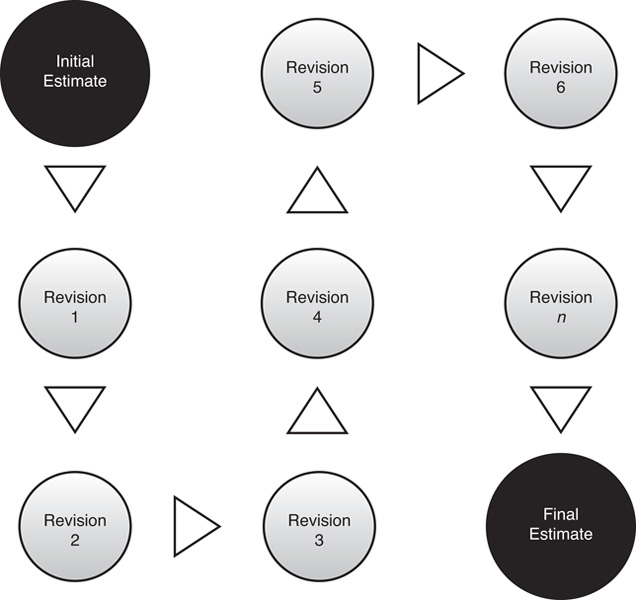
[FIGURE 9.2 Delphi Approximations.]
The author also assesses similarity among experts’ initial estimates, calling it inter-expert reliability (IER). One proposed approach correlates experts’ responses across items. Similar initial responses indicate agreement, though correlation alone does not show that the estimates are accurate or equal in level. The referenced Appendix B provides the author’s additional criteria.
When to use it
Forecasting the impact of a disruptive technology on an industry
Reaching consensus among executives on strategic priorities for the next five years
Developing a roadmap for research and development investments under uncertainty
Evaluating and ranking risks in a complex project with multiple stakeholders
FROM THEORY TO EVERYDAY LIFE
In practice
New Product Forecasting
A technology company uses the Delphi method to forecast adoption rates for a new product. A panel of industry experts, marketers, and engineers is assembled. Over multiple rounds, they provide estimates and feedback, revising their estimates after considering one another’s reasons. The company can later compare the group forecast with actual adoption.
Research Priority Setting
A research institute wants to identify the most critical areas for future study. They use the Delphi method with a panel of scientists who anonymously suggest topics and rank them. The iterative process helps prioritize research directions with high agreement.
A MOMENT TO REFLECT
Put it to work.
How might you apply the Delphi method to improve decision-making in a team setting where opinions initially diverge?
What are the potential drawbacks of relying on expert consensus, and how could you mitigate them?
In what situations would a structured iterative approach like Delphi be more beneficial than a simple group discussion or a single expert opinion?
CONTINUE THE CONVERSATION
Source texts
- Evidence-Based Decision-Making How to Leverage Available Data and Avoid Cognitive Biases (Andrew D. Banasiewicz)