Delay in judgement
Delay in judgement is a lateral thinking technique that involves suspending criticism or evaluation of ideas at various stages, allowing ideas to survive, develop, and potentially lead to solutions that would otherwise be rejected.
THE IDEA
Delay in judgement
The technique considered here is the delaying of judgement instead of applying it immediately. In practice judgement may be applied at any of the following stages:
 Judgement as to whether an information area is relevant to the matter under consideration. This precedes the development of any ideas.
Judgement as to the validity of an idea in one’s own internal thinking process. Dismissing such an idea instead of exploring it.
Judgement as to its correctness before offering an idea to others.
Judgement of an idea offered by someone else — either in refusing to accept it or in actual condemnation of it.
In this regard judgement, evaluation and criticism are regarded as similar processes. Suspending judgement means postponing evaluation, whether favourable or unfavourable.
The suspension of judgement can have the following effects:
An idea will survive longer and will breed further ideas.
Other people will offer ideas which their own judgement would have rejected. Such ideas may be extremely useful to those receiving them.
The ideas of others can be accepted for their stimulating effect instead of being rejected.
Ideas which are judged to be wrong within the current frame of reference may survive long enough to show that the frame of reference needs altering.
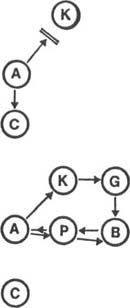
In the diagram below A is the starting point of a problem. In tackling the problem one moves towards K but this idea is unsound and so it is rejected. Instead one moves towards C. But from C one can go nowhere. Had one moved towards K then one could have proceeded from there to G and from G to B which is the solution. Once one had reached B then one would have been able to see the correct path from A through P.
When to use it
During a creative brainstorming session, delay judgment to allow all ideas to be considered and built upon.
When evaluating a new business strategy, suspend initial criticism to explore the potential of unconventional approaches.
In a team discussion, encourage members to offer ideas without fear of immediate rejection, fostering a more innovative atmosphere.
When analyzing a complex problem, postpone evaluation of partial solutions to allow for more diverse pathways to emerge.
FROM THEORY TO EVERYDAY LIFE
In practice
Example from the diagram
In the diagram, A is the starting point of a problem. One moves towards K but sees it as unsound and rejects it, moving to C instead. From C no progress is made. If judgment had been delayed on K, one would have moved to G then to B, the solution, revealing the correct path from A through P.
Brainstorming session
In a team brainstorming session, a participant suggests a seemingly impractical idea. Instead of immediately dismissing it, the team delays judgment and explores it further. This leads to a novel and effective solution that would have been missed otherwise.
A MOMENT TO REFLECT
Put it to work.
Think of a recent problem you solved. Were there any ideas you rejected early that might have been valuable if explored further?
How can you create an environment where delaying judgment is encouraged during group discussions?
What are the potential downsides of delaying judgment, and how can you balance them with the benefits?
CONTINUE THE CONVERSATION
Source texts
- Lateral Thinking A Textbook of Creativity (Edward de Bono)