Crucial Factor
A crucial factor is an element of a situation that must always be included, acting as a tethering point that restricts how a problem is viewed. Isolating and challenging the necessity of such factors can free up new ways of structuring the situation and enable lateral thinking.
THE IDEA
Crucial factor
A dominant idea is the organizing theme in a way of looking at a situation. It is often present but undefined and one tries to define it in order to escape from it. A crucial factor is some element of the situation which must always be included no matter how one looks at the situation. The crucial factor is a tethering point. Like a dominant idea a crucial factor can immobilize a situation and make it impossible to shift a point of view. Like a dominant idea a crucial factor may exert a powerful influence without ever being consciously recognized.
The difference between a dominant idea and a crucial factor is shown diagrammatically below. The dominant idea organizes the situation. The crucial factor tethers it and though some mobility is allowed this is restricted.
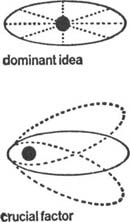
The purpose of isolating crucial factors is to examine them. Very often a crucial factor is an assumption — at least the ‘crucial’ nature of that factor is an assumption. Once the factor is isolated one challenges the necessity for it. If the factor is found not to be crucial then the tethering effect of that factor disappears and there is more freedom in structuring the situation in a different way. In the design of a machine for picking apples a crucial factor may have been ‘that the apples must not be damaged’ or ‘that only ripe apples were to be picked’. The necessity to include such crucial factors would restrict the way the problem could be looked at. For instance shaking the tree would not be a good idea.
There may be one crucial factor, several crucial factors or none at all. Different people may choose different crucial factors. As with finding the dominant idea what matters is that one identifies what seems to be a crucial factor in one’s own view of the problem. Whether it really is crucial or whether other people would think so does not matter for one picks it out only to challenge its necessity.
In looking for the dominant idea one wants to know, ‘why are we always looking at this thing in the same way?’ In looking for the crucial factor one wants to know, ‘what is holding us up, what is keeping us to this old approach?’
In itself the search for dominant ideas or crucial factors is not a lateral thinking process at all. It is a necessary step which allows one to use lateral thinking more effectively. It is difficult to restructure a pattern unless one can see the pattern. It is difficult to loosen up a pattern unless one can identify the rigid points.
When to use it
When designing a new product or system, list potential crucial factors (e.g., cost, safety, user preference) and test whether each is truly necessary.
In business strategy, challenge assumptions about market boundaries or customer requirements to discover new opportunities.
In personal decision-making, identify a crucial factor (e.g., fear of failure, need for approval) and explore what happens if you remove it.
In team problem-solving, have each member propose a crucial factor and debate its necessity to break out of groupthink.
FROM THEORY TO EVERYDAY LIFE
In practice
Apple Picking Machine Design
When designing a machine to pick apples, possible crucial factors might be 'apples must not be damaged' or 'only ripe apples should be picked'. These factors restrict approaches such as shaking the tree, which could damage fruit or dislodge unripe apples. By challenging the necessity of these factors, one might design a machine that gently shakes the tree and sorts apples by ripeness later, opening new solutions.
Hiring Process Assumption
In hiring, a crucial factor might be 'candidate must have a specific degree'. Challenging this assumption could allow considering candidates with equivalent experience or alternative qualifications, broadening the talent pool and potentially finding better fits.
A MOMENT TO REFLECT
Put it to work.
What is a crucial factor in a current problem you are facing that you are assuming must be included?
How would challenging the necessity of that factor change your approach to the problem?
Can you identify a dominant idea that is organizing your view of a situation, and how does it differ from a crucial factor?
Often confused with
CONTINUE THE CONVERSATION
Source texts
- Lateral Thinking A Textbook of Creativity (Edward de Bono)