Cranes and Skyhooks
Daniel Dennett uses cranes and skyhooks to distinguish ways of explaining complex design. A crane builds on existing processes and can make further development faster or more powerful. A skyhook invokes a mind or power whose own origins remain outside that explanation. Human invention can count as a crane when the inventor and the tools can themselves be explained through natural and cultural development.
THE IDEA
38. CRANES AND SKYHOOKS, LIFTING IN DESIGN SPACE
Life is amazing. When you think of the billions of solar systems that are almost certainly entirely lifeless, it is amazing that there is any way of being alive at all. And it is amazing to reflect on the variety of different ways of being alive, from bacteria to fish, birds, daisies, whales, snakes, maples, and people. Perhaps most amazing of all is the tenacity of living things, the thousands of ways they have of clinging to life and reproducing, eking out a living against formidable obstacles, thanks to millions of ingenious devices and arrangements, from the convoluted cascades of protein machinery within every cell, to echolocation in bats, to the elephant’s trunk, to the capacity of our brains to reflect on every topic “under the sun” and many others as well. All that magnificent adjustment of means to ends requires an explanation, since it cannot be pure chance or happenstance. There are only two known possibilities: Intelligent Design or evolution by natural selection. In either case there is a tremendous amount of design work to be done, either miraculously by an Intelligent Designer or ploddingly, unforesightedly, stupidly—but non-miraculously—by natural selection. Call the design work R & D (the standard abbreviation in industry for research and development), and recognize that R & D is always costly. It takes time and energy. The beauty of Darwin’s great idea is that he saw how, given billions of years in which to work, and a prodigious amount of “waste” motion (zillions of trials ending in errors), design improvements could non-miraculously accumulate, automatically, without intention or foresight or understanding. Robert Beverley MacKenzie, one of Darwin’s most ardent critics, put it eloquently:
In the theory with which we have to deal, Absolute Ignorance is the artificer; so that we may enunciate as the fundamental principle of the whole system, that, IN ORDER TO MAKE A PERFECT AND BEAUTIFUL MACHINE, IT IS NOT REQUISITE TO KNOW HOW TO MAKE IT. This proposition will be found, on careful examination, to express, in condensed form, the essential purport of the Theory, and to express in a few words all Mr. Darwin’s meaning; who, by a strange inversion of reasoning, seems to think Absolute Ignorance fully qualified to take the place of Absolute Wisdom in all the achievements of creative skill. [1868]
Exactly. And ever since Darwin proposed this amazing idea, skeptics have wondered whether there was enough time to do all that creative work the plodding way. A convenient way to imagine the design work that needs to have been done is to think of it as lifting in Design Space. What is Design Space? Like the Library of Babel and the Library of Mendel, it can best be conceived as a multidimensional space. In fact Design Space contains both of those libraries and more, because it includes not only all the (designed, authored) books and the (designed, evolved) organisms, but all other things that are well described by the design stance (see chapter 18), such as houses, mousetraps, battleaxes, computers, and spaceships. And just as most of the Library of Babel is gibberish, most of the places in Design Space are filled with junk, things that can’t do anything well at all. If you are like me, you can imagine just three dimensions at a time, but the more you play around with the idea in your imagination, the easier it gets to think of the familiar three dimensions as standing in for many. (This is a thinking tool that improves with practice.)
When we imagine placing the Tree of Life in the Library of Mendel, we can see how all the living things that have ever actually existed on this planet are connected to each other by lines of descent. Those lineages transmit the basic design improvements “discovered” by natural selection, preserving the earliest R & D for use in all subsequent living things. (The “machinery” inside every cell, from bacteria to brain cells, includes thousands of brilliantly designed nano-devices that have been cranking away for over three billion years, the basic engine room of life that we share with trees and birds and yeast cells.) At the multi-cell level we find hearts, lungs, eyes, arms, legs, and wings, reusing and improving on designs that were first developed “only” two billion years ago. But in addition to the parts of organisms, there are the artifacts of organisms: spider webs and bird nests and beaver dams, for example. These also show unmistakable evidence of R & D, and the fruits of that R & D have to have been transmitted somehow along the same lineage lines—either in the genes or by offspring copying their parents. Every now and then a novelty arises—by mutation or experimentation or accident—that is an improvement, and it gets copied and copied and copied. Failed experiments go extinct. Again, publish or perish.
Then there are the human artifacts, the plows and bridges and cathedrals, the paintings, plays, poems, and printing presses, the airplanes and computers and lawnmowers, and . . . the thinking tools. What about them? Do they not hang off the branches of one part of the Tree of Life—the human lineage? Each of them depends on at least one author or inventor, and most depend on uncounted thousands or millions of contributors to the R & D that lies behind them. Beethoven didn’t have to invent the symphony, which was already there for him to adapt, and Shakespeare didn’t have to invent the sonnet. A chainsaw is composed of dozens or hundreds of “off the shelf” elements, already invented, already optimized. Some of our human artifacts are probably copied from the artifacts of other animals. Did the weaverbird’s nest inspire the invention of weaving cloth? Was the raised snow shelf on the floor of an Inuit igloo, which permits the cold air to drain out the lower entryway, copied from the similar raised floor in polar bear dens, or are these independent inventions (or did polar bears copy from the Inuit)?
The deep similarities of function between hearts and pumps, bat echolocation and sonar and radar, beaver dams and irrigation dams, eyes and cameras are no accident; similar processes of exploration—of R & D—have shaped and honed and improved them over the centuries. Put them all in a common space: Design Space, the space of all possible designs.
This move is contentious among biologists, for reasons I think I understand, and deplore. Many biologists are extremely reluctant to talk about “design” in living things, because they think it gives aid and comfort to the Intelligent Design movement, that disingenuous, pseudo-scientific, crypto-religious campaign to undermine the richly deserved authority of evolutionary biology. (Among these resisters are two of my most esteemed colleagues and friends, evolutionary biologists Richard Dawkins and Jerry Coyne.) By speaking of purpose and design in nature, we (apparently) give the Intelligent Design gang half their case; it is better, some think, to maintain a stern embargo on such themes and insist that strictly speaking nothing in the biosphere is designed unless it is designed by human artificers. Nature’s way of generating complex systems (organs, behaviors) is so unlike an artificer’s way, they think, that we should not use the same language to describe them. Thus Richard Dawkins speaks (on occasion—e.g., 1996, p. 4) of designoid features of organisms, and in The Ancestor’s Tale (2004, p. 457), he says, “The illusion of design conjured by Darwinian natural selection is so breathtakingly powerful.” I disagree with this policy of austerity, which can backfire badly. I recently overheard a conversation among some young people in a bar about the marvels of the nano-machinery discovered inside all cells. “When you see all those fantastic little robots working away, how can you possibly believe in evolution!” one exclaimed, and another nodded wisely. Somehow these folks had gotten the impression that evolutionary biologists thought that life wasn’t all that complex, wasn’t made of components that were all that wonderful. These evolution-doubters were not rednecks; they were Harvard Medical students! They hugely underestimated the power of natural selection because evolutionary biologists had told them, again and again, that there is no actual design in nature, only the appearance of design. This episode strongly suggested to me that “common knowledge” is beginning to incorporate the mistaken idea that evolutionary biologists are reluctant to “admit” or “acknowledge” all the obvious design in nature.
Consider in this regard Christoph Schönborn, Catholic archbishop of Vienna, the chap duped by the Intelligent Design folks. He wrote, notoriously, in a New York Times op-ed piece entitled “Finding Design in Nature,”
The Catholic Church, while leaving to science many details about the history of life on earth, proclaims that by the light of reason the human intellect can readily and clearly discern purpose and design in the natural world, including the world of living things. Evolution in the sense of common ancestry might be true, but evolution in the neo-Darwinian sense—an unguided, unplanned process of random variation and natural selection—is not. Any system of thought that denies or seeks to explain away the overwhelming evidence for design in biology is ideology, not science.
Which campaign do we evolutionists want to lead? Do we want to try to convince laypeople that they don’t really see the design that is stunningly obvious at every scale in biology, or would we rather try to show that, wonderful to say, what Darwin has shown is that there can be design—real design, as real as it gets—without an Intelligent Designer? We have persuaded the world that the earth goes around the sun and that time is relative, not absolute. Why shrink from the pedagogical task of showing that there can be design without a designer? So I am defending here (once again, with new emphasis) the following claim:
The biosphere is utterly saturated with design, with purpose, with reasons. What I call the design stance predicts and explains features throughout the living world using the same assumptions that work so well when we are reverse engineering artifacts made by (somewhat) intelligent human designers. Evolution by natural selection is a set of processes that “find” and “track” reasons for things to be arranged one way rather than another. The chief difference between the reasons found by evolution and the reasons found by human designers is that the latter are typically (but not always) represented in the minds of the designers, whereas the reasons uncovered by natural selection are typically represented for the first time by the human investigators who succeed in reverse engineering nature’s productions. That is to say, human designers think about the reasons for the features of their artifacts, and hence have ideas that represent the reasons. They typically notice, appreciate, formulate, refine, and then convey, discuss, criticize the reasons for their designs. Evolution doesn’t do any of this; it just sifts mindlessly through the variation it generates, and the good stuff (which is good for reasons, reasons undreamed of or unrepresented by the process of natural selection) gets copied.
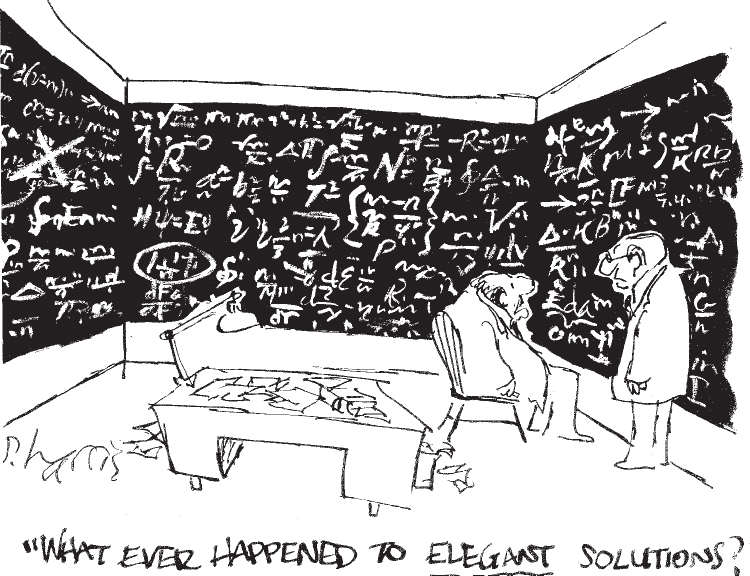
There could be a good use for the term designoid to mark merely apparent design, but it is not in biology. When I think of the mere appearance of design, I think of how cartoonists set the stage for cartoons about scientists by showing some bearded eggheads standing in front of a blackboard covered with (actually nonsensical) symbols, or in a chemistry lab stocked with an impressive-looking forest of tubes and beakers, or by showing us the mad inventor working on his time machine, bristling with dials and antennas and hi-tech gizmos. These things couldn’t actually do any work; they only appear to be functional. But the designs of nature are truly effective. In fact, they are often demonstrably much more efficient and powerful than any human-designed counterpart yet invented.
An example of a designoid inscription:
A healthy young man can walk, carrying all the food and water he needs to survive, for about a week, stopping and resting whenever he chooses, traveling perhaps 150 miles. (Water is the key burden: carrying fifty pounds of water and sixteen pounds of food and ten pounds of gear makes a very heavy pack; if he could find water on the way, he could go for months.) For a comparison from the period in which I wrote this chapter, consider the brainchild of Cornell University roboticist Andy Ruina and his colleagues. Their robot Ranger set a walking-distance record when it traveled nonstop 65.2 kilometers (40.5 miles) in a robot ultra-marathon in Japan on May 1–2, 2011. Ranger’s designers take advantage of the dynamical properties of limbs to create a superbly energy-efficient walker (around and around on a flat track for hours on end, guided by a human being with a joystick). Another magnificent four-legged walker robot of that period, Big Dog, was about fifteen times less energy-efficient, but had much more impressive capacities to accommodate difficult terrain. In this comparison, humans were more efficient transport devices than Ranger by a factor of four or five, and unlike Ranger, could respond autonomously to all manner of features in the world. (See Ruina, 2011.)
Something has to give. Either we define “design” as the product of an intelligent designer, such as a designer of poems or cars, for instance, or we acknowledge that there can be design—genuine design—without an intelligent designer. Tradition and etymology might seem to favor the former course, but consider this: atom— from the Greek a [without] + tomos, from temnein, to cut or slice. Atom originally meant “unsplittable thing,” but science discovered that splitting the atom, after all, was not a contradiction in terms. Science has also discovered, I submit, that design without a designer (lacking a designer with a mind, with foresight and intention) is not only possible but all around us. Design-by-evolution is a real, well-understood process. It differs in interesting ways from design-by-engineer, but it is also deeply similar, capable of humbling “ingenuity.” Time and again, biologists baffled by some apparently futile or maladroit bit of bad design in nature have eventually come to see that they have underestimated the sheer brilliance in one of Mother Nature’s creations. Francis Crick mischievously baptized this trend in the name of a colleague, Leslie Orgel, speaking of what he called Orgel’s Second Law: “evolution is cleverer than you are.” (This apparently reckless tactic of personifying the process of natural selection as Mother Nature, this in-your-face anthropomorphizing, will be defended in due course. It is not just an entertaining metaphor; it is a thinking tool in its own right.)
Back to Design Space, the multidimensional space of all possible designs, including not just the actual organisms and automobiles and poems, but—like the books in the Library of Babel—all the never-evolved, never-constructed designs: the talking kangaroos and flying snakes, nuclear-powered popcorn poppers and underwater roller-skates. What should our alphabet of basic design elements be? Since we aren’t going to try to make Design Space, but just think about it, we might as well be profligate: let’s say, all possible configurations of atoms, drawn from the periodic table of elements. (This Vast space will include atom-for-atom duplicates of all the undesigned things as well, such as every pebble on every beach, and Mt. Everest, but that is as it should be since there is nothing to prevent somebody from deciding to design and build replicas of these entities.) Where will Brahms’s Third Symphony be in Design Space? Well, the score (in spots of ink on paper, etc.) will be in kazillions of places, and tape recordings and vinyl stereo records will be in others, so it will be in Design Space for sure. A song that was never written down or recorded but rather preserved and transmitted in an oral tradition will be harder to tie down to families of atoms, but a suitably convoluted subsection of Design Space over time will house it well enough. Just as the Library of Babel is filled mainly with junk, unreadable books of nonsense, Design Space is filled mainly with nonsensical stuff of no interest or function or competence at all, but here and there, Vanishingly thin threads of actual and possible design shine through; things that can do things aside from just waiting around to crumble under the inexorable edict of the second law of thermodynamics.
With just this roughed-out idea of Design Space in our heads, we can now see “at a glance” how to frame a series of questions that have haunted debate about evolution ever since Darwin’s time: Are there any actual designs, natural or artificial, that are not ultimately derived from that single Tree of Life, either directly or indirectly?
Here are some answers to consider:
-
No.
-
Yes, some marvels of nature are just too wonderful, too “irreducibly complex,” to have been arrived at by the plodding uphill process of design-by-evolution. They must have been independently created by an Intelligent Designer.
-
Yes, some human artifacts, such as the plays of Shakespeare and Gödel’s theorem, are too wonderful to be “mere” products of evolved human brains; they are works of miraculous genius and are inexplicable by—unreachable by—the plodding uphill process of design-by-evolution.
We can characterize answers (2) and (3) as relying heavily on the contrast between the utterly inefficient, plodding process of natural selection (“Absolute Ignorance,” as MacKenzie called it), and the swift, apparently effortless brilliance of Mozart (or any other “Godlike” genius you choose). (Chapter 49 explores this.) Using our analogy between lifting and R & D, we can say that they each proclaim the need for a skyhook.
skyhook, orig. Aeronaut. An imaginary contrivance for attachment to the sky; an imaginary means of suspension in the sky. [Oxford English Dictionary]
The first use noted by the Oxford English Dictionary is dated 1915: “an aeroplane pilot commanded to remain in place (aloft) for another hour, replies ‘the machine is not fitted with skyhooks’.” The skyhook concept is perhaps a descendant of the deus ex machina of ancient Greek dramaturgy: when second-rate playwrights found their plots leading their heroes into inescapable difficulties, they were often tempted to crank down a god onto the scene, like Superman, to save the situation supernaturally. Or skyhooks may be an entirely independent creation of convergent folkloric evolution. Skyhooks would be wonderful things to have, great for lifting unwieldy objects out of difficult circumstances, and speeding up all sorts of construction projects. Sad to say, they are impossible.1
There are cranes, however. Cranes can do the lifting work our imaginary skyhooks might do, and they do it in an honest, non-question-begging fashion. They are expensive though. They have to be designed and built, from everyday parts already on hand, and they have to be located on a firm base of existing ground. Skyhooks are miraculous lifters, unsupported and insupportable. Cranes are no less excellent as lifters, and they have the advantage of being real. Anyone who, like me, is a lifelong onlooker at construction sites will have noticed with some satisfaction that it sometimes takes a small crane to set up a big crane. And it must have occurred to many other onlookers that in principle this big crane could be used to enable or speed up the building of a still more spectacular crane. Cascading cranes is a tactic that seldom if ever gets used more than once in real-world construction projects, but in principle there is no limit to the number of cranes that could be organized in series to accomplish some mighty end.2
Now imagine all the “lifting” that has to get done in Design Space to create the magnificent organisms and other artifacts we encounter in our world. Huge distances must have been traversed since the dawn of Life with the earliest, simplest, self-replicating entities, spreading outward (diversity) and upward (excellence). Darwin has offered us an account of the crudest, most rudimentary, stupidest imaginable lifting process—the wedge or inclined plane of natural selection. By taking tiny—the tiniest possible—steps, this process can gradually, over eons, traverse these huge distances. Or so Darwin claims. At no point would anything miraculous—from on high—be needed. Each step has been accomplished by brute, mechanical, algorithmic climbing, from the base already built by the efforts of earlier climbing.
It does seem incredible. Could it really have happened? Or did the process need a “leg up” now and then (perhaps only at the very beginning) from one sort of skyhook or another? For over a century, skeptics have been trying to find proof that Darwin’s idea just can’t work, at least not all the way. They have been hoping and hunting for skyhooks, as exceptions to what they see as the bleak vision of Darwin’s algorithm churning away. And time and again, they have come up with truly interesting challenges—leaps and gaps and other marvels that do seem, at first, to need skyhooks. But then along have come the cranes, discovered in many cases by the very skeptics who were hoping to find a skyhook.
It is time for some more careful definitions. Let us understand that a skyhook is a “mind-first” force or power or process, an exception to the principle that all design, and apparent design, is ultimately the result of mindless, motiveless mechanicity. A crane, in contrast, is a subprocess, or a special feature of a design process that can be demonstrated to permit the local speeding up of the basic, slow process of natural selection, and that can be demonstrated to be itself the predictable (or retrospectively explicable) product of the basic process. Some cranes are obvious and uncontroversial; others are still being argued about, very fruitfully. Just to give a general sense of the breadth and application of the concept, let me point to three very different examples.
Symbiosis is a crane. One of my favorite examples is the symbiotic origin of the eukaryotic cell. If you look at the Tree of Life (Chapter 43), you will notice that the glorious fan-out of multicellular life, including all plants and animals, occurs after the evolution of eukaryotes. For about a billion years on this planet, the only living things were single-celled organisms, bacteria and archaea, together known as prokaryotes. Then one lucky day, one prokaryote happened to bump into another (it no doubt happened very often then, as it still does today), and instead of one of them engulfing and dismantling the other (eating it), or repelling it, the two joined forces, forming a brand new kind of living thing, with (roughly) twice as many working parts and a greater variety of working parts. Two R & D lineages that had been chugging along separately for millions of years, each honing its own peculiar talents, came together and the result was—happened to be—an overnight success. (“Technology transfer” does not always or even often yield good results, but when it does, it can be spectacular.) Neither lineage had to go to the plodding trouble of reinventing all the tricks and systems of the other, and since the combination of their talents happened to be a net gain (synergy is the buzzword for this), this eu-karyote (“good” + “cell”) was fitter than either by itself, so the lineage of eukaryotes prospered. The claim that the origin of eukaryotes was such an event of symbiosis used to be controversial, but so many lines of evidence support it that it is now solidly in the textbooks. (It would be gratifying to report that the origin of the bacterial flagellum, long the flagship example of “irreducible complexity” among the Intelligent Design crowd, has also proved to be due to the helping crane of symbiosis, and although Lynn Margulis, the late biologist and champion of the symbiotic origin of the eukaryotes, vigorously defended this claim, the evidence currently favors alternative evolutionary accounts of the source of the flagellum. Given this embarrassment of riches, the claim that flagella need a skyhook is looking particularly forlorn now.)
As we can see at a glance in the Tree of Life, eukaryotes set the stage for all of multicellular life. All the multicolored lineages to the right of the bacteria and archaea are eukaryotes. To a first approximation, every living thing that can be seen by the naked eye is a eukaryote. The eukaryotic revolution opened up huge regions of Design Space, but it did not happen in order to make all these designs accessible. Cranes must be “paid for” locally, in terms of the immediate benefits they convey to those that have the design innovations. But once established they can have profound further effects. (Similarly, computers were not invented in order to make word-processing and the Internet possible, but once the space of possible computer applications was rendered accessible, design processes went into overdrive creating all the “species” we now rely on every day.)
Evolutionary theorists now generally agree that sex is a crane. Species that reproduce sexually can move through Design Space at a greater speed than species that reproduce asexually. Moreover, they can “discern” design improvements along the way that are all but “invisible” to asexually reproducing species (Holland, 1975). This cannot be the raison d’être of sex, however. Evolution cannot see way down the road, so anything it builds must have an immediate payoff to counterbalance the cost. As recent theorists have insisted, the “choice” of reproducing sexually carries a huge immediate cost: organisms send along only 50 percent of their genes in any one transaction (to say nothing of the effort and risk involved in securing a transaction in the first place). So the long-term payoff of heightened efficiency, acuity, and speed of the redesign process—the features that make sex a magnificent crane—is as nothing to the myopic, local competitions that must determine which organisms get favored in the very next generation. Some other, short-term benefit must have maintained the positive selection pressure required to make sexual reproduction an offer few species could refuse. There are a variety of compelling—and competing—hypotheses that might solve this puzzle, which was first forcefully posed for biologists by John Maynard Smith (1978). For a lucid introduction to this important topic in evolutionary biology, see Matt Ridley’s book The Red Queen: Sex and the Education of Human Nature (1993).
Sex reveals that a crane of great power may exist that was not created in order to exploit that power; it was created for other reasons, although its power as a crane may help explain why it has been maintained ever since. A crane that was obviously created to be a crane is genetic engineering. Genetic engineers can take huge leaps through Design Space, creating combinations that are unlikely to arise through “ordinary” means. This is no miracle provided that genetic engineers (and the artifacts they use in their trade) are themselves wholly the products of earlier, slower evolutionary processes. If the creationists were right that mankind is a species unto itself, divine and inaccessible via brute Darwinian paths, then genetic engineering would not be a crane after all, having been created with the help of a major skyhook. I don’t imagine that any genetic engineers think of themselves this way, but it is a logically available perch, however precarious. Less obviously silly is this idea: if the bodies of genetic engineers are products of evolution, but their minds can do creative things that are irreducibly non-algorithmic or inaccessible by all algorithmic paths, then the leaps of genetic engineering might involve a skyhook. The question, then, is whether the proposed creative power can itself be explained.
1 Well, not quite impossible. Geostationary satellites, orbiting in unison with the earth’s rotation, are a kind of real, non-miraculous skyhook. What makes them so valuable—what makes them financially sound investments—is that we often do want very much to attach something (such as an antenna or camera or telescope) to a place high in the sky. Satellites are impractical for lifting, alas, because they have to be placed so high in the sky. The idea has been carefully explored. It turns out that a rope of the strongest artificial fiber yet made would have to be over a hundred meters in diameter at the top—it could taper to a nearly invisible fishing line on its way down—just to suspend its own weight, let alone any payload. Even if you could spin such a cable, you wouldn’t want it falling out of orbit onto the city below!
2 I was pleased to see the sky crane invented to help lower Curiosity, the robotic rover, to the surface of Mars on August 6, 2012, and especially pleased that it is called a sky crane not a sky hook, since it is the product of stunning engineering but no miracle.
When to use it
Analyzing the evolution of a biological trait to see if it can be explained by natural selection without needing a designer.
Evaluating claims of intelligent design in educational debates to distinguish between genuine scientific explanations and supernatural ones.
Tracing the protocols, infrastructure, institutions, and earlier inventions that made the internet possible.
Investigating an apparently sudden innovation by identifying the capabilities and earlier work it depends on.
FROM THEORY TO EVERYDAY LIFE
In practice
Symbiosis as a crane
Dennett treats the symbiotic origin of eukaryotic cells as a crane: previously separate lineages combined capabilities that neither had to evolve from scratch. This illustrates how an existing biological process can open further possibilities without anticipating those later developments.
Sex as a crane
Sexual reproduction recombines genetic material and can change how populations explore possible adaptations. Dennett calls that capacity a crane, but emphasizes that a long-term advantage for evolution does not by itself explain why sexual reproduction spread. Its immediate benefits and costs also need explanation.
Genetic engineering as a crane
Genetic engineering can produce changes much faster than unaided evolution. In Dennett’s framework, it remains a crane if the engineers, their abilities, and their tools have explicable natural and cultural histories. Intelligence alone does not make a process a skyhook.
A MOMENT TO REFLECT
Put it to work.
Choose a complex development in your field. Which earlier tools, capabilities, and discoveries made it possible, and where does your explanation still have gaps?
When someone explains an achievement by invoking genius, what further questions could reveal the skills, resources, and prior work behind it?
How does the concept of cranes and skyhooks apply to technological innovation? Consider the invention of the internet or artificial intelligence.
References
- The Ancestor's Tale — Richard Dawkins (2004)
- The Red Queen: Sex and the Education of Human Nature — Matt Ridley (1993)
- Adaptation in Natural and Artificial Systems — John Holland (1975)
- The Evolution of Sex — John Maynard Smith (1978)
- Ranger robot ultra-marathon — Andy Ruina (2011)
- Finding Design in Nature — Christoph Schönborn (2005)
- On the Origin of Species — Robert Beverley MacKenzie (1868)
CONTINUE THE CONVERSATION
Source texts
- Intuition Pumps and Other Tools for Thinking