Conditional Probability
Conditional probability describes the chance of an event given specified information. Checking those conditions helps distinguish dependence from independence. The source also discusses fat tails and uncertainty about probability estimates as reasons to look beyond typical outcomes when planning.
THE IDEA
Conditional probability is the probability of an event given specified information. That information need not describe an earlier event. Two events are independent when learning that one occurred does not change the probability of the other; otherwise, they are dependent.
Suppose the last three times we went for ice cream, I chose vanilla. Does that establish that vanilla is my favorite, or that I will always choose it? First check the conditions. Could I choose from 100 flavors each time, or had the people ahead of me already taken all the chocolate?
If earlier choices reduce what remains, the probability of my choosing vanilla depends on those choices. Even when every flavor is available, a few observations do not establish that I will always choose the same one. The point is to identify what information a probability estimate assumes.
The source then turns to fat-tailed distributions. The bell curve is often called a “normal distribution.” It gives very little probability to outcomes far from its center. It has no mathematical hard cap: extreme values remain possible in the model, although their probabilities decline rapidly. Fat-tailed distributions assign comparatively more probability to extremes. They need not all have the same shape, and some lack a finite mean or variance.
Height and wealth illustrate why the distinction matters. Human height has biological constraints; wealth can vary over much larger multiples. Someone may have ten, 100, or 10,000 times another person’s wealth. In a distribution with a heavy upper tail, a few very large observations can strongly affect the average. The most common outcome may therefore be a poor guide to the total consequences.
Consider a hypothetical comparison: last year in your country, 1,000 people died after falling on stairs and 500 died in terrorist attacks. Those counts describe that year. They do not, by themselves, establish which risk has the larger expected toll in the future.
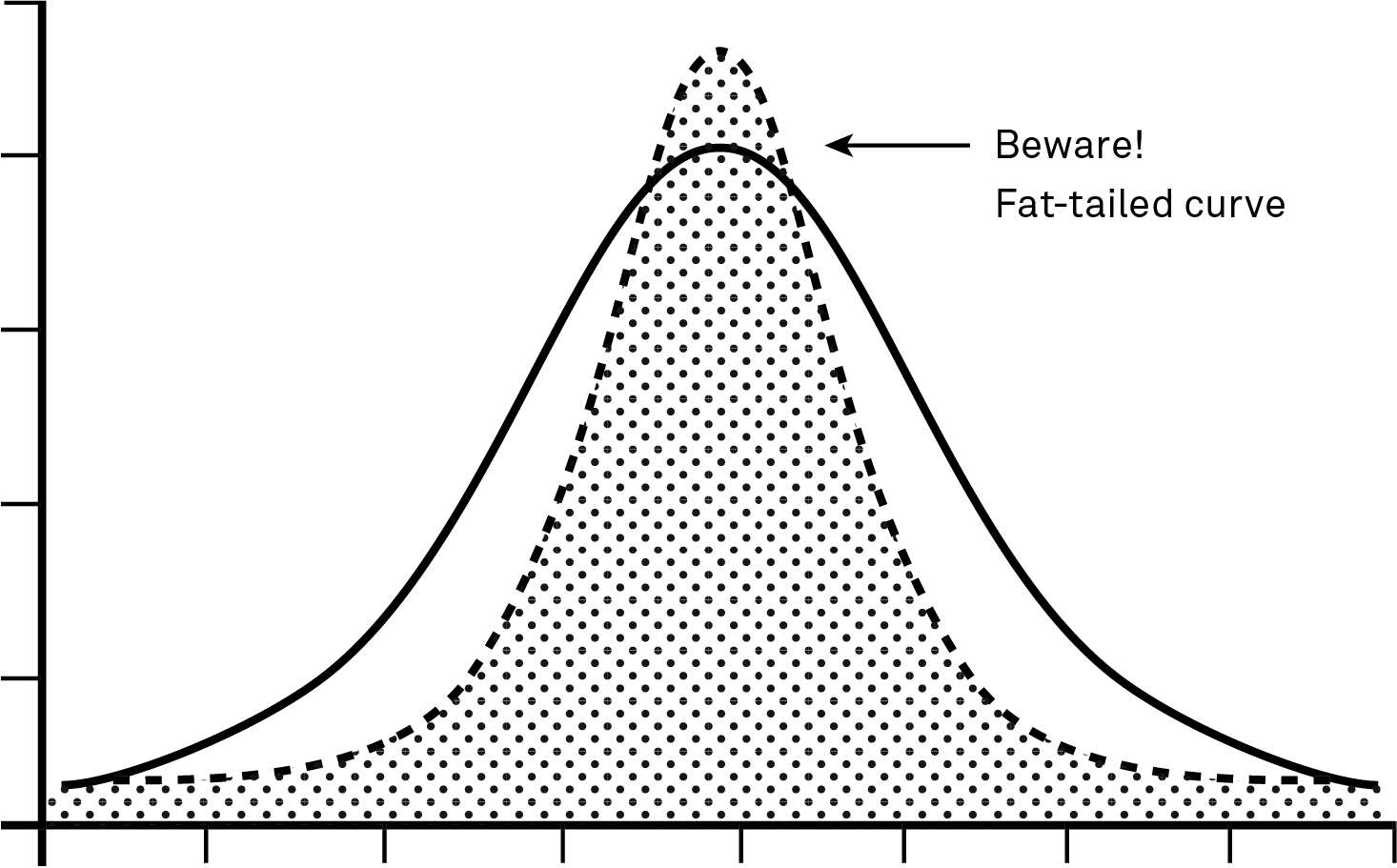
Always be extra mindful of the tails: They might mean everything.
The source uses this example to question comparisons based only on recent death counts.3 A rare event involving many deaths could change the comparison substantially. But identifying a possible catastrophe does not establish its probability, and neither type of risk is adequately described just by assigning it a distribution label. Exposure, the range of plausible outcomes, and uncertainty in the available data all matter.
Planning for tail risk means considering whether an unusually severe event would overwhelm a system. Reserves, redundancy, and limits on exposure can help when the timing and size of such events are uncertain. They do not require pretending to know which extreme event will occur next.
Finally, the source uses “metaprobability” to discuss uncertainty about probability estimates themselves. A forecast can sound precise even when its assumptions are poorly supported. To illustrate overconfidence, the source describes investors advertising annual returns of 20% to 40%, then contrasts those promises with a long-run US market return it summarizes as 7% to 8% per annum. Such comparisons depend on the period, inflation adjustment, dividends, and fees. A useful assessment asks how the forecast was made and how well similar forecasts have performed, rather than relying on the presenter’s confidence.
When to use it
Investing in stock markets by recognizing fat-tailed returns and avoiding overconfidence in stock-picking abilities.
Designing insurance policies or emergency plans that account for extreme, rare events rather than relying on historical averages.
Improving customer behavior predictions by checking if purchase patterns are independent or influenced by external limits (e.g., inventory, time of day).
Evaluating public safety policies with both routine incident data and scenarios for rare, high-impact events.
FROM THEORY TO EVERYDAY LIFE
In practice
Ice Cream Choice Dependency
You observe a friend choosing vanilla ice cream three times in a row. Before inferring a strong preference, check which flavors were available. If earlier customers had taken all the chocolate, the choice tells you about both preference and a restricted menu.
Stairs vs. Terrorism Risk
Suppose a country records more deaths from falls on stairs (1,000) than from terrorism (500) in a particular year. These hypothetical counts alone do not settle the future comparison. A rare, large attack could matter greatly, but its possibility is not enough to estimate its probability or justify a particular policy.
Investor Overconfidence
The source compares advertised annual returns of 20–40% with a historical market figure of 7–8%. Its point is to question confidence in return forecasts. A meaningful comparison would also need a defined period, treatment of inflation and dividends, fees, and a record of earlier forecasts.
A MOMENT TO REFLECT
Put it to work.
In a recent decision, did you assume events were independent when they might have been dependent on prior conditions? How could you have adjusted?
Think of a domain you operate in (finance, career, health): does it have fat-tailed or normal risks? How should that shape your planning?
When you last estimated the likelihood of an outcome, how confident were you in your estimate? What steps can you take to calibrate that confidence?
CONTINUE THE CONVERSATION
Source texts
- The Great Mental Models Volume 1 General Thinking Concepts