Click Restraint
Click restraint is the practice of resisting the impulse to click on the first search results, instead surveying the 'information neighborhood' to evaluate sources before engaging. It is a key heuristic for improving online fact-checking and information literacy.
THE IDEA
Click Restraint
Rather than immediately clicking on the first three results, we suggest that you follow step one of SIFT: stop. Take a deep breath. Look around. Figure out where you’ve landed. If it helps, take those sticky fingers off the mouse so you don’t click the first thing that pops up. Then do what professional fact-checkers do: practice click restraint.
How? By resisting the impulse to click. Click restraint is about surveying the information neighborhood into which you’ve landed. Who occupies the palatial mansion at the top of the page? Who’s dwelling in the row houses in the middle? What about the cellar dwellers at the bottom of the screen who, despite their lowly placement, might just be the best sources for your question?
Obviously, the importance of click restraint varies depending on what you want to know. Ask Google “Where was Beyoncé born?” and you’ll get an answer faster than it takes to type the question. Things start to get wonky when you put a question to Google that has multiple answers, or controversy.
For example, a post in your social media floats by that China has bought Walmart, and the chain will now be redubbed “the Great Wallmart,” with signs in English and Mandarin. You’re tempted to share the post—the new moniker is kinda clever—but since you’ve taken to heart what we’ve written, you do a thirty-second fact-check by googling “Did China buy Walmart?” Here are four results that come up:
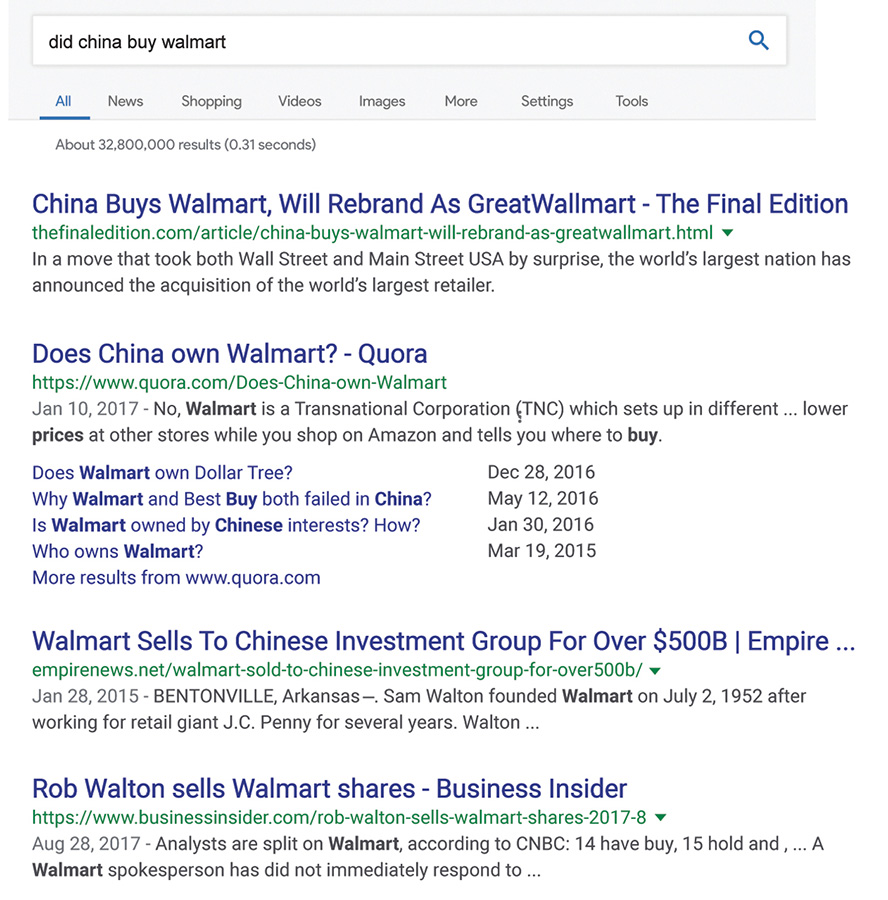
Figure 4.9 Search results for “Did China buy Walmart,” December 2017.
There’s your answer—right at the top. “China Buys Walmart, Will Rebrand as GreatWallmart.” You’re tempted to click, but you’ve turned over a new leaf: look but don’t click.
That first result? It comes from a site called thefinaledition.com, which claims that “the world’s largest nation has announced the acquisition of the world’s largest retailer.” Have you heard of thefinaledition.com? We haven’t either. We’ll move on.
Result two is from quora.com, a helpful question-answering site that offers a lot of useful material. There’s even a question relevant to our search: “Does China own Walmart?” We make a mental note and move on to empirenews.net. We haven’t heard of that site either. But the title’s pretty clear, and it even says the sale was valued over five hundred billion dollars. Maybe we will be shopping at the GreatWallmart.
We get to the last result, businessinsider.com, an established trade magazine (the site, with an expanded purview, was then called “Insider,” insider.com), and we read the snippet. Nothing about China. We make a wise first click and arrive at an article about how Rob Walton, the son of Walmart founder Sam Walton, sold less than 1 percent of his shares for a cool sixty-two million dollars. Nothing in the article about China. So, aside from that first link, which turns out to be from a satirical site, and empirenews.net, which, no surprise, is also a parody site, there seems to be no evidence that China bought Walmart. You can breathe a sigh of relief. (If you still need convincing, check out Quora and confirm there’s nothing to the rumor.)
When to use it
Fact-checking a viral social media post before sharing it.
Researching a controversial topic where search results may be biased or misleading.
Evaluating news sources to determine credibility.
FROM THEORY TO EVERYDAY LIFE
In practice
Evaluating the 'China Buys Walmart' Rumor
In the authors’ historical search for the Walmart rumor, they compare results before clicking. The apparently confirming stories turn out to be satire, while the established news source reports a different event: a share sale. The example shows why checking what each result actually supports matters more than accepting the top headline.
A MOMENT TO REFLECT
Put it to work.
How does practicing click restraint improve the accuracy of your online research?
In what situations is it most important to resist clicking the first search result?
What does 'surveying the information neighborhood' mean in your own words?
CONTINUE THE CONVERSATION
Source texts
- Verified How to Think Straight, Get Duped Less, and Make Better Decisions about What to Believe Online (Mike Caulfield, Sam Wineburg)