Change Your Mind a Little at a Time (Incremental Belief Updating)
Superforecasters often revise their confidence in small steps as evidence arrives. Treating belief change as a routine adjustment can reduce the pressure to defend an all-or-nothing position.
THE IDEA
CHANGE YOUR MIND A LITTLE AT A TIME
The superforecasters changed their minds all the time. Not dramatic, 180-degree reversals every day, but subtle revisions as they learned new information. The highest-scoring superforecaster, a software engineer named Tim Minto, usually changed his mind at least a dozen times on a single forecast, and sometimes as much as forty or fifty times. The graph below shows Minto’s evolving confidence in the proposition “The number of registered Syrian refugees reported by the United Nations Refugee Agency as of 1 April 2014 will be under 2.6 million.” Every dot represents a time that Minto revised his forecast over the course of three months. He’s course-correcting as he goes, like a captain steering his ship.
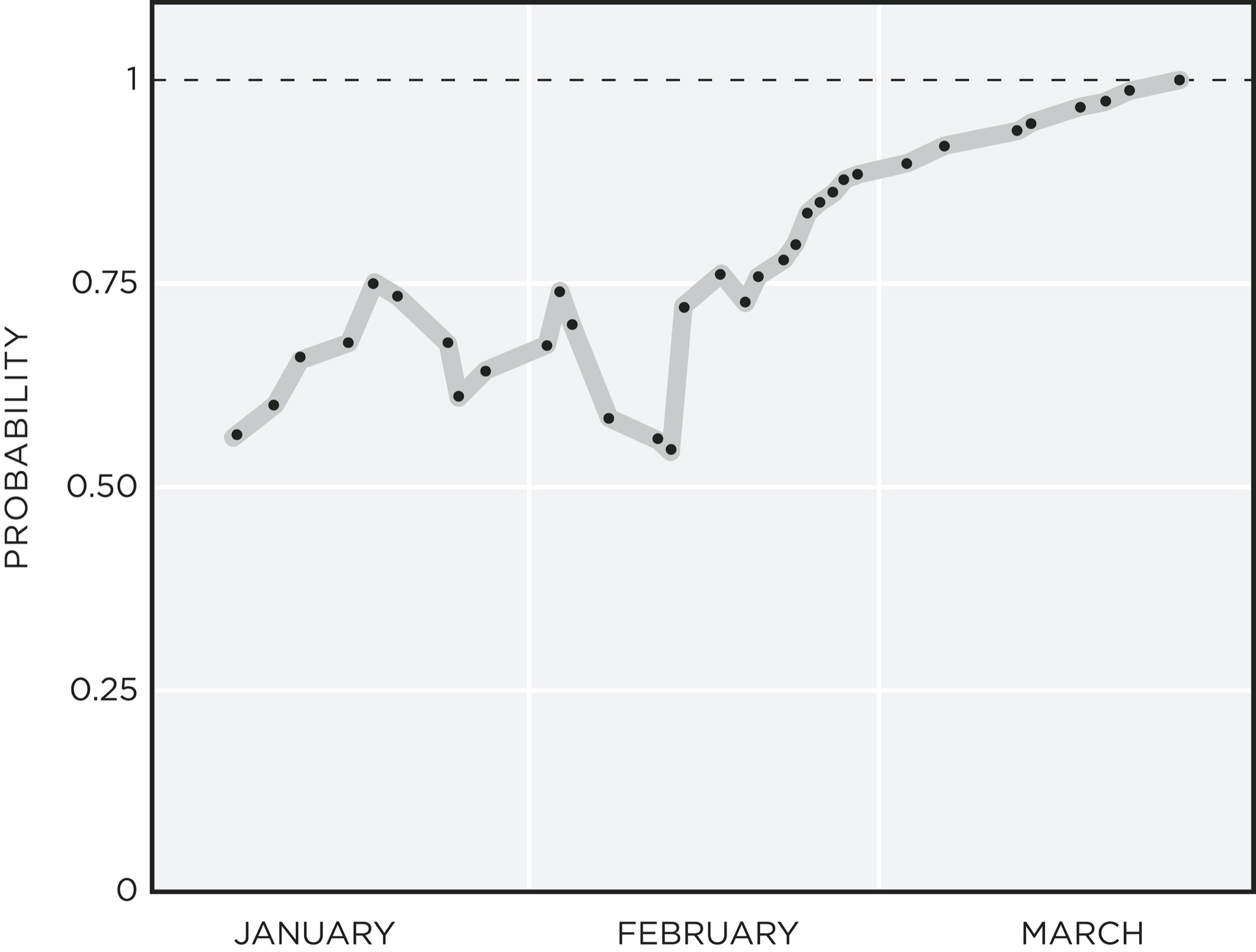
THE BELIEF-UPDATING STYLE OF A SUPERFORECASTER. ADAPTED FROM TETLOCK AND GARDNER (2015), PAGE 167.
You’re probably already comfortable with the idea of changing your mind incrementally in some contexts. When you submit a job application, you might figure you have about a 5 percent chance of ultimately getting an offer. After they call you to set up an in-person job interview, your estimate might rise to about 10 percent. During the interview, if you feel like you’re hitting it out of the park, maybe your confidence in getting an offer rises to 30 percent. If you haven’t heard from them for a couple of weeks after your interview, your confidence might fall back down to 20 percent.
What’s much rarer is for someone to do the same thing with their opinions about politics, morality, or other charged topics. For years, Jerry Taylor was one of the top climate change skeptics in the country. He worked for the Cato Institute, a libertarian think tank, and earned a good living appearing on talk shows and reassuring the public that fears about climate change were being blown way out of proportion.
The first crack in Taylor’s skepticism occurred after he participated in a televised debate with a famous climate change advocate named Joe Romm.3 During the debate with Romm, Taylor repeated one of his standard talking points: Global warming has been much slower than the doomsayers predicted. Compared to the original projections presented to Congress in 1988, the earth hasn’t warmed much at all.
Backstage after the taping, Romm accused Taylor of misrepresenting the facts, and challenged him to go check the testimony for himself. Taylor accepted the challenge, expecting to be vindicated. But to his shock, Romm turned out to be right. The 1988 projections were a much closer match to reality than Taylor had realized.
Taylor figured he must have been missing something. He had received this information from a well-respected, skeptical climate scientist. So he went back to the scientist, pointed out the problem, and asked, “What’s going on here?” To Taylor’s dismay, the scientist didn’t have a good answer ready. He hemmed and hawed for twenty minutes, until finally Taylor realized that this person whom he had trusted was “purposely and consciously skewing the debate.” It shook him.
From then on, whenever a fellow climate skeptic cited something, Taylor would follow up on the reference. Again and again, he found himself disappointed in the quality of the research. He still considered the skeptic narrative more plausible than the activist narrative overall, but bit by bit, Taylor was becoming less confident about that.
Changing your mind frequently, especially about important beliefs, might sound mentally and emotionally taxing. But, in a way, it’s less stressful than the alternative. If you see the world in binary black-and-white terms, then what happens when you encounter evidence against one of your beliefs? The stakes are high: you have to find a way to dismiss the evidence, because if you can’t, your entire belief is in jeopardy.
If instead you see the world in shades of gray, and you think of “changing your mind” as an incremental shift, then the experience of encountering evidence against one of your beliefs is very different. If you’re 80 percent sure that immigration is good for the economy, and a study comes out showing that immigration lowers wages, you can adjust your confidence in your belief down to 70 percent.
It may later turn out that study was flawed, or further evidence may come out showing that immigration boosts the economy in other ways, and your confidence in your belief may go back up to 80 percent or even higher. Or you may find additional evidence about the downsides of immigration, which could gradually lower your confidence even further below 70 percent. Either way, each adjustment is comparatively low stakes.
When to use it
Making personal decisions (e.g., choosing a career path) by updating probabilities as you gather more information.
Evaluating political or policy positions by tracking your confidence and adjusting as you read credible studies or opinions.
In business, using forecasts for sales or market trends that you revise weekly based on new data.
Scientific research: updating confidence in a hypothesis as experimental results accumulate.
FROM THEORY TO EVERYDAY LIFE
In practice
Job Application Probability Updating
When you submit a job application, you might initially estimate a 5% chance of getting an offer. After being called for an interview, you update to 10%. During a successful interview, confidence rises to 30%. After not hearing back for two weeks, confidence falls to 20%.
Jerry Taylor's Climate Change Belief Revision
Jerry Taylor, a prominent climate change skeptic, gradually updated his beliefs over time after verifying references and discovering that his trusted sources were unreliable. He started with high confidence in skepticism but slowly became less certain, illustrating incremental belief updating on an emotionally charged topic.
A MOMENT TO REFLECT
Put it to work.
Think of a strongly held belief you have. How often do you adjust your confidence in that belief based on new evidence? What would it look like to break that belief into probabilities (e.g., 80% sure) and update incrementally?
Recall a time when you encountered evidence that contradicted a core belief. Did you dismiss it or adjust your confidence? How might an incremental approach have changed your response?
Identify a topic where you tend to see things in black-and-white (e.g., politics, morality). What small adjustments could you make to start treating it as a matter of degrees?
Often confused with
References
- Superforecasting: The Art and Science of Prediction — Philip E. Tetlock and Dan Gardner (2015)
CONTINUE THE CONVERSATION
Source texts
- The Scout Mindset (Julia Galef)