Category Theory
A mathematical framework focusing on relationships between objects rather than their isolated properties, revealing hierarchical structures and insights through abstraction.
THE IDEA
Category theory is a field of modern mathematics that brings relationships between things to the forefront. In this approach, the framework for thinking starts with deciding what objects and relationships we’re going to focus on. For example, when thinking about employees in a company, we could think about age, or we could think about years of service, or we could think about their position in the hierarchy of the company. Each of these would produce a different way of thinking about the interactions, and we could then think about what insight we get from these different lenses. We might discover, for example, that animosity arises when someone is higher up in the hierarchy but lower in age.
In category theory mathematicians discover that highlighting relationships between things is often much more illuminating than just thinking of things in isolation. Let’s return for a moment to numbers. If we write down the factors of 30 we have these:
1; 2; 3; 5; 6; 10; 15; 30
Factors may elicit a shudder from those who only vaguely remember them from boring maths lessons years ago. The truth is, I too think that a list of numbers in a line is boring. We live in a merely three-dimensional world, so we are constrained to write on two-dimensional pieces of paper, in one-dimensional straight lines. We often force our thoughts into one dimension when really they have natural geometry in higher dimensions. I like to say that this is why I don’t tidy the papers on my desk – they have natural geometry in three-dimensional space where they are, positioned according to their relationships with each other by subject matter, importance, chronology, and so on. At least, that’s my excuse.
We can find some natural geometry in our factors of 30 by thinking about which ones are also factors of each other. We can draw something like a family tree for them. As in a family tree, we won’t draw lines between two “generations”. We get this picture:
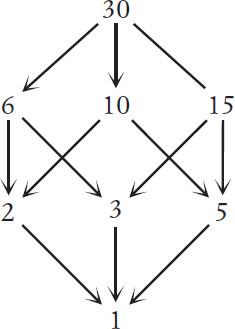
We now see that this has the structure of a cube – a more interesting structure than just some numbers listed in a straight line. We can then think about the hierarchy of these numbers in the picture. At the bottom we have 1, then we have the three next smallest factors, then the three next smallest, and the biggest one at the top. However, this hasn’t happened because of the size of the numbers: it has happened because of which numbers are prime.
At the second level we have the factors 2, 3 and 5 because nothing goes into them except 1. That is, they are prime numbers. (Recall that prime numbers are those numbers other than one that are only divisible by 1 and themselves.) The next level up has numbers that are each a product of two prime numbers:
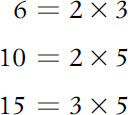
Finally at the top we have 30 which is a product of three prime numbers:

In fact, this structure arises precisely because 30 is a product of three different prime numbers. We could pick another number that is a product of three different prime numbers and do something similar, and see more clearly that the hierarchy is to do with prime factors, and not with size. For example:

has the following factors, in order of size:
1; 2; 3; 6; 7; 14; 21; 42.
If we arrange these in a picture as above it looks like this:
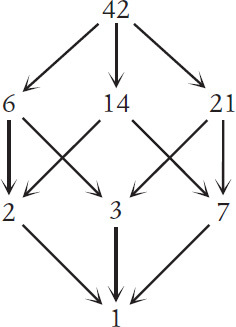
We now see that the next row of numbers up from 1 is not the next three smallest numbers: we have 2, 3 and 7 there as they are the three prime factors. The number 6 is smaller than 7, but has more prime factors as 6 = 2 × 3, so it’s on the level above.
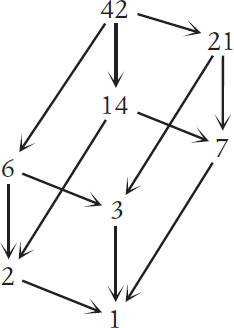
So we see that the hierarchy according to this diagram does not match the hierarchy of sheer size of numbers. If we also represented the size hierarchy, we would have to skew the diagram to look like this, a cuboid rather than a cube:
This might all seem like just messing around with numbers, but if we take it one step more abstract it suddenly becomes rather widely applicable. What we have seen is that the hierarchy comes from the prime factors of all the numbers, and this becomes clearer if we write down each number as a set of prime factors, instead of the number itself. For 30, we get this:
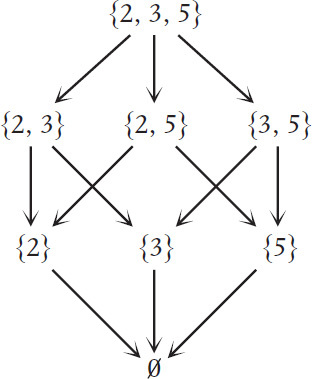
If we multiply the numbers in each position together, we get back to the actual diagram of factors from before. Here  is used to represent the prime factors of 1, because 1 does not have any prime factors.1
For 42 we have this:
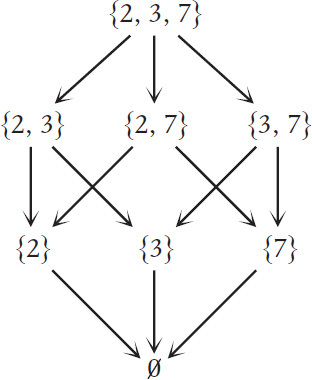
Comparing those diagrams, we can see that every 5 in the first one became a 7 in the second. The arrows represent omitting elements. From {2, 3}, one arrow keeps {2} and omits 3. Another removes {2}, the singleton containing 2, and keeps the other element.
Now, it doesn’t matter exactly what these numbers were – the diagram would work for sets of any three objects a, b, c. So, more abstractly, we get this diagram of relationships between sets:
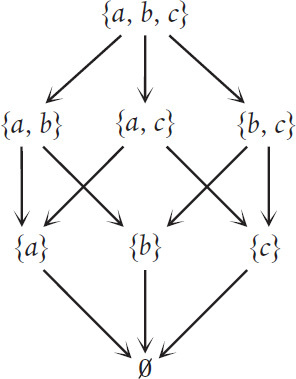
We can now examine this diagram for any three things, and this is where the framework becomes very widely applicable.
When to use it
Analyzing team dynamics by focusing on relationships and hierarchies among members.
Modeling problem-solving by abstracting relationships between components.
Applying the framework to understand complex systems by identifying key relationships.
Using commuting diagrams to represent processes in computer science or engineering.
FROM THEORY TO EVERYDAY LIFE
In practice
Factors of 30
The factors of 30 (1, 2, 3, 5, 6, 10, 15, 30) form a cube-shaped hierarchy when arranged by divisibility, revealing a structure tied to prime factors rather than size.
Factors of 42
The factors of 42 (1, 2, 3, 6, 7, 14, 21, 42) also form a cube, but the hierarchy shows that 6 (product of 2 and 3) is above 7 (prime), despite being smaller in size.
Abstract sets of three objects
Generalizing the factor diagrams to any three objects a, b, c yields a universal diagram of set inclusion, illustrating how category theory abstracts relationships.
A MOMENT TO REFLECT
Put it to work.
How can you apply category theory to analyze relationships in your organization or team?
What insights can you gain by focusing on relationships between objects rather than the objects themselves?
Think of a situation where hierarchy based on one property conflicts with hierarchy based on another. How does this structure reveal hidden dynamics?
CONTINUE THE CONVERSATION
Source texts
- The Art of Logic How to Make Sense in a World that Doesn’t (Eugenia Cheng)