Blue Personality Type (Insightful & Accurate)
Erikson’s Blue pattern emphasizes checking details before speaking and supplying information when asked. His anecdotes portray a person who values accuracy without routinely volunteering everything they know.
THE IDEA
“Excuse Me, but That’s Not Quite Accurate.”
We all have a friend like that. Think about it: You’re sitting in a restaurant with your friends. You’re discussing cats, football, or space rockets. Someone throws out a random comment. It may be your Red friend who claims that the Patriots have been to the Super Bowl eleven times; it can be the Yellow who cheerfully claims that as a child he lived in the same block as Will Smith in West Philly.
Your Blue buddy clears his throat and in a gentle voice says that the Patriots have actually only been to the Super Bowl ten times—with their first appearance after the 1985 season and eight times since 2001—and that Will Smith actually grew up in Wynnefield, which is well north of the block in question and a half-hour walk from the lovely Centennial Arboretum. In addition, without blinking an eye, the good friend adds, “It’s interesting to note that in the Super Bowl pregame coin toss, of the past fifty-one games, the outcome has been tails twenty-seven times and heads twenty-four times. And based on past statistics, the winner of the coin toss is slightly less likely to win the game overall.”
You just have to give up, boys. This guy simply knows everything. He doesn’t make a big deal about it, but his way of presenting facts makes it difficult for you to call them into question. He knows where he found the info and can go fetch the book to prove it.
That’s the way it is with Blues. They know how things stand before they open their mouth. They’ve Googled, read the owner’s manual, and checked the dictionary—and afterwards they present a report in full.
But an important thing to note: If the question doesn’t come up, it’s unlikely that your Blue buddy will say anything on the subject. He has no need to tell everyone about what he knows. Of course, a Blue doesn’t know everything; no one can. But you can usually bank on the fact that what he says is correct.
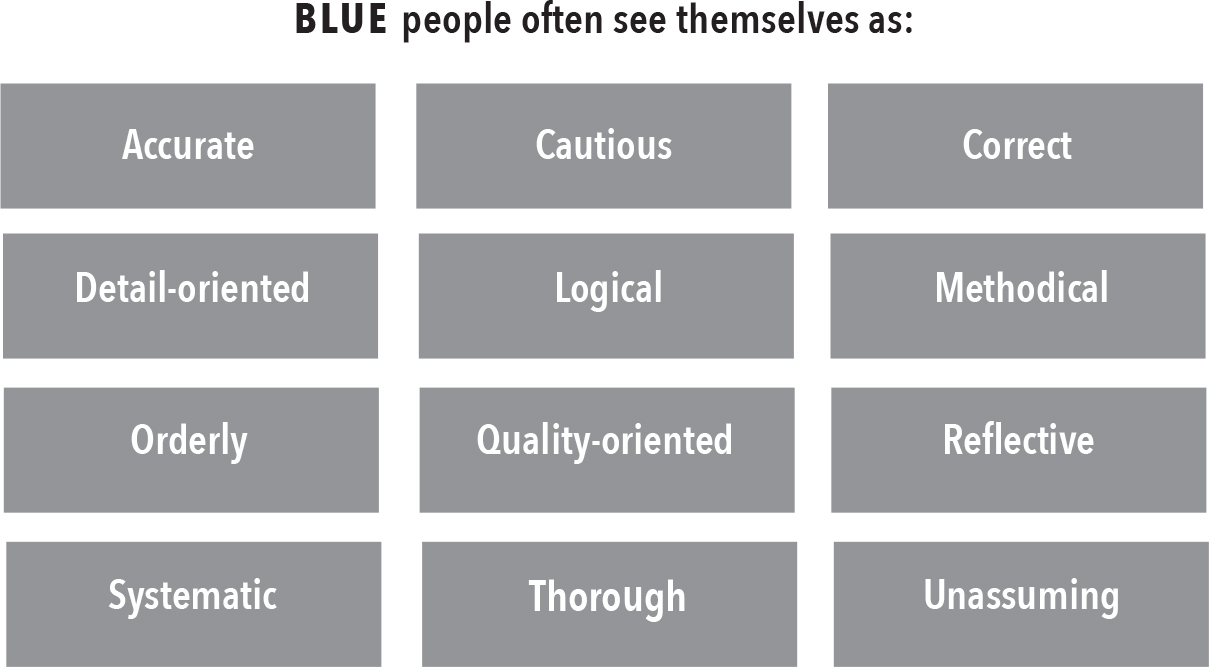
Did you notice anything about the art above? Of course you did. This time I listed the different characteristics in alphabetical order—something a Blue would certainly appreciate. However, I might get in trouble because I don’t discuss each and every one of these characteristics individually on the subsequent pages. To all Blue individuals who are reading this—who have probably jotted down a little note in the margin to go to my website to look for possible explanations for this blunder—I just want to say that I didn’t mean to cause any strife.
When to use it
For a decision requiring accurate data, ask a detail-oriented colleague to trace important claims to their sources.
In team meetings, invite corrections and make supporting evidence available.
When writing a report, ask a reviewer to check factual claims rather than assume accuracy from a personality label.
Seek colleagues who can explain where detailed information came from and how it was checked.
FROM THEORY TO EVERYDAY LIFE
In practice
Patriots Super Bowl Appearances
In Erikson’s historical anecdote, a Blue friend challenges another person’s count of the Patriots’ Super Bowl appearances and supplies supporting dates. The example illustrates the checking habit; its count is not presented as a current sports statistic.
Will Smith's Childhood Location
A friend claims to have lived on the same block as Will Smith. The Blue friend disputes the specific location and supplies Wynnefield as the relevant neighborhood. The claimed correction concerns the block, rather than simply whether Smith grew up in West Philadelphia.
A MOMENT TO REFLECT
Put it to work.
How can you cultivate the habit of verifying facts before speaking?
In what situations might it be beneficial to share knowledge even if not asked?
When can an insistence on exact detail help a discussion, and when can it distract from the question being decided?
CONTINUE THE CONVERSATION
Source texts
- Surrounded By Idiots (Thomas Erikson)