Belief Interdependence
Beliefs are interconnected like a web; changing one significant belief often requires adjusting related supporting beliefs. This interdependence explains why presenting contrary evidence rarely changes minds immediately.
THE IDEA
3. Our beliefs are interdependent—changing one requires changing others
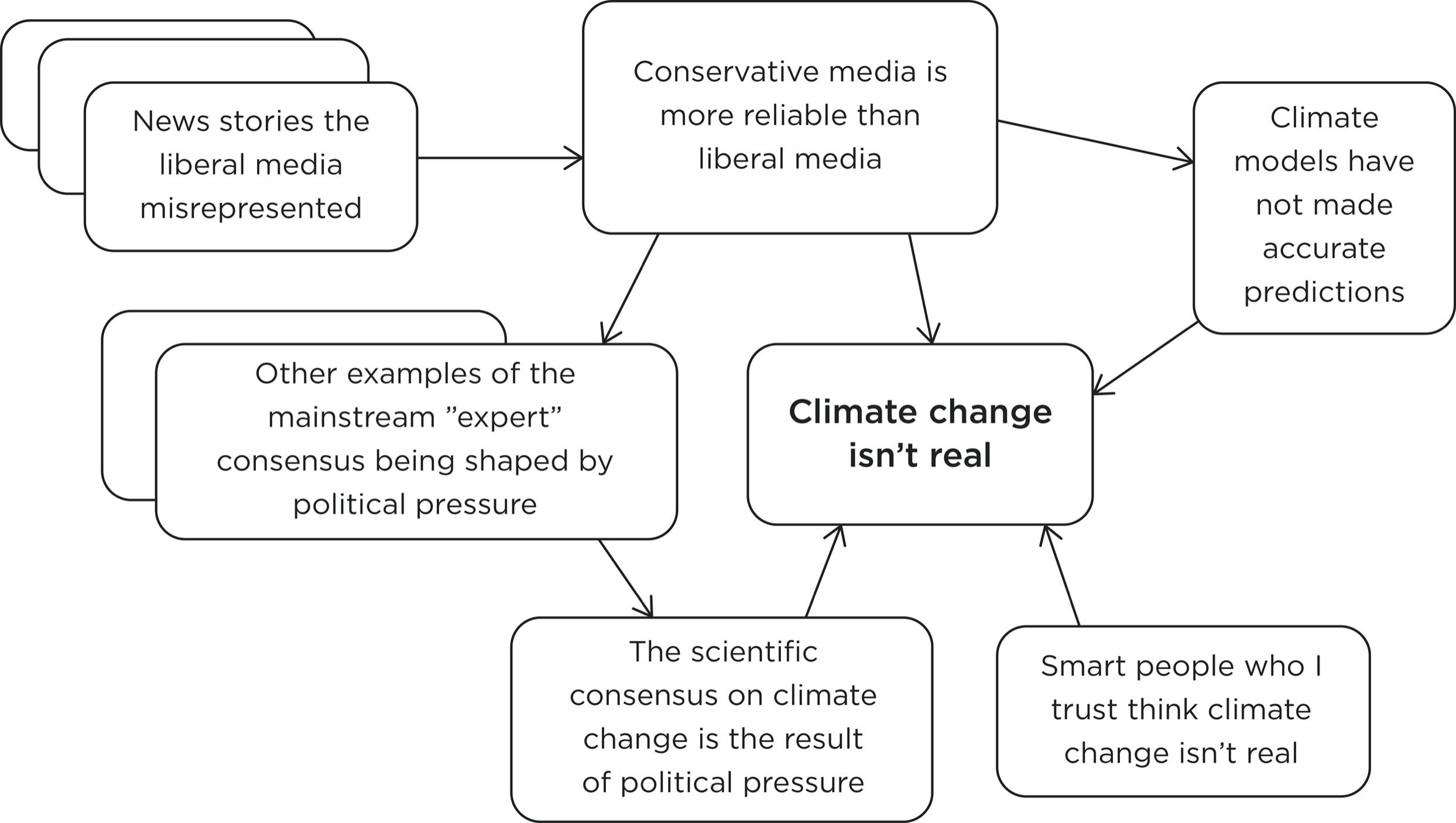
Suppose that Alice believes that climate change is a serious problem, and she’s talking to Kevin, who disagrees. Alice could show Kevin an article saying that climate science models have made accurate predictions, but that’s not likely to change Kevin’s mind—even if Kevin is in scout mindset.
That’s because our beliefs are all interconnected, like a web. The belief “climate change isn’t real” is supported by other beliefs Kevin holds about how the world works and which sources are trustworthy. For Kevin to significantly update the belief “climate change isn’t real,” he’ll have to also update a few of his associated beliefs, such as “Climate change skeptic media outlets are more trustworthy than the mainstream media,” or “Smart people don’t buy the climate science consensus.” That can happen, but it will take a lot more evidence than a single article from a news source Kevin doesn’t currently trust.
When to use it
In persuasive communication, understanding that beliefs are interdependent helps in crafting arguments that address underlying assumptions rather than just presenting counter-evidence.
In education, teachers can help students see how new concepts connect to their existing knowledge, facilitating deeper understanding and belief revision.
In personal growth, reflecting on one's own belief system can reveal which core beliefs are holding back change and what supporting beliefs need to be examined.
FROM THEORY TO EVERYDAY LIFE
In practice
Climate Change Disagreement
Alice believes climate change is serious; Kevin disagrees. Alice shows Kevin an article supporting climate science, but Kevin doesn't change his mind because his disbelief is supported by other beliefs: that skeptical media are more trustworthy and that smart people reject the consensus. Kevin would need to update those supporting beliefs before his main belief can shift.
A MOMENT TO REFLECT
Put it to work.
Think of a belief you hold strongly. What other beliefs support it? How would you need to adjust those if you were to change your central belief?
Consider a time when someone tried to change your mind with a single piece of evidence. Why did it not work? What additional evidence might have been needed?
How can you use the concept of belief interdependence to persuade others more effectively in a debate or discussion?
CONTINUE THE CONVERSATION
Source texts
- The Scout Mindset (Julia Galef)