Autocatalysis
In an autocatalytic reaction, a product catalyzes further production of itself. Under suitable conditions, this feedback accelerates the reaction before reactant depletion slows it. Similar feedback patterns can serve as analogies in other fields.
THE IDEA
Chemistry without catalysis would be a sword without a handle, a light without brilliance, a bell without sound.
—Alwin Mittasch
In an autocatalytic reaction, a product acts as a catalyst for the reaction that produces it. The catalyst participates in reaction steps and is regenerated; the overall process also produces more of it.
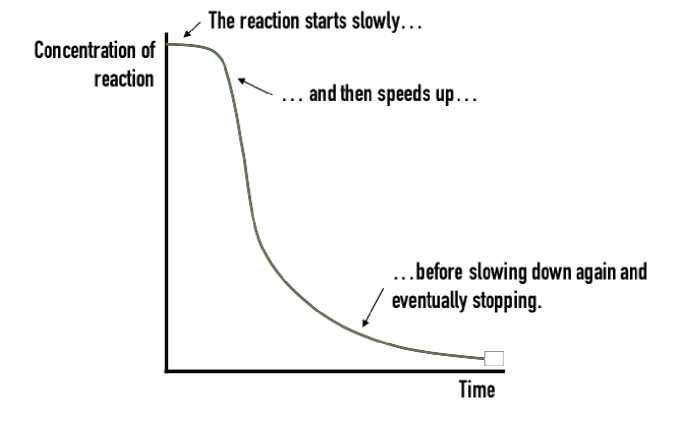
A reaction is autocatalytic when one of the products obtained acts as a catalyst for the process. In a simple case, the reaction starts slowly because little product is present. As product accumulates, it speeds the reaction; depletion of reactants can then slow it. Under those conditions, product concentration follows a sigmoidal curve. A sigmoidal curve alone does not establish autocatalysis.
The concept of autocatalysis was introduced in 1890 by Ostwald and today it is successfully applied in various fields such as biology or economy to explain phenomena such as the evolution of population or genes (in economics one can speak of positive feedback). A catalyst changes a reaction’s rate and is regenerated through the reaction mechanism.
—Wolfgang Ostwald
When to use it
Designing a viral marketing campaign where each new customer brings in more customers (product as catalyst).
Explaining the rapid adoption curve of a technology once a critical mass of users is reached.
Understanding tumor growth where cancer cells stimulate their own proliferation.
Enzymatic reactions in metabolic pathways that are self-amplifying under certain conditions.
FROM THEORY TO EVERYDAY LIFE
In practice
Photographic film processing
Silver halide development is autocatalytic: the metallic silver produced during development catalyzes further reduction of silver halide, accelerating the reaction in exposed areas.
DNA replication
In polymerase chain reactions (PCR), newly synthesized DNA strands can become templates in later cycles, allowing amplification. This illustrates self-replication: template multiplication should be distinguished from the chemical catalyst’s role in copying DNA.
Binding of oxygen by hemoglobin
Oxygen binding to one hemoglobin subunit increases the affinity of other subunits. This cooperativity produces a sigmoidal oxygen-dissociation curve, illustrating why that curve shape alone does not establish autocatalysis.
Aspirin degradation
Aspirin (acetylsalicylic acid) hydrolyzes spontaneously into salicylic acid and acetic acid; the acetic acid produced catalyzes further hydrolysis, causing old aspirin to smell like vinegar.
A MOMENT TO REFLECT
Put it to work.
Where in your life or work do you see small initial efforts suddenly taking off after a threshold? Could those be autocatalytic processes?
If a reaction is autocatalytic, what might happen if you introduce a tiny amount of the product early on? How could this be strategically applied?
How does the sigmoidal curve of autocatalysis differ from pure exponential growth, and what constraints cause the eventual slowdown?
Often confused with
References
- On the concept of autocatalysis — Wilhelm Ostwald (1890)
- [Untitled quote provided] — Alwin Mittasch
CONTINUE THE CONVERSATION
Source texts
- Wisdom Theory 100 Mental Models (2020) (Wisdom Theory)