Attention Area
The attention area is the initial focus of a problem, but important parts may be left out. Shifting attention to overlooked aspects can unlock new solutions.
THE IDEA
Attention area
The entry point is the first attention area. Usually attention starts at this point but eventually covers the whole problem. Sometimes, however, important parts are left out. Bringing these parts into view may be what allows the problem to be solved.
In one of Sherlock Holmes’s cases there was a large dog. Dr Watson dismissed the dog as being of no importance because it had done nothing on the night of the crime. Sherlock Holmes pointed out that the great significance of the dog was precisely that it had done nothing. He shifted attention from the significance of what the dog might have done to the significance of the fact that it had done nothing. This meant that the criminal must have been known to the dog.
In Shakespeare’s Merchant of Venice there comes the moment when Shylock demands the pound of flesh that is owed to him by the merchant as the result of a bargain. Shylock is outwitted by Portia who shifts attention from the flesh which is due to Shylock to the blood that must go with it. Since that is not part of the bargain Shylock could be charged with the serious offence of spilling blood. Thus by a shift of attention which brought into the problem something that would otherwise have been left out the problem was solved.
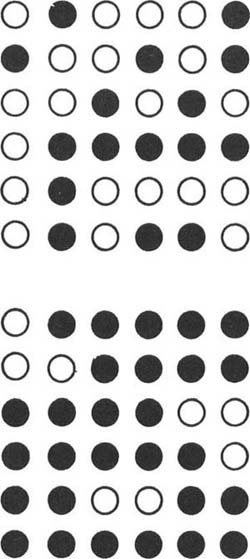
The source illustrates a counting task with two sets of circles. In each, the task is to count the solid circles as quickly as possible.
The obvious way to tackle this problem is to count the solid circles in each case. But when you come to the second set of circles it is much easier to shift attention to the open circles, find the total number of all circles by multiplying the number of circles along one edge of the rectangle by the number along the other edge, and then subtract the small number of open circles from this total. The answer is the number of filled circles.
In a tennis tournament there are one hundred and eleven entrants. It is a singles knockout tournament and you as secretary have to arrange the matches. What is the minimum number of matches that would have to be arranged with this number of entrants?
When faced with this problem most people draw little diagrams showing the actual pairings in each match and the number of byes. Others try and work it out by reference to powers of 2 (i.e. 4, 8, 16, 32 etc). In fact the answer is one hundred and ten matches and one can work this out at once without any complicated mathematics. To work it out one must shift attention from the winners of each match to the losers (in whom no one is usually very interested). Since there can only be one winner there must be one hundred and ten losers. Each loser can only lose once so there must be one hundred and ten matches.
The tournament problem changes more than the entry point: it brings the losers into consideration at all. What we attend to may give no sign of what we have left out. Deliberately looking for that omission can be enough to change how the problem is understood.
When to use it
Problem-solving sessions where teams get stuck on initial framing
Analyzing failures by looking at what didn't happen
Negotiations where shifting focus to less obvious factors can create breakthroughs
Strategic planning by considering overlooked opportunities or threats
FROM THEORY TO EVERYDAY LIFE
In practice
The Dog That Did Nothing
In a Sherlock Holmes story, a dog's lack of action was initially dismissed. Holmes realized the significance: the dog knew the criminal, so it didn't bark.
Portia's Shift in The Merchant of Venice
Portia shifts attention from the flesh Shylock is owed to the blood that must accompany it, saving Antonio by highlighting an overlooked detail.
Tennis Tournament Matches
To find the number of matches in a knockout tournament of 111 entrants, shift attention from winners to losers. Since each loser loses once, there are 110 matches (111-1).
A MOMENT TO REFLECT
Put it to work.
What aspects of your current problem are you ignoring or taking for granted?
How can shifting your attention from the obvious to the overlooked reveal new solutions?
What 'dog that didn't bark' exists in your situation?
CONTINUE THE CONVERSATION
Source texts
- Lateral Thinking A Textbook of Creativity (Edward de Bono)