Asking Complex Interdisciplinary Questions
When facing a question spanning multiple domains, break it down by identifying relevant disciplines (e.g., economic, biological, ethical) and formulate sub-questions to avoid missing critical complexities.
THE IDEA
Asking Complex Interdisciplinary Questions
When addressing a complex question covering more than one domain of thought, target prior questions by formulating questions according to domain. Does the question, for example, include an economic dimension? Does it include a biological, sociological, cultural, political, ethical, psychological, religious, historical, or some other dimension? For each dimension of thinking inherent in the question, formulate questions that force you to consider complexities you otherwise may miss.
When focusing on domains within questions, consider such questions as:
- What are the domains of thinking inherent in this complex question?
- Am I dealing with all the relevant domains within the question?
- Are we leaving out some important domains?
This figure shows some of the domains that might be embedded in a complex question:
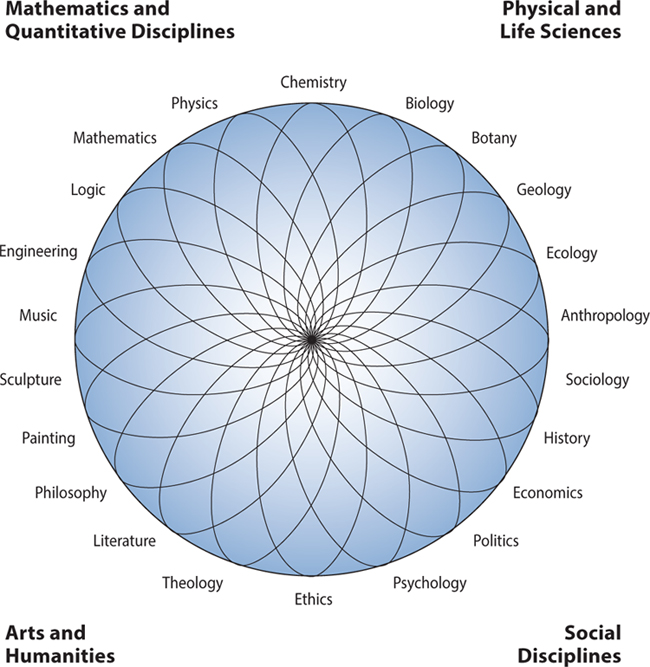
Domains of Questions (by discipline)
This diagram was adapted from a diagram created by John Trapasso.
When to use it
Analyzing a business decision that involves financial, ethical, and social dimensions.
Formulating a research question for a multidisciplinary study in environmental science, economics, and policy.
Debating a public policy issue such as healthcare reform by considering medical, economic, and ethical aspects.
Designing an interdisciplinary curriculum by identifying which domains should be integrated into a project or course.
FROM THEORY TO EVERYDAY LIFE
In practice
Climate Policy Decision
When evaluating a climate change policy, break the question down into economic (cost-benefit analysis), environmental (impact on ecosystems), political (feasibility and legislation), and ethical (intergenerational justice) dimensions.
Medical Treatment Evaluation
Assessing a new medical treatment requires considering biological (efficacy), psychological (patient well-being), ethical (informed consent), and economic (cost) domains.
A MOMENT TO REFLECT
Put it to work.
What are the domains of thinking inherent in a complex question you are currently facing?
Are you dealing with all the relevant domains within the question, or are some being overlooked?
How might breaking a question into domain-specific sub-questions change your understanding or approach?
References
- Domains of Questions diagram — John Trapasso
CONTINUE THE CONVERSATION
Source texts
- The Art of Asking Essential Questions Based on Critical Thinking Concepts and Socratic Principles (Linda Elder, Richard Paul)