Anchoring and Adjustment Heuristic
The excerpt describes a study asking participants how they made numerical estimates. Researchers compared reports involving self-generated and supplied anchors, counting anchoring and adjustment only when participants mentioned both steps.
THE IDEA
Method
Fifty Cornell undergraduates were each asked four questions, two of which involved questions to which most participants could be counted on to generate a particular anchor value (e.g., “When did the second European explorer land in the West Indies?”; anchor-1492), and two involved anchors provided by the experimenter (one high and one low value) (Table 7.1).
Table 7.1. Percentage of Participants Describing a Process of Anchoring and Adjustment in Their Verbal Reports, for Self-Generated and Experimenter-Provided Anchoring Items
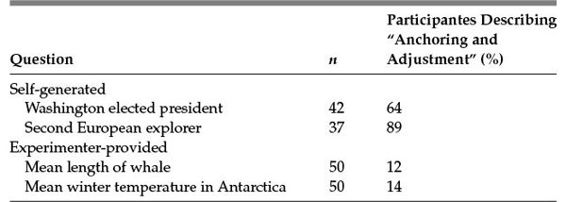
Note: There were 50 participants in this experiment. The number of participants varies for the self-generated anchoring items because not all participants knew the relevant anchor (i.e., the date of Columbus’ arrival in the West Indies or the date of the Declaration of Independence). The anchor value provided for the mean length of a whale was 69 feet, and was 1°F for the mean winter temperature in Antarctica.
Participants were asked to explain how they arrived at the answer to each question. Their responses were recorded, transcribed, and evaluated by two raters who were unaware of our hypotheses. The raters evaluated whether the participant appeared to know the anchor value, whether they used the anchor as a basis of their answer, and whether they mentioned adjustment from the anchor to arrive at a final estimate. Interrater agreement was .94. A third rater who was also unaware of our hypotheses resolved disagreements. Participants were considered to have used anchoring and adjustment only if their verbal reports referred to the anchor and a process of adjustment.
When to use it
In negotiations, the first offer often serves as an anchor; knowing this can help you prepare a counter-anchor or adjust deliberately.
In forecasting or budgeting, being presented with past data as an anchor may skew projections; consider multiple reference points.
When evaluating the likelihood of events, initial probabilities can anchor subsequent judgments; use base rates to counteract.
In education, teachers can use anchoring to guide students toward reasonable estimates, but should also teach awareness of bias.
FROM THEORY TO EVERYDAY LIFE
In practice
Self-Generated Anchor: Date of Second European Explorer
When asked when the second European explorer landed in the West Indies, participants likely used the anchor of 1492 (Columbus’s first voyage) and adjusted, leading to estimates influenced by that initial value.
Experimenter-Provided Anchors: Whale Length and Antarctic Temperature
The experiment supplied 69 feet as an anchor for mean whale length and 1°F for mean winter temperature in Antarctica. Researchers examined participants’ explanations for references to both the anchor and an adjustment; the method excerpt does not supply the resulting percentages.
A MOMENT TO REFLECT
Put it to work.
Describe a real-life situation where an initial anchor (e.g., a suggested price or statistic) influenced your judgment. How might you become aware of such influence in the future?
When making numerical estimates, what strategies can you employ to reduce the impact of arbitrary anchors?
How can the anchoring and adjustment heuristic affect decisions in negotiations, such as salary discussions or car purchases?
CONTINUE THE CONVERSATION
Source texts
- Heuristics and Biases The Psychology of Intuitive Judgment (Thomas Gilovich, Dale Griffin, Daniel Kahneman)