Analogies for Engaging Emotions
Analogies can change how people feel about a situation and help them see its logic differently. By pivoting from a logically similar but emotionally neutral situation to one that evokes strong feelings, you can bypass logical arguments and engage emotions to persuade or explain.
THE IDEA
ANALOGIES FOR ENGAGING EMOTIONS
In Chapter 13 we talked about analogies as the result of performing an abstraction, explicitly or otherwise, and pivoting from one manifestation of it to another. At the simplest level, an analogy is a situation that has something in common with the one you’re really discussing. But I think that analogies are hiding something very powerful: a way to try and get people to feel things differently about a situation. Once they feel things differently, they might be able to see the logic differently. The power of the analogy is in doing this via emotions, without having to appeal to anyone’s understanding of the logic involved. Unless you are talking to someone already proficient in abstraction and logic, this might be the best you can do.
One way of doing this is to pivot from a situation that they don’t seem to feel anything about, to one that they feel a strong emotional reaction to. For example, trying to persuade white women to care more about racism, one might make an analogy with sexism and try to wake up their emotions that way. In a way, this entire technique is a pivot at a more abstract level, from the world of logic to the world of emotions:
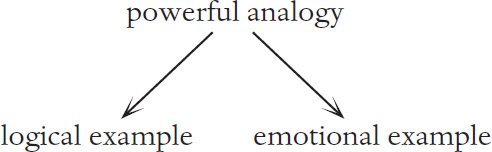
One interesting thing about finding analogies is that when I’m thinking about a good one, I have to think abstractly to find the deep logical argument, and then apply it creatively to another situation to engage someone’s emotions. When I am doing this I do feel like I’m using my brain in a highly mathematical manner; it feels like I’m using the same part of my brain. But in arguments in real life the point of it is to enable others to feel my point without having to think in that highly mathematical manner. In a world where everyone has varying levels of proficiency in abstraction and logic, it is important to be able to find ways of explaining things that bypass that. This is why I make heavy use of analogies when explaining maths to students or non-mathematicians, and much less when explaining it in research seminars.
Drawing together the subjects of the last three chapters, we will now show how to use analogies to engage someone emotionally around the issue of prejudice across power relationships. We have talked about the fact that men occupy a position of power over women in society in general. Some people argue that this means men making rude jokes about women is worse than women making rude jokes about men. Or to push it to a greater extreme, that men sexually harassing women is worse than women sexually harassing men. Others argue that this is the same.
There is no right or wrong answer to this, but there is a sense in which the two are the same and a sense in which they are different. The sense in which they are the same is that both consist of “people mistreating other people”. At this level of abstraction we have an equivalence.
However, this has forgotten very many details about the situation. We could instead retain the information about power in society, and only abstract as far as “people with power mistreating people without power”. At this level, men mistreating women is equivalent to white people mistreating black people, but not equivalent to women mistreating men, or black people mistreating white people:
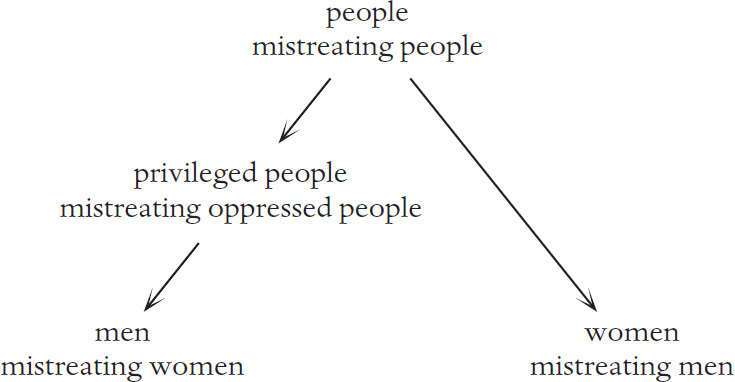
The question has become one of whether or not the intermediate level of abstraction is relevant: that is, whether or not power differential is a relevant factor. I believe it is relevant, but many people insist that it is not. We could try to push them to think about power differentials in general by invoking a more clear-cut example, about which they definitely feel something. For example, a teacher flirting with a pupil. There is a definite problem with power differences here, which is why even if an interaction appears to be consensual, it is illegal between a teacher and a pupil in some countries, just as between an adult and a minor. In the case of minors it is also to do with the absolute inability of a child to consent, but in the case of teachers and pupils the pupil might be over the age of consent but still considered to be unable to consent within that particular power relationship.
We have the following analogy (in fact, an analogous analogy):
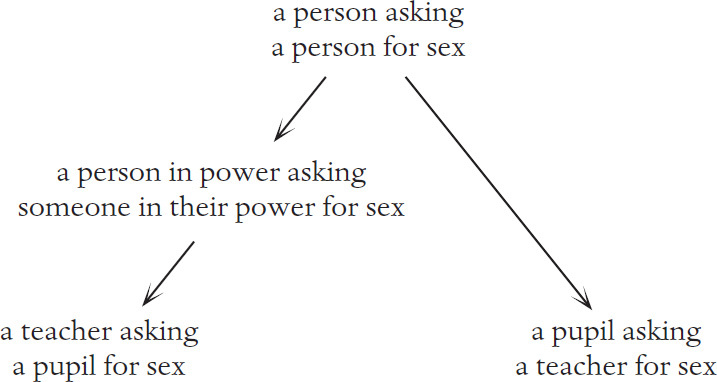
I hope everyone would agree that a teacher making advances on a pupil is not equivalent to a pupil making advances on a teacher, because of the power differentials. Similarly a boss trying to seduce an employee is a different situation from an employee trying to seduce a boss, because of the power that the boss has over the employee.
If we can agree that power differentials at least sometimes make a difference in some clear-cut cases, then the argument becomes one about grey areas and where to draw the line, if anywhere – which power differentials do make a difference and which ones don’t? We can try to persuade people that because white people are so dominant in all levels of power, politics, management, entertainment, and all positions of influence, the position white people collectively hold over black people is analogous to the position a boss holds over an employee.
If they still disagree, it might come down to a question of transferring from the idea of an individual having direct power (boss over employee) and the idea of group power (white people over black people) and whether group power transfers at all to individuals. This is the question of structural racism.
In the process of writing this book and thinking through these arguments very carefully, stripping away layer upon layer to find further abstractions and logical points of view, I have realised how many of these arguments come down to tensions between the idea of individuals and the idea of groups. This applies to the idea of individual vs group responsibility, the extent to which everyone should look after themselves or whether there should be group care. It applies to whether people think a group’s treatment by society has any bearing on an individual’s. This may go back to a difference in basic personal axioms, in which case we will need to think about how to persuade someone to change their axioms.
We have discussed using analogies to uncover our own personal axioms. But we can also use analogies to uncover other people’s personal axioms, to understand why they are thinking the way they are. If we are disagreeing with them because of a different use of logic that is one thing, but if we are disagreeing because of different fundamental principles, it is hard to change those without invoking emotions.
For example, why are some people sometimes so unconvinced by scientific evidence? It might be because they are very invested in not believing it, in which case piling up more evidence won’t help: changing their sense of investment will help. Getting to the bottom of why they don’t believe it will help, rather than berating them for not believing it.
Once we have uncovered someone’s axioms that are at the root of a disagreement, we can start thinking about how to change them. If they are deeply rooted it can be hard, but it could be by experience, meeting people, education, empathy, but in all cases by engaging them emotionally. Our analysis does not tell us how to do that, but at least if we have reached an understanding of really why someone feels something, we are in a better position than if we just think they are stupid.
For many people, emotions and intuition are more convincing than logic. As I have discussed, this is true of mathematics as well, which is why I don’t think we should simply scorn the idea. In fact, my whole field of research, category theory, can be thought of as a field that makes precise our mathematical intuitions so that we can do calculations almost entirely by using our intuition, knowing that it will match rigorous logic.
Use of intuition has achieved a lot for mathematicians over the course of history, as long as it is backed up by rigorous justification. So I believe that intuition and emotions can achieve a lot in normal life too, if backed up by logic. Unfortunately while almost everyone feels feelings, not everyone can follow complicated logic. I believe it is therefore incumbent on more logical people to invoke emotional means to make sure logical thoughts are conveyed. This is the subject of the closing chapter of this book.
1 “Denying Rape but Endorsing Forceful Intercourse: Exploring Differences Among Responders”. Edwards Sarah R., Bradshaw Kathryn A., and Hinsz Verlin B. Violence and Gender. December 2014, Vol. 1, No. 4: 188–193
When to use it
When debating controversial topics like structural racism, using analogies of clear power imbalances (e.g., boss-employee) can help people understand the role of power.
In teaching abstract mathematical concepts, analogies to everyday situations can make them accessible without requiring deep logical abstraction.
In personal disagreements where core values differ, analogies can help uncover the underlying axioms and engage emotions to shift perspective.
FROM THEORY TO EVERYDAY LIFE
In practice
Using Sexism to Explain Racism
To persuade white women to care more about racism, one can make an analogy with sexism. Since many white women have personally experienced sexism, drawing parallels between sexism and racism can evoke an emotional response that makes the abstract concept of structural racism more relatable and urgent.
Teacher-Pupil Power Differential
When debating whether power imbalances matter (e.g., in sexual harassment), use the clear-cut example of a teacher making advances on a pupil vs. a pupil making advances on a teacher. Most people agree these are not equivalent due to the teacher's power. This analogy helps argue that similar power differentials (like white-over-black in society) also make a difference.
A MOMENT TO REFLECT
Put it to work.
Think of a situation where you struggled to convince someone of something. Can you find an analogy that pivots their emotional response?
How can you use analogies to uncover your own underlying axioms? Try to think of an analogy for a belief you hold strongly.
Consider a contentious social issue. What analogies are commonly used, and do they rely on emotional engagement or logical reasoning?
Often confused with
References
- Denying Rape but Endorsing Forceful Intercourse: Exploring Differences Among Responders — Edwards Sarah R., Bradshaw Kathryn A., and Hinsz Verlin B. (2014)
CONTINUE THE CONVERSATION
Source texts
- The Art of Logic How to Make Sense in a World that Doesn’t (Eugenia Cheng)