Almost Everybody Is Above Average
This fallacy occurs when one assumes that not more than 50% of individuals can be above average, ignoring the distinction between mean and median in skewed distributions.
THE IDEA
Almost Everybody Is Above Average
Jim Rogers is not the only person committing such traditional fallacy of mistaking mean and median. In all fairness to him, some people who think for a living, such as the star philosopher Robert Nozick, have committed versions of the same mistake (Nozick, besides, was an admirable and incisive thinker; before his premature death he was perhaps the most respected American philosopher of his generation). In his book The Nature of Rationality he gets, as is typical with philosophers, into amateur evolutionary arguments and writes the following: “Since not more than 50 percent of the individuals can be wealthier than average.” Of course, more than 50% of individuals can be wealthier than average. Consider that you have a very small number of very poor people and the rest clustering around the middle class. The mean will be lower than the median. Take a population of 10 people, 9 having a net worth of $30,000 and 1 having a net worth of $1,000. The average net worth is $27,100 and 9 out of 10 people will have above average wealth.
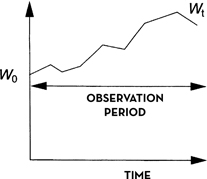
Figure 6.1 shows a series of points starting with an initial level W 0 and ending at the period concerned Wt. It can also be seen as the performance, hypothetical or realized, of your favorite trading strategy, the track record of an investment manager, the price of a foot of average Palazzo real estate in Renaissance Florence, the price series of the Mongolian stock market, or the difference between the U.S. and Mongolian stock markets. It is composed of a given number of sequential observations W 1, W 2, etc., ordered in such a way that the one to the right comes after the one to the left.
When to use it
Interpreting income distribution reports: If the mean income is significantly higher than the median, it suggests inequality, and many people earn below the average.
Evaluating investment returns: If the average return of a group of funds is high due to a few outliers, most funds may actually perform below average.
Analyzing test scores: In a class where a few students score extremely high, the mean may be above the median, indicating that most students scored below the average.
Understanding public opinion: When survey responses are skewed, saying 'above average' support may be misleading if the distribution is not symmetric.
FROM THEORY TO EVERYDAY LIFE
In practice
Income Distribution Example
Consider a population of 10 people, 9 with a net worth of $30,000 and 1 with $1,000. The average net worth is $27,100, so 9 out of 10 have above average wealth, contradicting the belief that at most 50% can be above average.
Robert Nozick's Fallacy
Philosopher Robert Nozick wrote in 'The Nature of Rationality' that 'not more than 50 percent of the individuals can be wealthier than average,' which is false because the mean can be lower than the median.
A MOMENT TO REFLECT
Put it to work.
Think of a real-world situation where you assumed most people are below average. Could the distribution be skewed such that the mean is lower than the median?
How would you explain the difference between mean and median to someone who thinks 'above average' is rare?
Identify a dataset (e.g., incomes, test scores) where the mean and median differ significantly. What does that imply about the distribution?
References
- The Nature of Rationality — Robert Nozick
CONTINUE THE CONVERSATION
Source texts
- Fooled by Randomness The Hidden Role of Chance in the Markets and in Life (Nassim Nicholas Taleb)